Manchester City Begins Premier League Campaign with Tactical Shift
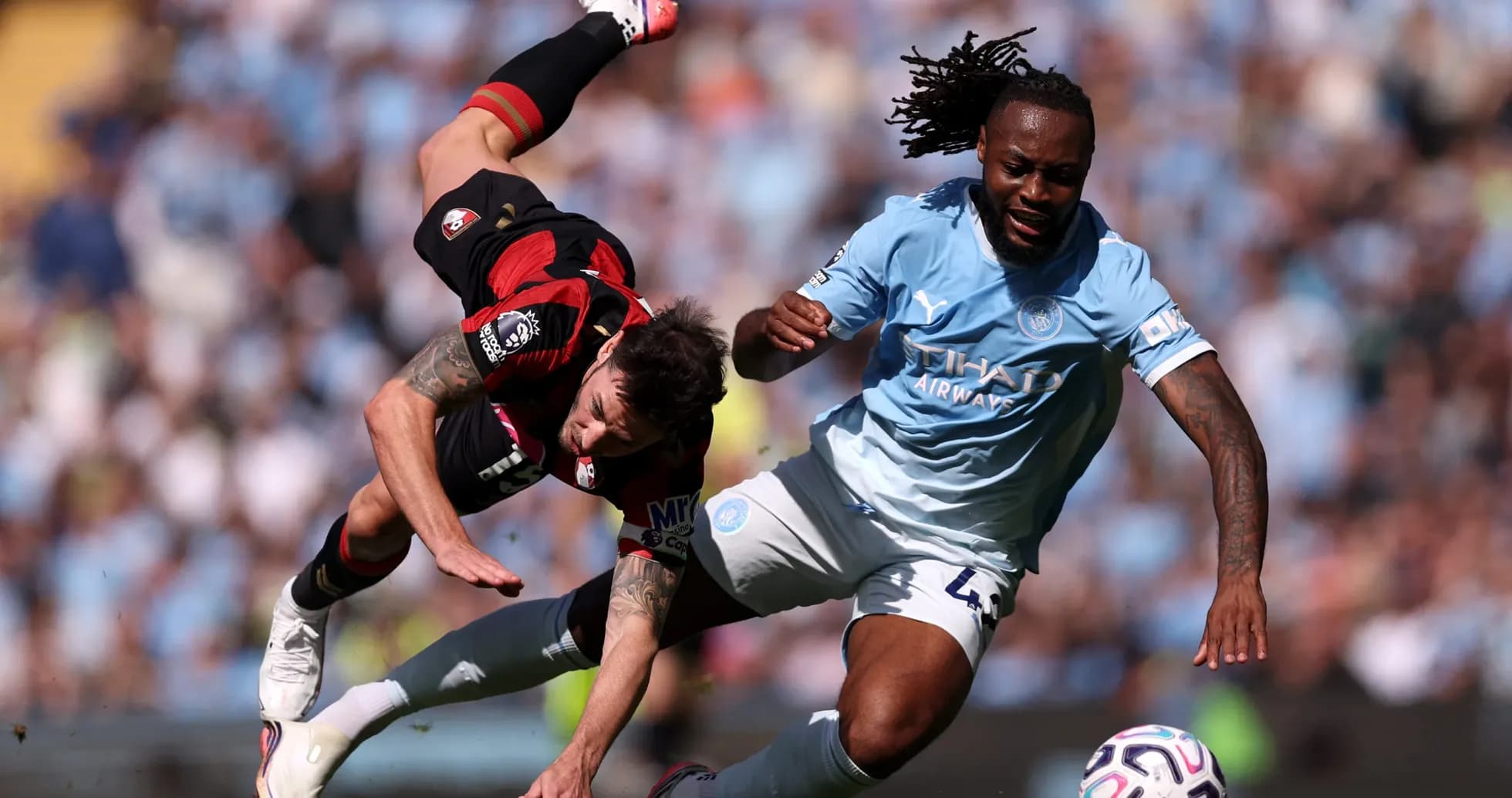
Under the grey Manchester sky at the Etihad Stadium, the opening afternoon of the 2026–27 Premier League season delivered a familiar storyline with unfamiliar faces. Manchester City, now under Enzo Maresca, came from behind to beat Bournemouth 2–1, beginning their campaign with three points that already hint at a new tactical era as much as a continuation of old dominance.
I. The Big Picture – New Faces, Same Demands
Following this result, City sit 7th with 3 points from 1 match, their goal difference at +1 after scoring 2 and conceding 1 overall. At home they mirror that exactly: 1 game, 1 win, 2 goals for, 1 against. Bournemouth, beaten but far from cowed, leave Manchester ranked 14th, still pointless after 1 away game in which they scored once and conceded twice, giving them an overall goal difference of -1.
Both sides lined up in a 4-2-3-1, but the shapes carried very different intentions.
For City, Maresca’s selection underlined a shift towards a more hybrid, possession-heavy structure:
- G. Donnarumma behind a back four of R. Lewis, A. Khusanov, R. Dias and J. Gvardiol.
- A double pivot of E. Anderson and M. Guehi – the latter repurposed from his usual defensive role into a midfield controller.
- A fluid three of P. Foden, N. O’Reilly and A. Semenyo supporting E. Haaland as the lone striker.
Bournemouth, under Marco Rose, mirrored the formation but with a clear counter-punching edge:
- D. Petrovic in goal, protected by A. Smith, J. Hill, A. Silva and A. Truffert.
- L. Cook and A. Scott as the screening pair.
- A creative trio of Rayan, J. Kluivert and M. Tavernier behind Evanilson up front.
The scoreline – Bournemouth leading 1–0 at half-time before City turned it around – reflects a contest in which the visitors’ structure initially frustrated the champions-elect before Maresca’s bench tilted the balance.
II. Tactical Voids – Who Was Missing, and What It Meant
City’s attacking depth was notably thinned by the absence of J. Doku (calf injury) and Savinho (transfer negotiations). Without Doku’s verticality and one‑v‑one threat, City’s left side lacked natural width, placing greater creative responsibility on Foden and N. O’Reilly to find pockets between the lines. The decision to start A. Semenyo as a nominal wide midfielder added power and pressing, but less pure dribbling than Doku would have offered.
Bournemouth’s absentee list was even more consequential. A. Adli, J. Araujo, E. J. Kroupi, V. Milosavljevic and J. Soler were all unavailable through various injuries or fitness issues, while R. Christie missed out due to a red card suspension. That stripped Rose of a significant chunk of his rotational options in midfield and attack, forcing him to lean heavily on M. Tavernier and J. Kluivert as his main creative outlets and limiting his ability to change the game from the bench.
Disciplinary patterns from the early season statistics also framed the contest. City’s only yellow card so far has come in the 76–90’ window, a late-game flashpoint that underlines how their intensity can spill over as they chase or protect results. Bournemouth’s two yellows this season are split evenly: one between 46–60’ and another in 76–90’, a profile that hints at a side that can lose composure just as matches open up after the break and again in the closing stages.
III. Key Matchups – Hunter vs Shield, Engine Room vs Enforcer
The central narrative was always going to circle around E. Haaland, the pure “hunter” at the apex of City’s structure, against a Bournemouth back line tasked with protecting a team that, on their travels so far, has conceded 2.0 goals per game while scoring 1.0. That away balance – one scored, two conceded overall – underlines the scale of the assignment for J. Hill and A. Silva.
Haaland’s presence did more than threaten goal; it bent Bournemouth’s entire defensive block. A. Silva and J. Hill were repeatedly forced to narrow and defend the box, creating corridors for City’s second line. This is where the game’s quiet tactical turning point emerged: the introduction and influence of R. Cherki from the bench.
Cherki, who leads the league’s early assist charts with 2 assists from his single appearance, became Maresca’s late-game “unlock code.” In just 27 minutes, he completed 13 passes at 92% accuracy, with 4 key passes. That output, in such a short window, tells the story of City’s attacking reconfiguration: Foden and N. O’Reilly could now drift wider or higher, while Cherki operated between the lines, stitching together combinations with Haaland and the overlapping full-backs.
In the “engine room”, City’s double pivot of E. Anderson and M. Guehi faced L. Cook and A. Scott. With City averaging 2.0 goals for and 1.0 against overall so far, the onus on Anderson and Guehi was to sustain territorial dominance while protecting transitions. Bournemouth’s midfield, by contrast, had to be both shield and launchpad, knowing their away profile – 1.0 goal for, 2.0 against – left them little margin for error.
Evanilson, meanwhile, carried a dual label in this early-season data: a creative spearhead and a disciplinary risk. As Bournemouth’s leading assister with 1 assist and also prominent in the yellow card charts with 1 booking, his game is clearly built on physical duels and aggressive pressing. His 7 total duels (winning 2) and 3 interceptions underline how he set the tone from the front, dropping in to hassle City’s build-up. Yet that edge comes at a cost: two fouls committed and a yellow card, a microcosm of Bournemouth’s delicate balance between disruption and self-inflicted damage.
IV. Statistical Prognosis – What This Match Tells Us
Following this result, City’s statistical profile is starkly efficient: 1 game, 1 win, 2 goals scored, 1 conceded overall; no clean sheets yet, but no failures to score either. Their penalty record remains untouched – no spot-kicks taken, none missed – and their only recorded yellow card arriving in the 76–90’ range underscores how their intensity peaks late.
Bournemouth’s early-season numbers paint a brave but brittle picture. On their travels they have played 1, lost 1, scored 1 and conceded 2, with no clean sheets and no failures to score. Their card distribution – one yellow just after the break, one in the closing quarter-hour – suggests a team that strains to maintain tactical discipline as fatigue and pressure mount.
In narrative terms, this was a match that confirmed both expectation and evolution. Manchester City, even in transition under Maresca and without key wide threats like J. Doku, still found a way to turn territorial dominance into goals, with R. Cherki emerging as the early creative talisman. Bournemouth, shorn of several important squad members, showed enough structure and courage to lead at half-time and to threaten in transition through Evanilson and the supporting three.
The tactical verdict: City’s superior bench quality and their capacity to reconfigure the attacking structure mid-game remain decisive weapons. Bournemouth’s compact 4-2-3-1 and front-foot pressing can trouble elite sides, but their current away defensive record – 2.0 goals conceded per game – and late-game disciplinary profile will need tightening if they are to turn brave performances into points over the long Premier League campaign.