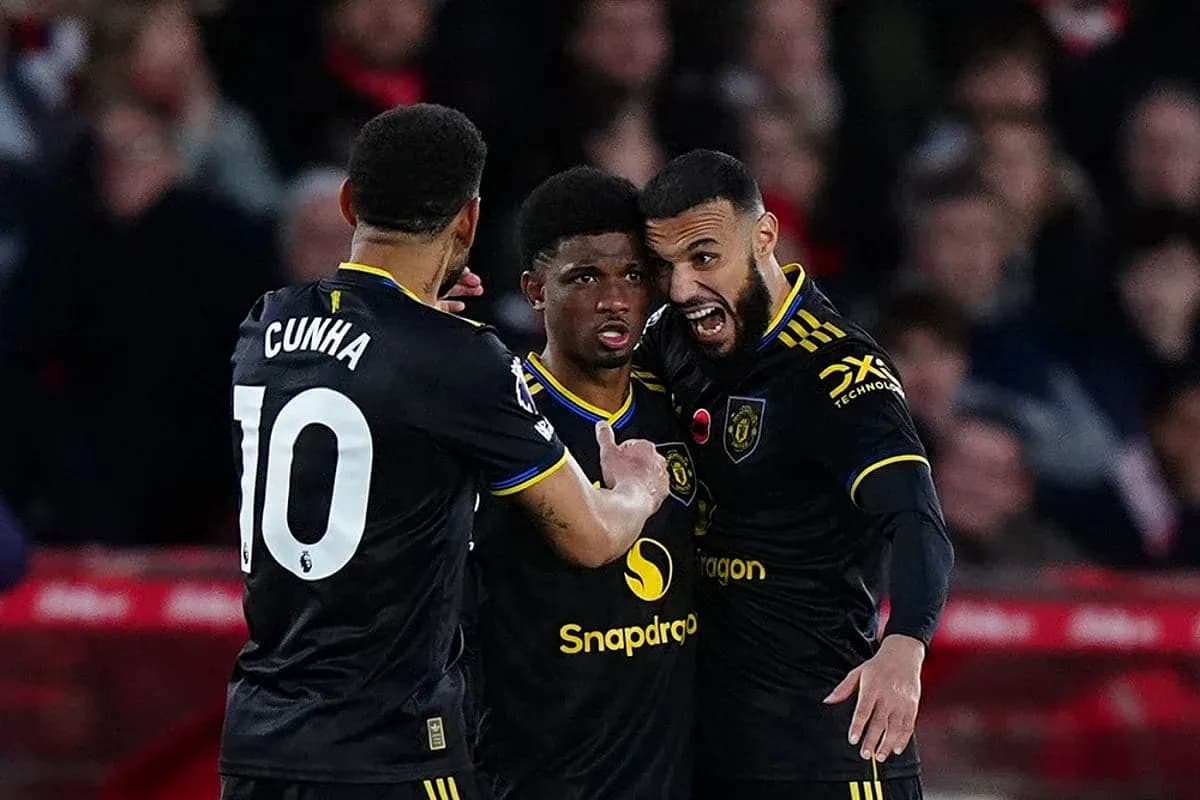
Manchester United vs Nottingham Forest: Premier League Round 37 Preview
Manchester United host Nottingham Forest at Old Trafford in a high-stakes Premier League Round 37 fixture in 2026, with United (3rd on 65 points, goal difference +15) looking to lock in Champions League qualification and keep faint title hopes alive, while Forest (16th on 43 points, goal difference -2) aim to secure safety and avoid being dragged back toward the relegation fight in the final week.
Head-to-Head Tactical Summary
The recent head-to-head record is finely balanced and tactically diverse across venues and competitions. On 1 November 2025 at the City Ground in the Premier League (Regular Season - 10), Nottingham Forest and Manchester United drew 2-2, with United leading 1-0 at half-time before Forest recovered for a point. On 1 April 2025, again at The City Ground in the Premier League (Regular Season - 30), Forest edged a tight contest 1-0, having already led 1-0 at half-time.
At Old Trafford on 7 December 2024 in the Premier League (Regular Season - 15), Forest produced a notable 3-2 away win over United, with the sides level 1-1 at half-time before Forest finished stronger. In the FA Cup 5th Round on 28 February 2024 at The City Ground, United delivered a controlled 1-0 away victory, with the match goalless at half-time before United found the only goal. Earlier, on 30 December 2023 in the Premier League (Regular Season - 20) at The City Ground, Forest beat United 2-1, with a 0-0 scoreline at half-time preceding a more open second period.
Global Season Picture
- League Phase Performance:
In the league phase, Manchester United sit 3rd with 65 points from 36 matches (18 wins, 11 draws, 7 losses), scoring 63 goals and conceding 48. Their home record is strong: 12 wins, 3 draws, 3 losses, with 36 goals for and 22 against at Old Trafford. Nottingham Forest are 16th with 43 points from 36 matches (11 wins, 10 draws, 15 losses), scoring 45 goals and conceding 47. Away from home they have 7 wins, 3 draws, 8 losses, with 26 goals scored and 25 conceded. - Season Metrics:
In the league phase, United’s attacking output is consistent with their table position: 63 goals in 36 games (1.8 per match), while conceding 48 (1.3 per match), indicating a proactive but occasionally vulnerable defensive structure (goals for 63, goals against 48). Forest show a more balanced but lower-yield profile: 45 goals scored and 47 conceded across 36 games (1.3 scored and 1.3 conceded per match), reflecting a mid-to-lower-table side that keeps games relatively tight. Card data underlines United’s tendency to pick up yellows in the middle and late phases of games, and Forest’s discipline profile shows a similar pattern with a single red card concentrated in the 31-45 minute window, hinting at potential volatility just before the interval. - Form Trajectory:
In the league phase, United’s recent form string of DWWWL shows a strong run of three consecutive wins followed by a draw, before a setback defeat. The underlying longer form pattern from their statistics (a mix of short winning streaks and scattered draws) suggests a side that has recently stabilised after inconsistency earlier in the year. Forest’s form string of DWWWD indicates an upward curve: unbeaten in five, with three wins and two draws, matching the longer-term statistics profile where they have alternated poor runs with sudden recovery bursts. Coming into Round 37, Forest look to be in one of their positive cycles, while United are trying to reassert control after a minor stumble.
Tactical Efficiency
In the league phase, Manchester United’s attacking efficiency is reflected by their 63 goals at an average of 1.8 per match, supported by flexible use of both 3-4-2-1 and 4-2-3-1 formations across 18 games each. This blend points to a side comfortable either building through an extra centre-back or committing more advanced midfielders, with a clear emphasis on sustaining attacking pressure at Old Trafford (36 home goals at 2.0 per game). Defensively, 48 goals conceded (1.3 per match) and only 7 clean sheets show that while United can outscore opponents, their defensive structure is not fully watertight.
Nottingham Forest, also primarily using a 4-2-3-1 base, complement it with occasional shifts to back-five and front-three systems, aiming for compactness and counter-attacking width. Their 45 goals (1.3 per game) and 47 conceded (1.3 per game) show a relatively balanced but modest attack and a defence that, while not collapsing, does not consistently shut games down despite 9 clean sheets. The away numbers – 26 scored and 25 conceded – underline a pragmatic approach on the road, where Forest are prepared to trade territory for efficiency in transition.
When aligned with typical comparison-model attack and defence indices, United project as a high-attack, medium-defence side: their goal output and varied formations support a strong attacking index, while their concession rate and limited clean sheets temper their defensive rating. Forest profile closer to league average in both directions, with a slightly lower attacking ceiling but a defence that is competitive without being dominant. In tactical terms, United’s efficiency comes from sustained volume and structural flexibility, whereas Forest rely on game-state management, selective pressing, and set-piece or transition moments to convert relatively fewer chances into results.
The Verdict: Seasonal Impact
In the league phase, this match is pivotal for both ends of the table. For Manchester United, a win would push them toward securing a Champions League place with a game to spare and keep any residual title or top-two ambitions mathematically alive, especially given their strong home metrics (12 wins, 36 goals scored at Old Trafford). Dropped points, however, would open the door for chasing teams to close the gap, potentially turning the final round into a high-pressure shootout for Champions League qualification and undermining the momentum built by their recent winning run.
For Nottingham Forest, arriving in Manchester on a DWWWD run, any result – even a draw – would be a major step toward consolidating their Premier League status, especially with 43 points already on the board and a near-level goal difference (-2). A win at Old Trafford, following previous successes both home and away in recent years, would likely remove any lingering relegation anxiety and provide a powerful platform to plan for 2027 with a more ambitious outlook. Conversely, a defeat would leave Forest still looking over their shoulder going into the final day, reliant on other results and their own capacity to sustain their improved form under pressure.
Overall, this fixture functions as a hinge point: for United, between a solid top-four finish and a potentially nervy conclusion; for Forest, between comfortable mid-table safety and a last-day survival calculation. The tactical and psychological weight of recent head-to-head results – with Forest having proven they can win at Old Trafford – adds an extra layer to what is, in pure table terms, one of the defining matches of the 2026 run-in.