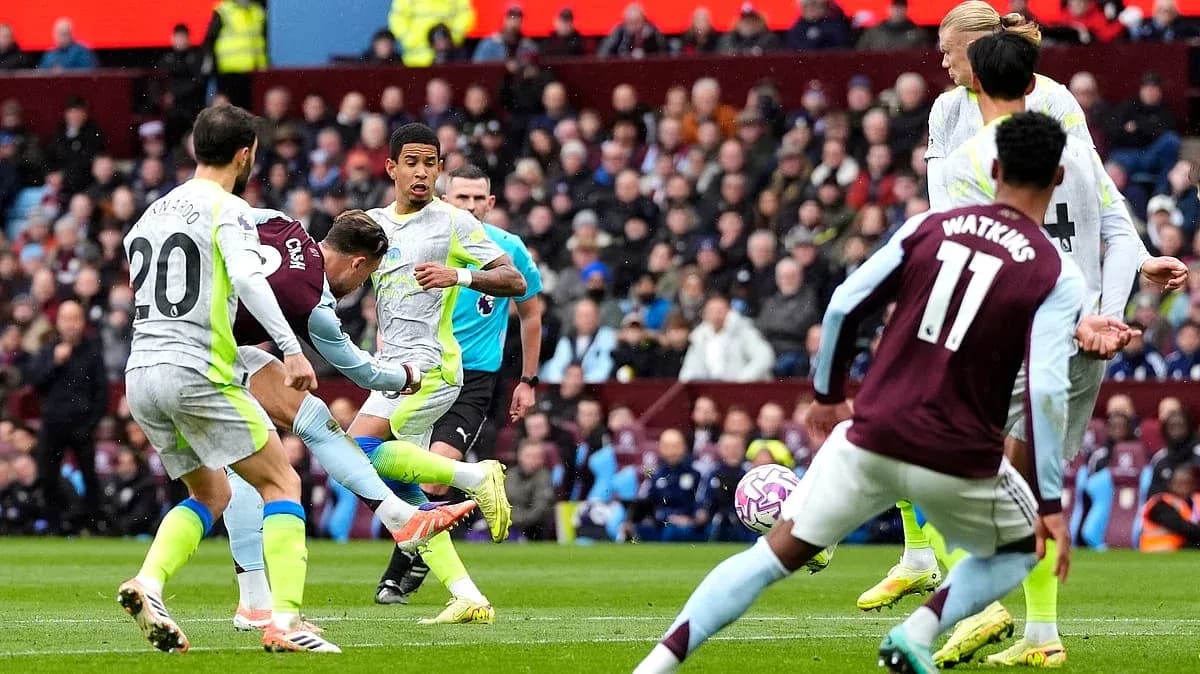
Manchester City 1–2 Aston Villa: A Premier League Upset
Etihad Stadium’s final act of the 2025–26 Premier League season unfolded with a twist: Manchester City, chasing perfection at home, were turned over 2–1 by Aston Villa despite leading at half-time. Following this result, City close the campaign 2nd on 78 points, while Villa’s comeback underlines why a 4th‑place finish and Champions League return feel fully earned.
I. The Big Picture – Contrasting seasonal DNA
Across the season, City have been a machine of territorial control and attacking volume. Overall they scored 77 league goals and conceded 35, a goal difference of 42 carved out by a relentless attack averaging 2.0 goals per game and a defence allowing just 0.9. At home they have been even more ruthless: 45 goals scored at the Etihad at an average of 2.4 per match, with only 14 conceded at 0.7 per game, and 14 wins from 19.
Aston Villa, by contrast, have lived on the edge. Their overall record of 56 goals for and 49 against (goal difference 7) paints a picture of a side that embraces risk. On their travels they scored 24 times, averaging 1.3 away goals, but conceded 27 at 1.4 per game. They are less secure away than at Villa Park, yet still dangerous enough to win 7 of 19 on their travels.
This fixture, then, became a clash of City’s structured dominance against Villa’s vertical threat. Guardiola rolled out a bold 4‑2‑2‑2, while Emery stayed loyal to his season-long 4‑2‑3‑1, the shape he has used in 34 league matches.
II. Tactical Voids – Absences and disciplinary shadows
The most telling void was in Villa’s spine. The visitors arrived without E. Martinez (finger injury), B. Kamara (knee injury) and Alysson (muscle injury), all listed as missing. Martinez’s absence in particular forced Emery to turn to M. Bizot in goal, altering Villa’s build‑up dynamics and penalty‑box presence. Kamara’s absence removed a natural shield in front of the back four, shifting more defensive burden onto Douglas Luiz and L. Bogarde.
Despite those setbacks, Villa managed the emotional and tactical discipline of a high‑stakes away game. Over the season, their yellow‑card profile shows a spike between 46–60 minutes, with 29.31% of their cautions arriving just after the break – a period where their aggression can tip into recklessness. City’s own card distribution is more spread, but there is a late‑game surge: 20.90% of their yellows come between 76–90 minutes, a window where their press can become desperate and transitions exposed.
In this match, though, there were no red‑card implosions from either side, consistent with their league records. Villa’s only red this season came between 61–75 minutes in another game; City have not seen a league red at all. That relative discipline allowed both managers to keep their tactical frameworks intact across the 90 minutes.
III. Key Matchups – Hunter vs Shield, Engine Room battles
Hunter vs Shield: O. Watkins vs City’s defensive record O. Watkins came into the day as Villa’s leading scorer with 16 league goals and 3 assists, the spearhead of Emery’s 4‑2‑3‑1. His 60 shots with 38 on target underline a striker who works the channels but finishes centrally. Facing a City defence that, heading into this game, conceded just 0.7 goals per match at home, the duel was clear: Watkins’ movement against a back four of R. Lewis, J. Stones, R. Dias and N. Ake.
Guardiola’s choice of J. Trafford in goal over more established names added an intriguing wrinkle. Trafford, shielded by Dias and Stones, was tasked with dealing not only with Watkins’ runs but also the second‑line threats of L. Bailey and E. Buendia arriving from wide and half‑spaces. Villa’s eventual two‑goal haul at the Etihad is a rare breach of City’s home shield and a testament to Watkins’ capacity to stretch even elite defences.
Engine Room: Creativity vs Disruption City’s midfield double pivot of Nico and Bernardo Silva sat beneath a line of A. Semenyo and Savinho, with P. Foden and T. Reijnders operating as nominal forwards. It was a structure designed to flood the half‑spaces, with Bernardo’s metronomic passing (2,196 passes in the league at 90% accuracy) and press resistance anchoring circulation. His 10 yellow cards this season, however, also reveal how often he is asked to halt counters – a tactical foul specialist.
Opposite them, Douglas Luiz and Bogarde formed Villa’s central screen, with R. Barkley, Buendia and Bailey ahead. Without Kamara, Douglas Luiz had to be both enforcer and first passer. The plan was clear: absorb City’s pressure, then use Barkley and Buendia between the lines to spring transitions into Watkins and Bailey.
On paper, the creative axis of the day should have tilted City’s way. They boast two of the league’s leading playmakers in R. Cherki (12 assists) and P. Foden (5 assists), both on the bench and pitch respectively. Cherki’s 61 key passes and 86% pass accuracy across the season show a player capable of unlocking deep blocks; Foden’s 56 key passes and 7 goals mark him as a dual‑threat. Guardiola’s decision to start Foden high and keep Cherki in reserve suggested a desire to stretch Villa first, then introduce a specialist schemer if the block held.
IV. Statistical Prognosis – xG logic and defensive solidity
If we map the season’s data onto this match narrative, the expected goals story leans towards a City‑tilted xG, even in defeat. At home they average 2.4 goals scored and 0.7 conceded; Villa away average 1.3 scored and 1.4 conceded. A neutral model would likely project City to create the better volume and quality of chances, with Villa relying on efficiency and set‑piece or transition moments.
Yet the 2–1 scoreline in Villa’s favour reflects how Emery’s side have thrived in high‑variance contests all season. Their overall defensive numbers – 49 goals conceded at 1.3 per game – are not those of a classic shut‑down unit, but they bend without quite breaking, and they carry enough attacking threat to punish any lapse. City, for all their control, still failed to translate territory into a second or third goal, a familiar story in matches where Erling Haaland is not on the pitch to convert volume into inevitability.
Following this result, the tactical verdict is stark. City’s structure and season‑long metrics still mark them as an elite xG side, but Villa’s ability to survive long spells without the ball, then strike with clinical precision, has turned them into one of the league’s most dangerous hunters on their travels. On the final day at the Etihad, the numbers said City; the story, and the scoreboard, belonged to Aston Villa.