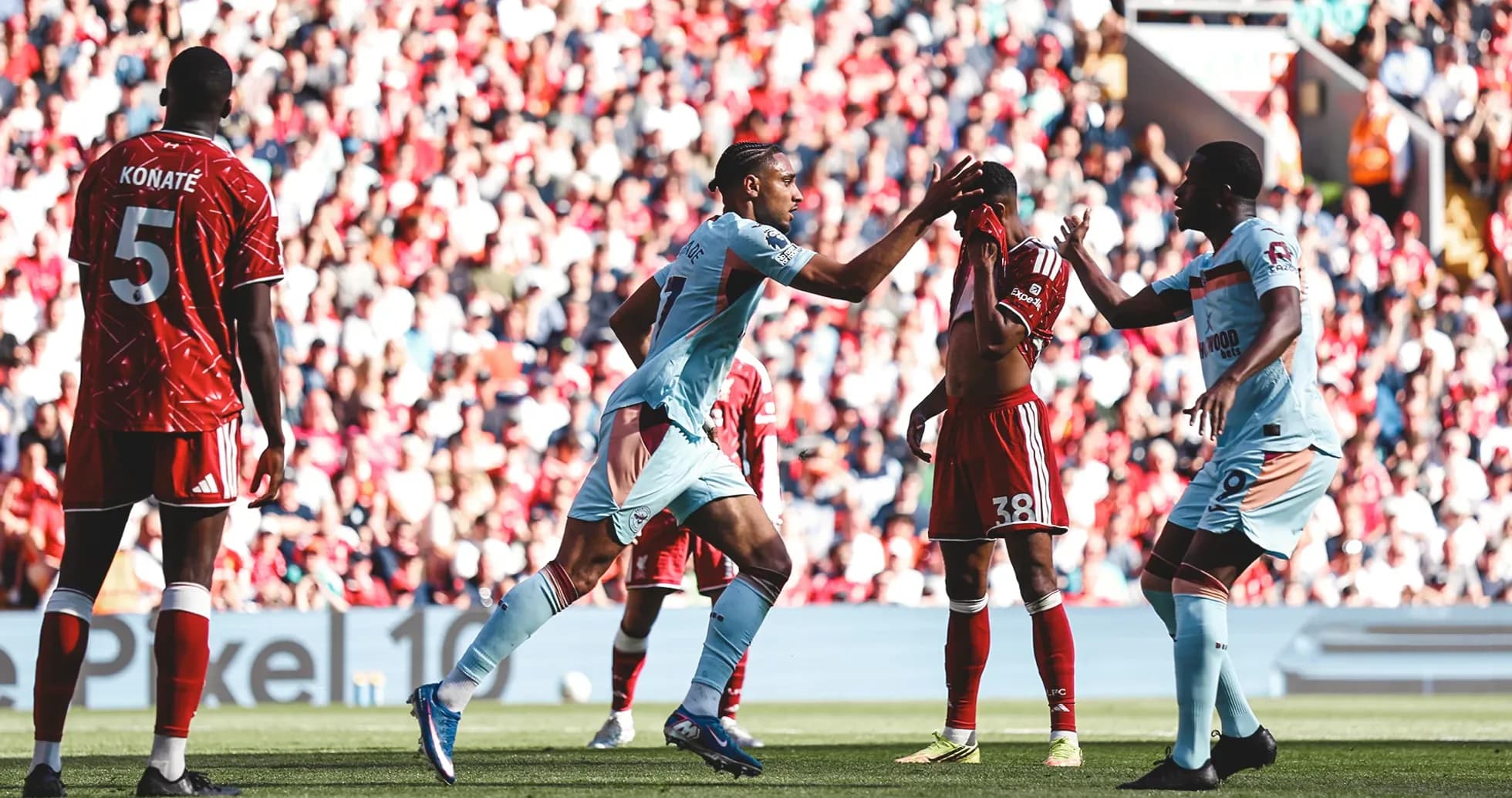
Liverpool vs Brentford: Tactical Analysis of 1-1 Draw
Liverpool’s 1-1 draw with Brentford at Anfield was a territorial siege that never quite translated into the decisive control the underlying numbers suggested. Arne Slot’s 4-2-3-1 dominated territory, possession and shot volume, but Keith Andrews’ Brentford, in the same base shape, absorbed pressure compactly and struck with a single, well-timed transition to escape with a point.
Structurally, Liverpool’s 4-2-3-1 was aggressively tilted towards the ball. A back four of C. Jones, I. Konate, V. van Dijk and A. Robertson gave a broad first line of build-up, with A. Mac Allister and R. Gravenberch as the double pivot. In practice, Mac Allister dropped to orchestrate, often forming a 3+1 with the centre-backs as Robertson pushed high on the left. Ahead of them, M. Salah and D. Szoboszlai occupied the right half-space and central lane respectively, with R. Ngumoha on the left and C. Gakpo as the nominal striker.
That structure underpinned Liverpool’s 60% possession and 503 passes (434 accurate, 86%), but the key was field position: 24 total shots, 17 from inside the box, and 14 corners show how relentlessly they pinned Brentford back. The eight blocked shots underline how often Brentford’s last line got bodies between ball and goal rather than contesting higher up.
Brentford’s own 4-2-3-1, with M. Kayode, S. van den Berg, Nathan Collins and K. Lewis-Potter across the back and a double pivot of J. Henderson and Vitaly Janelt, was set up to be conservative. Out of possession, it flattened into a 4-4-1-1, with K. Schade and D. Ouattara dropping alongside the midfield to form a narrow band in front of the defence. The priority was to protect the central lane and the half-spaces where Salah and Szoboszlai operate, forcing Liverpool wide and then contesting crosses.
The statistical split illustrates that trade-off. Brentford completed 331 passes (262 accurate, 79%) and generated just 11 shots (nine inside the box, two outside) with only two on target, but they turned one of those rare incursions into Schade’s equaliser. Their limited attacking output was a function of their low block and reluctance to commit numbers forward; the front four were often isolated, leaving I. Thiago chasing long clearances rather than linking sustained attacks.
In goal, Alisson (Liverpool) had a quiet but punishingly efficient afternoon in terms of shot-stopping volume: just one save recorded, with Brentford’s two shots on goal split between that stop and the conceded strike. The goals prevented metric (1.4) suggests the quality of chances faced was modest overall but that his interventions were still high-value relative to the xG he confronted. At the other end, C. Kelleher (Brentford) was central to the away side’s survival. He made seven saves against Liverpool’s eight shots on target, and with Brentford’s goals prevented also at 1.4, his performance was the single biggest factor in keeping the game level despite Liverpool’s xG of 2.9.
Slot’s in-game adjustments aimed to refresh the press and add a different kind of final-third threat rather than overhaul the structure. At 73', F. Wirtz (IN) came on for R. Ngumoha (OUT), adding more central creativity from the left side. A minute later, J. Frimpong (IN) replaced M. Salah (OUT), shifting the right flank from an inside-forward profile to a true wide runner who could attack the outside of K. Lewis-Potter and stretch Brentford’s back four horizontally.
As legs tired, Liverpool doubled down on energy and overlapping power. At 83', M. Kerkez (IN) came on for A. Robertson (OUT), injecting fresh pace at left-back, while T. Nyoni (IN) replaced R. Gravenberch (OUT), adding dynamism ahead of Mac Allister. The final defensive change at 89' saw J. Gomez (IN) for I. Konate (OUT), a like-for-like switch to maintain back-line stability while chasing a winner. None of these moves altered the basic 4-2-3-1; instead, they rotated profiles within the same framework, seeking to sustain tempo and width against a Brentford side increasingly content to defend their box.
Andrews’ substitutions were more about shoring up and refreshing defensive effort than changing the game state. At 60', A. Hickey (IN) came on for J. Henderson (OUT), replacing a controlling midfielder with a more defensive-minded presence and enabling small structural tweaks down the right. At 83', M. Damsgaard (IN) replaced M. Jensen (OUT), adding legs and some ball-carrying threat in transition. The 89' change, with R. Nelson (IN) for K. Lewis-Potter (OUT), offered a fresher outlet on the flank but did not materially alter Brentford’s low-block posture.
Discipline also reflected the game’s pattern. Liverpool committed nine fouls to Brentford’s nine, but the distribution of cards shows how tension rose as Liverpool pushed for a winner. Ibrahima Konaté’s late yellow for “Foul” came as he defended high against rare Brentford breaks, while Alexis Mac Allister’s caution, also for “Foul”, arrived in added time as Liverpool continued to press aggressively. Brentford’s three yellows — Jordan Henderson for “Argument” before kick-off, then Nathan Collins and Vitaly Janelt both for “Argument” deep into stoppage time — underline a different kind of stress: managing the emotional and time-management aspects of protecting a draw under heavy pressure.
The statistical verdict is stark. Liverpool’s 24 shots to Brentford’s 11, their 17 efforts inside the box, and a 2.9 xG to 1.22 profile describe a match they controlled territorially and in chance quality. Their 14 corners to Brentford’s two further highlight how play was funnelled towards Kelleher’s goal for long spells. Yet the combination of Brentford’s deep defensive density (three blocked shots, plus numerous interventions in the box), Kelleher’s seven saves and Liverpool’s occasional imprecision meant that control did not become victory.
From a season-pattern perspective, this is the archetype of a dominant home performance that fails to convert xG supremacy into three points. For Liverpool, the tactical framework functioned: the 4-2-3-1 created volume and high-quality looks, and the defensive structure limited Brentford to very few meaningful attacks. The issue lay in final-third efficiency and dealing with the one moment where the rest defence was breached. For Brentford, the draw validates a pragmatic, low-possession game plan built on compactness, disciplined box defending and an outstanding display from C. Kelleher — a blueprint for how underdogs can survive at Anfield even when the underlying numbers are stacked against them.