Iraola’s Balancing Act: Managing Liverpool's Demanding Schedule
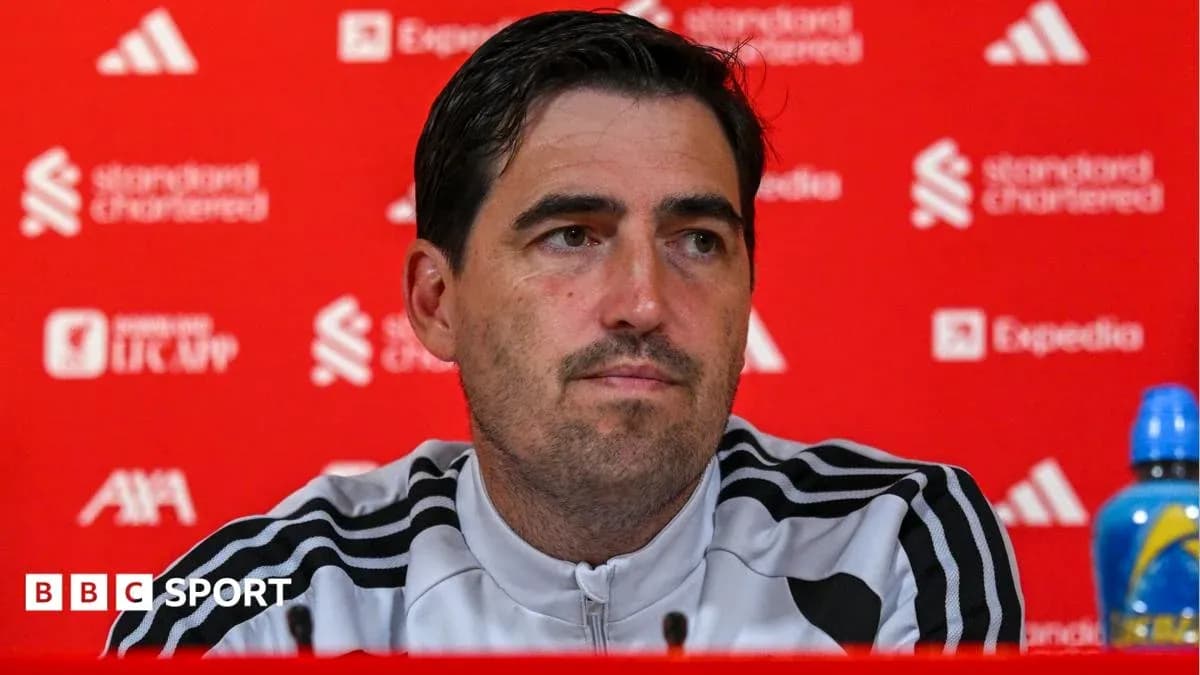
Andoni Iraola is only a few weeks into life at Anfield, but the calendar has already started asking hard questions of his squad.
Liverpool host Tottenham in the Carabao Cup at 20:00 BST, and the head coach has made it clear: he cannot simply roll out the same XI every three days and hope for the best.
“You can decide and put the same players in every game,” he said. “The problem is there'll be a moment when they're really tired. And there is more risk of injury.”
That’s the reality of a season that is already stretching Liverpool across the Premier League and Champions League, with the domestic cups now muscling in. Iraola knows some players can live in that world.
“There are players who play every three days with no issues. They are very robust, their performances don't change too much,” he admitted. Others? Not so much.
“There are other players where the risk is bigger and the performances are different. I have to learn who is ready to play games every three days and who needs a rest so their performance level isn't affected.
“I thought I had it quite clear in my mind with some, but with others, it's new, even for them, because they haven't played as many games. We are learning.”
Learning, in this case, under the floodlights and under pressure.
Tottenham Tie Turns Rotation Into a Gamble
Normally, the early rounds of the EFL Cup give Premier League managers a breather. A lower-league opponent, a handful of fringe players, a few academy graduates, and a chance to rest the stars.
Not this time.
Liverpool’s draw has thrown them straight into a meeting with Tottenham. The visitors have stumbled out of the blocks this season, but they remain a top-flight side with enough quality to punish a patched‑up team.
So Iraola faces a classic cup dilemma with a twist. Does he lean into rotation and trust his depth? Or does he send out something close to full strength to restore momentum after a frustrating league weekend?
Saturday’s 0-0 at home to Fulham sucked some of the energy out of Anfield. There is a strong argument that Liverpool should respond with a statement performance and a strong line-up. There is an equally strong argument that, with the fixture list tightening, minutes need to be managed now, not when the damage is already done.
Either way, this is no gentle introduction to the competition. Every selection call against Tottenham will carry a bit more risk than usual.
A Cup That Belongs to Liverpool
If any club feels at home in this competition, it is Liverpool.
They are the most successful team in League Cup history, with 10 titles already in the cabinet. Their relationship with the trophy began in 1980-81, the start of a remarkable run of four consecutive wins that ended in 1984 and set the standard for the club’s dominance in the competition.
The fifth success did not arrive until 1995, when Steve McManaman’s brace at Wembley sank Bolton and broke a decade-long wait.
The new millennium brought another wave. Under Gerard Houllier, Liverpool lifted the cup in 2001, then again in 2003 after beating Manchester United in the final. It felt like a competition that naturally gravitated towards Anfield.
Kenny Dalglish added another chapter in 2012, in his second spell in charge, as Liverpool edged past Cardiff City on penalties. Then came another long pause.
The drought finally ended in 2022, when Jurgen Klopp’s side survived an extraordinary 11-10 penalty shootout against Chelsea to reclaim the trophy. Klopp then delivered number 10 in 2024, again at Chelsea’s expense.
Now the question hangs over Iraola. Can he navigate a brutal schedule, learn his squad on the fly, and still find a way to take Liverpool to number 11?
Flat at Anfield: Tired Legs, Tired Minds
Two home league games. Two draws. For Liverpool, that is rare territory.
For just the third time in 63 years, they have failed to win either of their opening Premier League fixtures at Anfield. It is not the launch Iraola imagined.
The contrast with midweek could not have been sharper. Against Atletico Madrid in the Champions League, Liverpool played with urgency and bite, beating a Diego Simeone side that reached last season’s semi-finals. Against Fulham on Saturday, they looked like a different team.
The goalless draw felt heavy. Fulham arrived low on confidence after conceding seven goals in their first three league games. Yet it was Liverpool who looked physically and mentally drained.
This was the first real test of Iraola’s high-energy style under the strain of two games a week, and the signs were worrying. Six points from the first four league matches is not a disaster, but it is underwhelming for a team with Liverpool’s ambitions: dropped points at home to Nottingham Forest and Fulham, another draw at Newcastle, with the only win coming away at Ipswich.
The spotlight inevitably fell on the new-look attack. The £364m trio of Alexander Isak, Bradley Barcola and Florian Wirtz started together in the league for the first time, but the chemistry did not click.
Liverpool created some decent chances, yet nowhere near enough. Isak had just 16 touches in 90 minutes – the second fewest on record for a Liverpool outfield player, having set the low mark himself with 14 against Forest two weeks earlier. Wirtz, so influential in midweek against Atletico, faded badly. Barcola and Isak showed flashes, but this front line clearly needs time.
Time, though, is exactly what the schedule refuses to offer.
With at least seven more Champions League games locked in and Tottenham visiting in the Carabao Cup on Tuesday, Iraola and his players already understand the reality: when the turnarounds are this short, they must adapt or fall behind. The learning curve is steep, and the fixture list is only getting steeper.
Fulham Dig In, Liverpool Run Out of Ideas
Alvaro Arbeloa arrived back at Anfield under pressure and left with his first Premier League point as Fulham manager.
His side’s 0-0 draw was not pretty, but it was disciplined and deserved. Less than 72 hours after Liverpool’s European exertions, Iraola’s men could not find a way through and failed to score for the first time this season.
Iraola made three changes from the Atletico win. Kostas Tsimikas, Ryan Gravenberch and Victor Munoz started in place of Milos Kerkez, Alexis Mac Allister and Rio Ngumoha. Arbeloa, who played 98 games for Liverpool between 2007 and 2009, responded with two changes of his own: Austrian centre-back David Affengruber came in for Joachim Andersen, while Sander Berge replaced Cesar Palacios.
Fulham should have struck early. A mix-up between Alisson and Gravenberch left Gonzalo Garcia with a clear sight of goal, only for Jeremy Jacquet to hack the effort off the line. It was a mess entirely of Liverpool’s making and a warning they did not heed quickly enough.
The visitors were the better side before the break. Josh King forced a save from Alisson from inside the box, and Antonee Robinson headed wide when well placed. Liverpool’s response was sporadic. Munoz saw a header beaten away by Bernd Leno, and a Bradley Barcola volley was deflected behind by Timothy Castagne.
Iraola acted at half-time, replacing Tsimikas with Kerkez after a difficult opening 45 minutes for the Greek. By the hour, Gravenberch and Munoz had also been withdrawn for Mac Allister and Cody Gakpo as the coach tried to inject some control and attacking thrust.
There were half-chances. Isak fashioned an opening but shot too close to Leno. Dominik Szoboszlai unleashed a powerful drive that the Fulham goalkeeper pushed away.
With 72 minutes gone, Iraola threw on Ngumoha and Jeremie Frimpong in a final attempt to crack the visitors. It did not work. Deep into added time, Isak headed wide from a corner, and that was that.
Fulham, who still had late opportunities through King and Kevin, held on for a point that felt like a platform. For Liverpool, it felt like a warning.
Martinez Rages at “Unacceptable” Derby Decision
Away from Anfield, the fallout from the Manchester derby has not cooled.
Lisandro Martinez did not hide his anger after Manchester United’s 1-0 home defeat to Manchester City, focusing squarely on the decision to allow Erling Haaland’s winner to stand.
“What I can't understand is the rules. I want to be calm now, I want to control myself,” he said. “It's so hard because you lose a derby, you lose three points at home, and every season they're [referees] coming to our club, they explain for one hour the rules, and they look so confident with that, and then after [there are] five or six people doing these kind of mistakes in the Premier League - it's unacceptable.
“It's the best league in the world, you have the best teams in the world, the best players in the world, and now we have to go home with this injustice.”
The controversy centres on Enzo Fernandez’s involvement in the build-up. Haaland was onside from Josko Gvardiol’s pass, but the question is whether Fernandez, in an offside position, either touched the ball or interfered with Martinez or goalkeeper Senne Lammens.
VAR Under the Microscope Again
Those questions should get clearer answers soon.
The first edition of “Match Officials Mic’d Up” is due to be broadcast on Tuesday, and it is highly likely the VAR audio from the derby incident will be released.
Two scenarios are on the table. Either the VAR team decided there was no offside offence by Fernandez at all, or they simply failed to factor in his offside position while focusing on whether he touched the ball.
It is hard to argue Fernandez did not impact Martinez or Lammens. This would not be the first time human error at Stockley Park has shaped a game. In 2023, Arsenal were left furious when Lee Mason, on VAR duty against Brentford, checked several incidents in the build-up to an Ivan Toney goal but neglected to review Christian Norgaard’s offside position.
The Haaland goal has revived that debate. Were the officials so fixated on whether Fernandez got a touch that they ignored the wider picture of him trying to play the ball and interfering with an opponent?
As Liverpool juggle rotations, cup history and a demanding schedule, and as United simmer over a derby defeat, English football finds itself asking the same blunt question on multiple fronts: who can handle the pressure when the margins get this thin?