Iran's World Cup Journey Disrupted by Travel Orders
Iran’s World Cup campaign had barely begun when it was abruptly put back on a plane.
A few hours after a draining, politically charged 2-2 draw with New Zealand in Los Angeles on Monday night, coach Amir Ghalenoei revealed his squad had been ordered out of the U.S. and sent back to its training base in Tijuana, Mexico — scrapping carefully laid recovery plans after their opening match.
“They didn’t even give us time to recover,” Ghalenoei said through an interpreter. “After the game today, they said to us, ‘You have to leave immediately.’”
Iran had expected to stay overnight in California, a standard step in elite tournament preparation to maximize rest and treatment. Instead, players and staff were told to head straight to the airport for the short but disruptive 140-mile journey back across the border.
Who gave the order? Ghalenoei didn’t say. But his frustration was unmistakable.
“It’s very important for us to have time for recovery,” he said. “We are asked to get on a plane and return to our camp in Tijuana, and we are really troubled by that.”
A World Cup under fire
Iran’s World Cup cycle has been engulfed in turmoil since the U.S. and Israel began a war against Iran on Feb. 28. The team debated whether to come at all after FIFA rejected its request to move all three group matches out of the United States.
They came anyway. The obstacles kept coming with them.
Captain Mehdi Taremi described a five-hour slog of travel and security checks just to get from Tijuana to the Los Angeles area on Sunday — a journey that, in normal circumstances, barely qualifies as a trip.
“We don’t know why they are returning us, to be honest,” Ghalenoei said. “I think it’s very strange. It seems like others are doing the planning for us. The decision-making for us is being made elsewhere.”
The original plan was simple: arrive two nights before the New Zealand game, stay in California after the match, then fly back to Tijuana around lunchtime the following day. Instead, the squad found itself hustled out of Los Angeles in the small hours, still carrying the fatigue of a tense 90 minutes and a month of political strain.
“I think our team is perhaps the most oppressed in the World Cup,” Ghalenoei said.
Staff missing, visas denied
The disruption has not been limited to travel.
Taremi and Ghalenoei both lamented the absence of key staff members — including the president of Iran’s football federation, additional coaching personnel and media officers — who were denied U.S. visas. The omissions have hollowed out the support structure around the squad at precisely the moment they need it most.
“We have to leave Los Angeles right now, and it’s not good for us,” Taremi said about an hour after full time. “I think FIFA have to help us more than this. ... Everything is like a disaster, actually, for us.”
On the pitch, the consequences were visible. The match at SoFi Stadium was played in mild conditions, but several Iranian players cramped up and had to be substituted.
“Before the game, I said we haven’t had time to adjust because of the travel,” Ghalenoei explained. “Many of our players, they had cramps, and that’s why we had to substitute them. So it wasn’t for technical reasons. It was because of the injury and because of the cramp.”
Those players will be assessed by the technical staff, he said, but he drew a straight line between the late arrivals, the forced early departure, and the growing physical toll.
“They delayed our arrivals and they are forcing us to go back early without time for recovery,” he said. “They are making the situation more difficult.”
A draw that felt like a warning
On paper, Iran’s 2-2 draw with New Zealand is a stumble. Team Melli is ranked 65 places higher in FIFA’s standings and entered the match as a clear favorite. Twice they trailed. Twice they had to claw their way back.
Yet the performance also revealed a stubborn streak. Elijah Just struck early in each half for New Zealand, but Iran hit back with two superb goals of their own.
Ramin Rezaeian produced a deft finish off the side of his boot in the first half. Then, in the 64th minute, he delivered a perfect cross that Mohammad Mohebi met with a thumping header to level the match again.
The equalizer detonated inside SoFi Stadium, where a heavily pro-Iranian crowd — drawn from the largest Iranian community outside the country’s borders — turned the arena into a kind of temporary home ground.
“The Iranians who live in Los Angeles, they make a great atmosphere,” Mohebi said. “That celebration, it comes in the mind, and I did like this for all the fans. Just a celebration.”
Mohebi’s gestures after scoring, including what appeared to be a mimed gun action and the “ice in my veins” sign made famous by Los Angeles Lakers guard D’Angelo Russell, sparked criticism online. He finished the sequence by forming a heart with his hands toward the stands.
Inside the stadium, the noise barely dipped.
A divided crowd, united for 90 minutes
The night carried a tension that went far beyond football. Outside SoFi, several hundred Iranian Americans protested against the government in Tehran. Inside, the contradictions of a global diaspora played out in full view.
Some fans turned their backs and jeered during the national anthem. Many remain fiercely opposed to the regime. Yet once the whistle blew, the vast majority roared for the players in red, white and green.
“It was an incredible atmosphere in the game, all 90 minutes,” Taremi said. “It was like at home for us.”
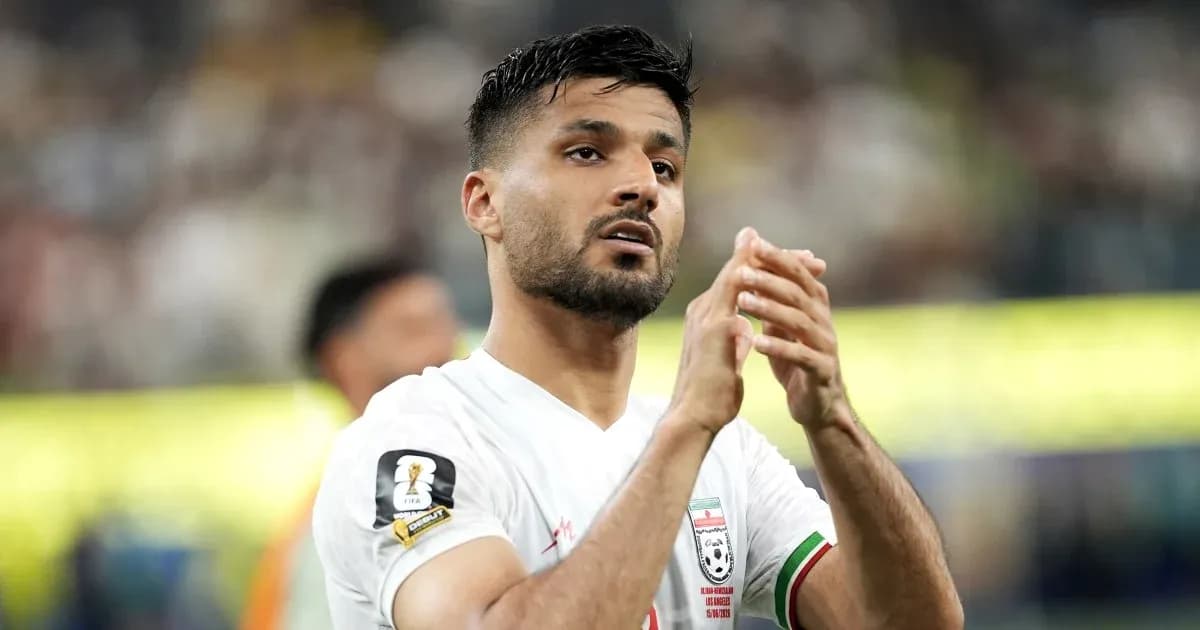
When the final whistle came, players from both teams embraced and swapped shirts. Iran’s squad formed a line and walked the perimeter, applauding the thousands who stayed behind, flags still shaking, voices still hoarse. Ghalenoei, alone in the dugout, watched it unfold from a short distance.
The football had been chaotic, compelling and, at times, high quality. The context around it was anything but normal.
Tougher tests ahead
There is little time to dwell. Iran’s next two group matches are, on paper, significantly more demanding: Belgium in Inglewood on Sunday, then Egypt in Seattle next week.
All four teams — Iran, Belgium, Egypt and New Zealand — sit on one point after the opening round. For Iran, the path to a first-ever appearance in the World Cup knockout stages already looks steep, and the off-field hurdles are piling up.
“We’re facing more hurdles, but we’re not going to let that stop us from doing our best,” Ghalenoei said. “I think today was one of the best games in the World Cup so far, and I think the fans really enjoyed it inside the stadium and outside the stadium.”
Enjoyment is one thing. Survival in this group, under these conditions, is another. Iran will have to find a way to manage both — on the pitch and at the border.