Gnabry’s Unexpected Rebirth: A New Challenge at Bayern Munich
Serge Gnabry’s summer of 2025 felt like a reset. He turned 30 on 14 July, then walked back into Bayern Munich not as a fringe name on the rumour mill, but as a starter in Vincent Kompany’s best XI. A year earlier, many inside and outside the club had him pegged as expendable. Now he was central.
The twist was not just about form. It was about circumstance.
Bayern’s attacking hierarchy seemed clear: Harry Kane, Michael Olise and Luis Diaz were untouchable. Kompany’s 4-2-3-1 left one slot free in the line of three behind Kane – the No. 10 position. And when the season began, there was really only one established candidate.
Jamal Musiala, the man who wears the No. 10 shirt and was long billed as the future face of the club, was still sidelined with a fibula fracture and expected to be out for months. Lennart Karl, hugely gifted but just 18, was still seen as a prospect, not a pillar. Nicolas Jackson only arrived on Deadline Day at the start of September and needed time to adjust to the pace, the expectations, the system.
So it became simple: Gnabry or nothing.
Kompany trusted him. In the biggest games, more often than not, Gnabry started. Karl developed rapidly and turned himself into a genuine alternative, Jackson got his opportunities but struggled to grab them, and Musiala finally returned in January. Yet through that stretch, Gnabry’s name kept appearing on the team sheet when it mattered most.
Now, that clarity has vanished.
A Four-Way Fight Behind Bayern’s Front Three
Munich’s attack once picked itself. Today, it crackles with uncertainty. Kane, Olise and Diaz are locked in. The fourth spot is a war zone.
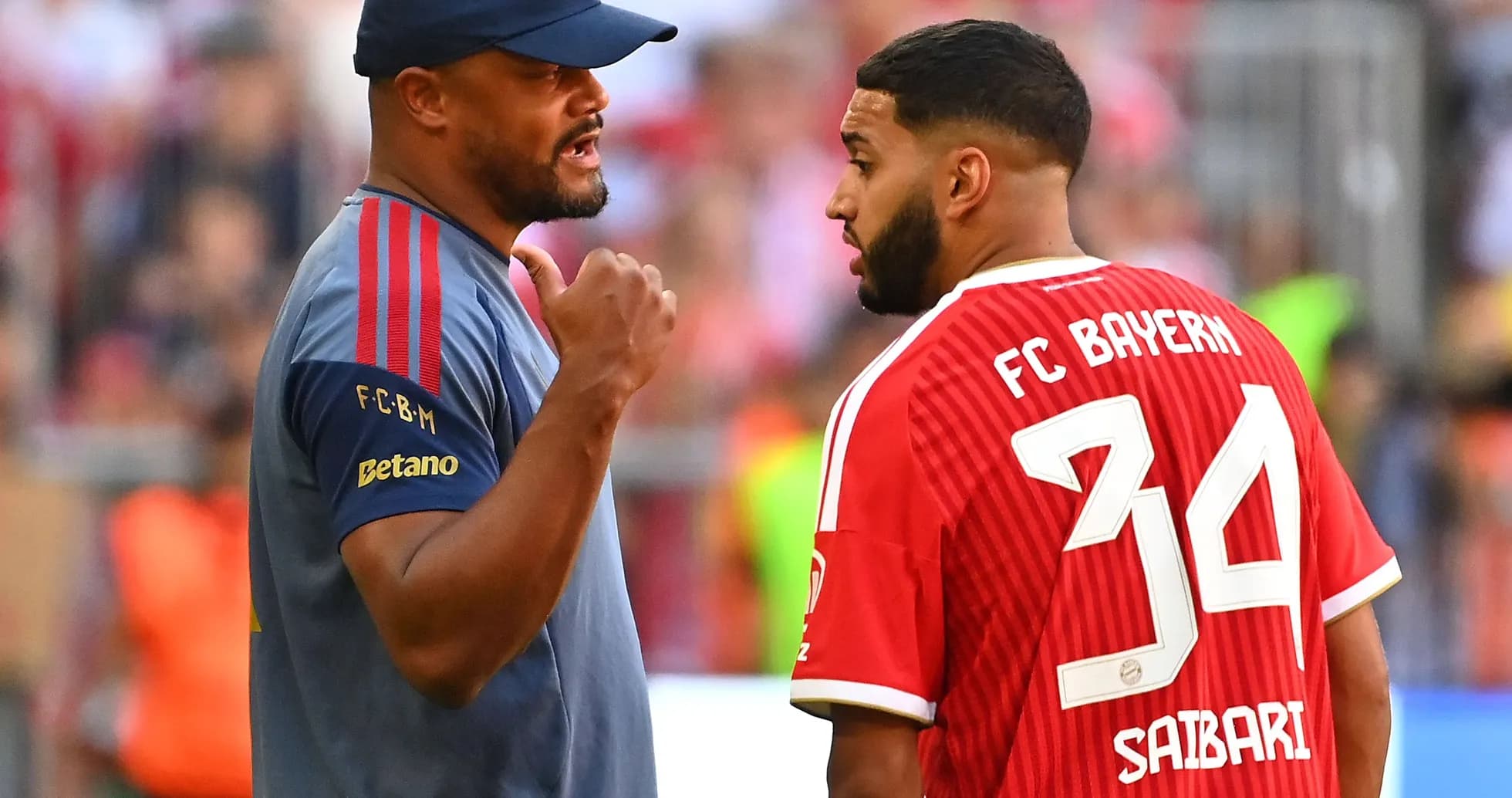
Musiala, Gnabry, Karl and new €50 million signing Ismael Saibari all have a realistic claim to minutes. The calendar is brutal, the games relentless. Kompany will have to rotate, sometimes heavily. But when Bayern walk out for the season’s defining nights, no one can say with conviction who will join the three superstars.
On paper, Musiala should be leading the race. He earns like a key player, wears the iconic number, and was once positioned as the club’s attacking cornerstone. Right now, though, he is nowhere near that status.
Since his January comeback, he has not rediscovered his old sharpness. The hangover from a disappointing World Cup has been compounded by physical and medical challenges. After the tournament, he had a metal plate removed from his foot. Then came the worrying scenes in pre-season.
Musiala collapsed in friendlies against RB Leipzig and 1. FC Heidenheim. Those incidents triggered serious questions over whether the 23-year-old can consistently withstand the demands at the very top level. He has since been diagnosed with absence epilepsy, yet, as neurologist Dr Regina Becker explained to SPOX, a professional career remains entirely possible with the condition.
Musiala is not looking for time off. In a widely shared Instagram statement, he made his stance clear: in close, regular consultation with specialists, it is his personal wish to confront the challenge and, with medical clearance, to continue living his everyday life and pursue his passion for football. He wants to play. He believes playing helps him recover.
The competition around him, though, is only getting stronger.
Saibari Steps In With a Head Start
While Musiala wrestled with fitness and health issues, Gnabry and Karl were fighting their own battles. Both missed the World Cup with muscle injuries. Both spent large chunks of pre-season away from the main group, working individually on their returns.
They are now edging back. The pair have rejoined team training and could feature as early as Saturday’s Super Cup against Borussia Dortmund. If that comes too soon, the expectation is that they will at least be ready as options for the Bundesliga opener against VfB Stuttgart the following Friday.
Saibari, though, has stolen a march on all of them.
Fresh from an impressive World Cup with Morocco, the 25-year-old also had to pause with a torn muscle fibre. Once fit, he accelerated quickly. He is now fully up to speed, has looked sharp in his first two friendlies and delivered tangible output – an assist in the 3-1 win over Leipzig.
Right now, he is the fittest of the four contenders. That simple fact gives him the early advantage in this high-stakes audition for the last attacking berth.
Youngsters Knock, But the Door Is Heavier Now
While the established names recovered, others used the vacuum to step into the light. Loan returnee Arijon Ibrahimovic and academy products Tim Binder and Maycon Cardozo all caught the eye during pre-season. Their cameos carried echoes of Karl’s rapid rise a year earlier, when he went from promising youth to serious first-team option in a matter of months.
A repeat story is possible. Bayern have seen it before. Yet the odds are different now.
This squad is deeper, especially in those advanced midfield and wing roles. Kompany has Kane, Olise, Diaz, Musiala, Gnabry, Karl and Saibari to juggle before he even glances at the academy list. For Binder, Cardozo or Ibrahimovic to break through in the same way Karl did, they would have to smash down a far sturdier door.
So Bayern move into the new season with a familiar question turned on its head. A year ago, it was Gnabry or nothing. Now, with Musiala fighting to reclaim his level, Saibari surging, Karl lurking and Gnabry back from the brink, the problem is no longer scarcity.
It is this: when the biggest night comes, who dares Kompany leave out?