Everton vs Sunderland: Tactical Analysis of a 1-3 Defeat
Everton’s 1-3 defeat to Sunderland at Hill Dickinson Stadium unfolded as a study in how structural control and in-possession fluency can be undermined by transition fragility and late-game management. Both sides lined up in a 4-2-3-1, but the way they occupied those shapes, and adapted within them, defined the tactical story more than raw possession (Everton 49%, Sunderland 51%).
Leighton Baines’ Everton built a clear positional framework. With Jordan Pickford behind a back four of Jake O’Brien, James Tarkowski, Michael Keane and Vitaliy Mykolenko, the home side sought to progress through a double pivot of James Garner and Tim Iroegbunam. Ahead of them, M. Rohl, Kiernan Dewsbury-Hall and Iliman Ndiaye operated as a fluid line of three behind Beto. The structure produced reasonable volume in the final third: 10 total shots, with 6 inside the box and 4 on target, underpinned by 406 passes, 346 accurate (85%).
First Half
The first half largely belonged to Everton territorially. Sunderland’s 4-2-3-1, marshalled by Regis Le Bris, was more conservative early on. R. Roefs was protected by a back four of Lutsharel Geertruida, Nordi Mukiele, Omar Alderete and Reinildo Mandava, with Granit Xhaka and N. Sadiki shielding in front. T. Hume, E. Le Fee and N. Angulo supported B. Brobbey, but initially the visitors focused on compactness rather than pressing high. Sunderland’s lower shot volume (7 total, 3 on target) reflected a plan to wait for Everton mistakes rather than force the game.
Everton’s reward for their more proactive approach came on 43 minutes. From a phase that showcased their set-up, Keane stepped out from the back line and contributed directly, assisting M. Rohl’s finish. The goal encapsulated Everton’s best sequences: centre-backs willing to break lines, the double pivot providing security, and the No. 10 arriving into space between Sunderland’s midfield and defence. At 1-0 and with Sunderland’s attack limited to sporadic forays, the home side’s xG of 1.07 versus Sunderland’s 0.73 suggested a slight but real attacking edge.
However, the defensive and disciplinary details hinted at underlying instability. Tim Iroegbunam’s yellow card for Foul on 25 minutes was an early warning of how Everton’s midfield could be stretched when Sunderland did break. Jake O’Brien’s booking, also for Foul at 47 minutes, underlined the same issue: Everton’s back line was repeatedly asked to defend in emergency scenarios when the first line of pressure was bypassed.
Second Half
Sunderland’s tactical shift after the interval was decisive. Le Bris pushed his attacking midfielders higher and encouraged quicker vertical play into Brobbey, who became the focal point for transitions. The equaliser on 59 minutes, B. Brobbey finishing from an E. Le Fee assist, was emblematic: Sunderland broke Everton’s midfield line, found Le Fee between the lines, and exploited the space between centre-backs and full-backs. It was less about volume of chances and more about the clarity of the routes they were targeting.
The visitors then used substitutions aggressively to tilt the game further. At 60 minutes, T. Hume (OUT) made way for C. Talbi (IN), adding fresh legs and a more direct threat in the attacking band. The triple change on 77 minutes was a key tactical pivot: N. Angulo (OUT) for C. Rigg (IN), N. Sadiki (OUT) for H. Diarra (IN), and Brobbey (OUT) for W. Isidor (IN). This re-energised Sunderland’s front four and, crucially, introduced Diarra’s running power and Rigg’s creativity against a tiring Everton midfield.
Everton’s response at 73 minutes was to adjust their own structure: Iroegbunam (OUT) for T. George (IN) and Beto (OUT) for T. Barry (IN). Removing Iroegbunam weakened the double pivot’s defensive ballast at precisely the moment Sunderland were adding dynamism between the lines. The later changes at 88 minutes — J. O’Brien (OUT) for Seamus Coleman (IN) and M. Rohl (OUT) for Dwight McNeil (IN) — were more like-for-like and came too late to restore control.
Sunderland’s second goal on 81 minutes, E. Le Fee scoring from a C. Rigg assist, showcased the impact of those substitutions. With Everton’s midfield spacing loosened, Rigg found pockets to receive and turn, while Le Fee advanced into more aggressive positions. The move again bypassed Everton’s central block, attacking the half-spaces and forcing Tarkowski and Keane into reactive defending rather than proactive line management.
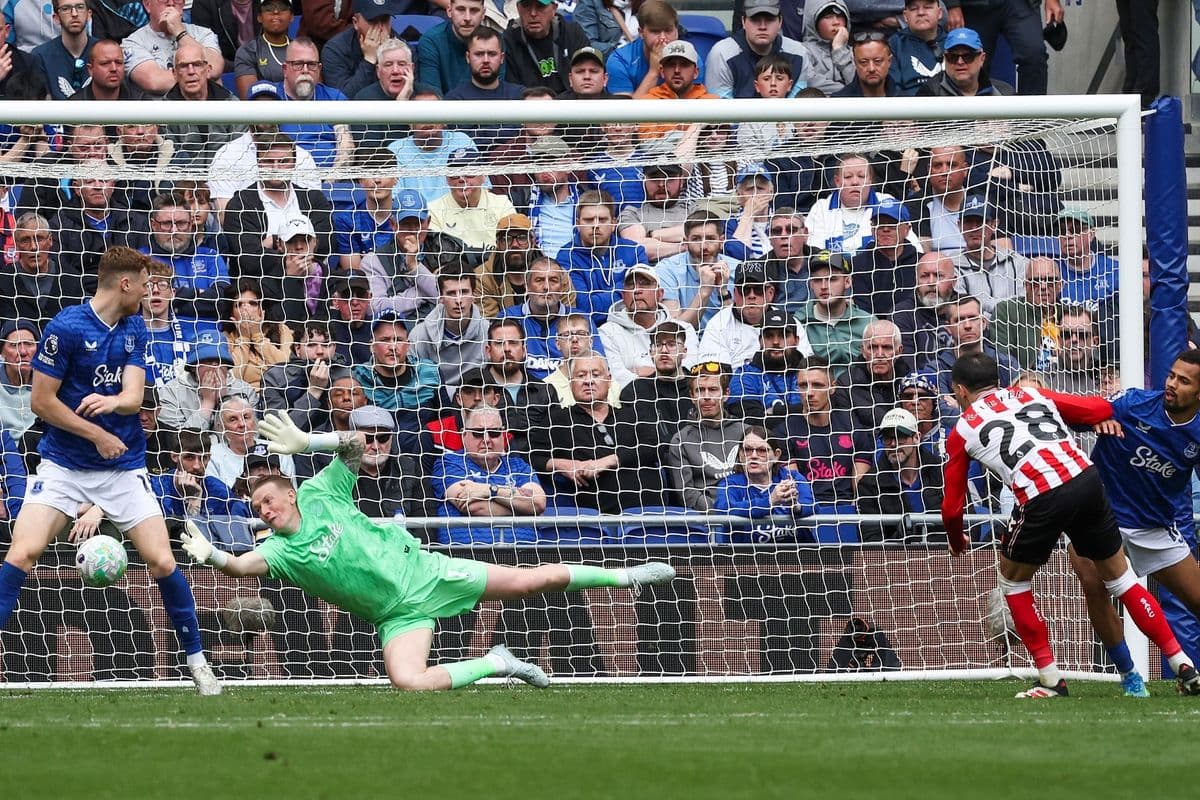
The third goal at 90 minutes, W. Isidor finishing from an H. Diarra assist, completed the pattern. Sunderland, now fresher and more vertical, exploited Everton’s stretched shape as the hosts chased an equaliser. Diarra’s introduction gave Sunderland a ball-carrier who could drive at a disorganised block; Isidor’s movement punished the gaps left as Everton committed bodies forward.
From a statistical standpoint, the match underlined how efficiency and game-state management can outweigh marginal possession edges. Sunderland, with fewer shots (7 vs 10) and similar pass metrics (430 passes, 365 accurate, 85%), converted 3 of their 3 shots on target, aligning a 0.73 xG with ruthless finishing and transition clarity. Everton, despite slightly higher xG and more shots, lacked that same precision in both boxes. Roefs’ 3 saves and 0.02 goals prevented reflect a steady, if unspectacular, goalkeeping display, while Everton’s 0 goalkeeper saves underlined how clean Sunderland’s finishing chances were once they broke through.
Discipline also told a story. Everton’s three yellow cards — Tim Iroegbunam (25', Foul), Jake O’Brien (47', Foul), and James Garner (90+6', Foul) — contrasted with Sunderland’s clean sheet in disciplinary terms. The pattern of bookings, all for Foul and all on the home side, mapped onto a team increasingly defending on the stretch, especially in the latter stages.
In sum, Everton’s 4-2-3-1 provided structure and phases of control but lacked in-game adaptation once Sunderland raised the tempo and retooled their attacking band. Sunderland’s mirror 4-2-3-1 evolved more effectively, using substitutions to sharpen transitions and exploit a tiring, increasingly unbalanced Everton side, turning a 1-0 deficit into a 1-3 away win through superior tactical timing and box execution.