Brazil’s World Cup Strategy: Matheus Cunha as the ‘Nine-and-a-Half’
The World Cup is beginning to harden into shape. So are Brazil.
Carlo Ancelotti looks to have settled on his best XI, and with each group game the team has added another layer: more control, more conviction, more edge. The timing is no accident. Japan await in the last 32, a far sharper test than Haiti or Scotland, and Brazil are arriving at the knockout rounds with something they did not have at kick-off: clarity.
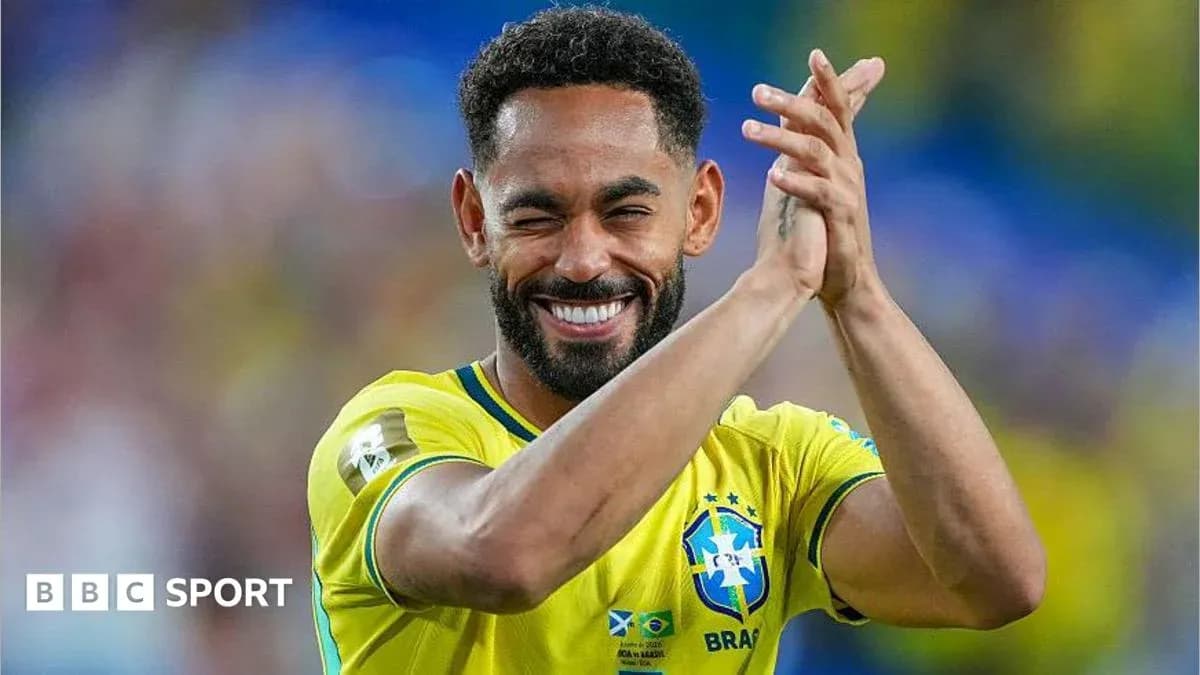
At the centre of that clarity stands Matheus Cunha.
The ‘Nine-and-a-Half’ Changing Brazil’s Profile
Brazilian fans grow up expecting a certain silhouette leading the line. A classic number nine. A Ronaldo, an Adriano, a Romario. Someone who lives between the posts, bullies centre-backs, finishes the moves others start.
Cunha is not that. Not quite.
He is a “nine-and-a-half” – a forward who can play as a nine, but also drop into the 10 space, link play, knit attacks together. He is neither pure finisher nor pure playmaker, but something in between, and that nuance is reshaping this Brazil.
Three goals already at this tournament say he can finish. His movement says he can do far more.
Cunha constantly drops off the front, dragging his marker into uncomfortable territory, asking questions defenders don’t like to answer. Follow him and you leave Vinicius Jr and Rayan with room to explode into. Hold your line and Cunha turns, finds pockets, receives between the lines, and either slides passes or pulls the trigger himself.
It is a profile Brazil have rarely had in the centre-forward position. The effect has been immediate.
There is more. Cunha looks completely at ease with the ugly side of the role. He starts the press, works as the first line of defence, and at times defends almost like a number six in front of the midfield. That work without the ball is giving this team a balance they lacked at the start of the tournament.
The comparison that comes most naturally is Roberto Firmino. Cunha’s constant movement, his habit of dropping deep, the way he plants doubt in the mind of the defender marking him – it all echoes the former Liverpool forward. The same selflessness. The same intelligence. The same willingness to be the one who unlocks space rather than simply occupies it.
Ancelotti’s Accidental Discovery
For Brazil to reach a World Cup without a nailed-on number nine is unusual. Unsettling, even.
Right up to the Scotland game, no one could say with certainty who would start at centre-forward. Ancelotti tested Cunha, Igor Thiago, Endrick, Joao Pedro and Richarlison. None of them were clearly ahead of the others. The shirt was there to be claimed.
Then football’s cruel constant – injury – quietly made the decision easier.
Raphinha, brilliant but restless in his movement, began the tournament as a central 10 behind Igor Thiago against Morocco and can also operate on either wing. His hamstring injury in that opener brought Rayan into the side on the right.
That single change altered the geometry of Brazil’s attack.
Rayan tends to hold his position more than Raphinha. Vinicius Jr stays high and wide on the left. With both wingers stretching the pitch, the central space between the lines has opened up for Cunha to roam almost unaccompanied. For a nine-and-a-half, it is the perfect playground.
The result: a front line that looks coherent, complementary, and difficult to pin down.
That does not mean Brazil are locked into one idea. Igor Thiago still offers something different if the game demands it – a more traditional target man who can stay high, plant himself on the centre-backs and occupy that central zone when Brazil need more physical presence or are chasing the match.
The key is that Ancelotti now has real options, not just names on a teamsheet. Back home, the noise is growing that Cunha is the answer. The hope, inside and outside the camp, is that he can keep this level when the stakes rise again.
Opponents will now have a dossier on him. They will know his habits, his starting positions, his triggers. But intelligence is harder to neutralise than pace or power. Cunha reads the game too well to be easily filed away.
A Brazil That Doesn’t Need the Ball to Dominate
Ancelotti’s reputation has always leaned heavily on man-management. The arm around the shoulder. The calm in big moments. It is deserved. But this Brazil side is a reminder that he is also a sharp tactician who adapts, not a dogmatist who imposes.
One of the most striking aspects of this team is their comfort without the ball. This is not a Brazil obsessed with 70% possession or endless passing sequences for their own sake.
They are happy to let the opposition have it, on their terms.
Against Scotland, that approach was clear. Brazil gave Scotland the ball and then subtly guided their build-up into traps. Passing lanes were left open by design, not accident. Once the ball went where Brazil wanted it, the press snapped into life at exactly the right moment and with the right intensity.
The first goal came from that plan. The second, ruled out harshly, followed the same pattern. These were not one-off moments or lucky breaks. Brazil had already scored similar goals in warm-up matches against Panama and Egypt. This is now part of their identity.
They did not dominate possession. They dominated the game.
A New Shape, A New Brazil
So what is this Brazil, exactly? A possession team? A counter-attacking side? Something in between?
Under Ancelotti, the answer depends on the opponent and on the moment. With players who can adapt, the team adapts with them. The days of one fixed template, regardless of context, feel distant.
This is not the swashbuckling, full-back-flying Brazil of old. For the first time at a World Cup in decades, the flanks are not defined by Roberto Carlos, Cafu, Maicon, Marcelo or Dani Alves tearing forward at every opportunity.
Instead, Douglas Santos, Roger Ibanez or Danilo are more conservative in their runs. They choose their moments. That restraint has a purpose: it allows Vinicius Jr to stay higher, conserve energy, and be fresher and more dangerous when Brazil spring forward.
The back four looks secure. The midfield, once exposed, now feels properly stitched together.
In the opener against Morocco, Casemiro was left alone at the base of midfield and heavily criticised afterwards. The blame was misplaced. At 34, he has never been the kind of player who can cover every blade of grass, flying into every press and every tackle. The structure around him was the issue, not his ability.
Ancelotti responded by shifting from a 4-2-3-1 to a 4-3-3. The difference has been significant.
Now, when Bruno Guimaraes steps forward as Brazil want him to, Casemiro has Lucas Paqueta alongside him rather than acres of space to patrol on his own. The distances are shorter, the coverage better, the risks lower.
Against Haiti and Scotland, that tweak brought far more control. Against Japan, a far more fluid and dangerous attacking side than either of those, it will be essential.
Momentum, Numbers – and Expectation
Seven goals scored. One conceded. A team that looks more solid at the back, more inventive in attack, and more sure of itself with every game.
The numbers tell a positive story, but in Brazil the only statistic that truly matters is the result. Win, and the country smiles. Anything less, and the debate begins.
Before the first game, there was tension. After it, there was worry. Three matches later, the mood has flipped. Excitement has replaced anxiety. The public can see a team taking shape, a manager in control, and a centre-forward finally making sense of a long-standing question.
Now comes the real examination.
Japan will not be as forgiving as the group. They will press, combine, and test every inch of this “new Brazil” – the more cautious full-backs, the rebalanced midfield, the nine-and-a-half who has become the hinge of Ancelotti’s attack.
Brazil have found their rhythm. The knockout rounds will reveal whether it is strong enough to carry them all the way.