Brazil's Historic Olympic Gold: A Night of Redemption
For decades, Olympic gold was the missing piece in Brazilian football’s trophy cabinet. World Cups, Copa Américas, club world titles – all there. But not this. Not the medal an entire country had been craving.
On 20 August 2016, at a tense, heaving Maracanã, that gap finally closed.
More than 63,000 fans packed the stadium in Rio, carrying the weight of history and the scars of 7–1 into a final against Germany that felt far bigger than an Olympic showdown. It was a chance for catharsis. A chance to rewrite a chapter.
Neymar’s Free-Kick, Germany’s Reply, and a Long Night
The game itself mirrored the occasion: tight, nervy, on edge.
Midway through the first half, the release came. In the 26th minute, Neymar stepped over a free kick, just outside the box. One swing of his right foot, the ball arcing over the wall and in. Maracanã erupted. Brazil led. The dream was on.
Germany refused to fold. They grew into the match, and in the 60th minute, they struck back. Maximilian Meyer found space and levelled, silencing the stadium and dragging Brazil into another emotional test.
At 1–1, neither side blinked. Ninety minutes weren’t enough. Extra time came and went with the tension rising and the football tightening. No breakthrough. No room for error now.
Penalties.
Weverton’s Save, Neymar’s Walk
Both teams walked to the spot with a kind of cold precision. Up to the fourth kick, nobody missed.
For Brazil: Renato Augusto, Marquinhos, Rafinha and Luan converted. For Germany: Matthias Ginter, Serge Gnabry, Julian Brandt and Niklas Süle answered in kind.
Then came Nils Petersen, one of the tournament’s top scorers. His run-up was steady, the strike firm. But Weverton guessed right, plunged, and saved. In an instant, the entire dynamic flipped. The stadium roared his name.
Suddenly, the gold medal sat at Neymar’s feet.
He picked up the ball, walked alone to the spot, and paused. One kick to end decades of frustration. One kick to complete a story Brazilian football had been trying to write since Olympic football began.
He buried it.
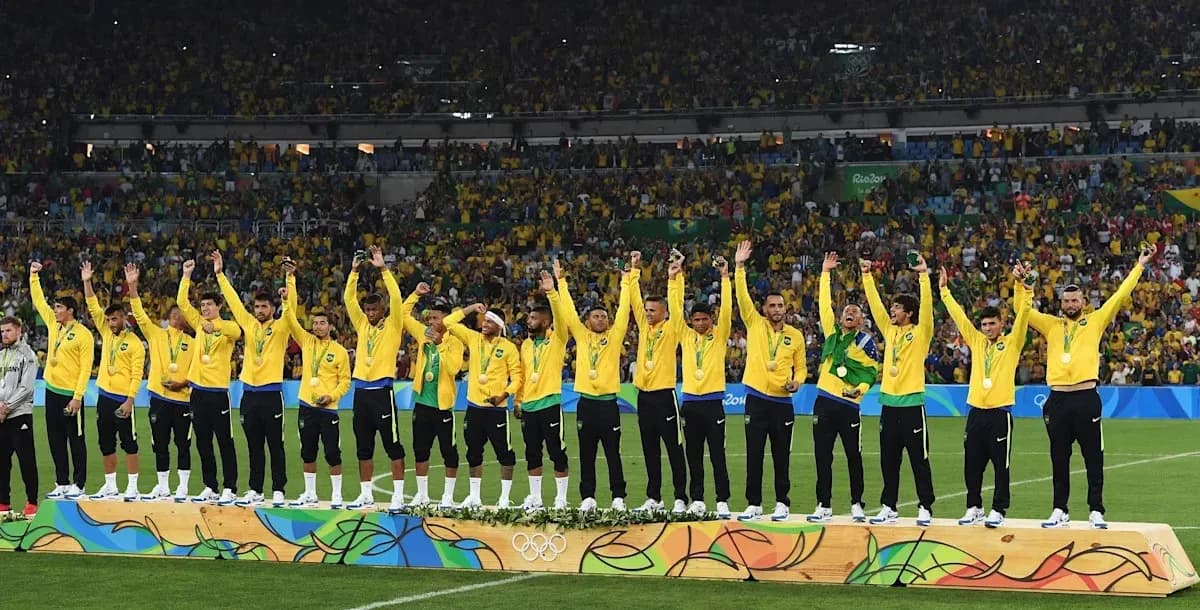
Neymar turned away, collapsed to his knees, and the Maracanã exploded. Brazil, at last, had its first Olympic football gold.
From Stumbles to Statement Wins
That night felt inevitable only in hindsight. The journey to the final was anything but smooth.
Brazil opened Group A in Brasília and immediately hit turbulence. Two goalless draws – first against South Africa, then against Iraq – triggered familiar anxiety. A home Olympics, a star-studded squad, and after two games they still hadn’t scored.
Qualification hung on the third match in Salvador, against Denmark. This time, the response was ruthless.
At Arena Fonte Nova, Brazil tore into the Danes. Gabriel Barbosa scored twice, Gabriel Jesus added another, and Luan completed a 4–0 rout. The doubts eased. Brazil topped the group and finally looked like a team worthy of the gold conversation.
With the group stage cleared, the knockout pressure arrived.
In the quarterfinals at Arena Corinthians in São Paulo, Brazil met Colombia, runners-up in Group B after draws with Sweden and Japan and a win over Nigeria. This time, the hosts controlled the occasion. Neymar struck, Luan scored again, and a 2–0 victory pushed Brazil into the last four with at least a bronze medal already guaranteed.
But bronze was never the target.
Honduras awaited in the semifinals at the Maracanã, having already knocked out Argentina, Algeria and South Korea. Any hint of a tight contest vanished quickly. Brazil blew them away.
Neymar scored twice, Gabriel Jesus matched him with two of his own, and Marquinhos and Luan added to a 6–0 demolition that felt like a statement: Brazil were no longer just surviving the tournament. They were owning it.
All that remained was Germany, a penalty shootout, and a moment etched into Olympic history.
The 18 Who Made History
Behind Neymar’s iconic penalty and Weverton’s decisive save stood a squad that finally delivered a long-awaited title. Eighteen players became the first Olympic gold medallists in Brazilian football history.
- Goalkeepers
- Weverton (Athletico-PR)
- Uilson (Atlético Mineiro)
- Full-backs
- William (Internacional)
- Douglas Santos (Atlético Mineiro)
- Zeca (Santos)
- Center-backs
- Rodrigo Caio (São Paulo)
- Luan Garcia (Vasco da Gama)
- Marquinhos (Paris Saint Germain – FRA)
- Midfielders
- Thiago Maia (Santos)
- Rodrigo Dourado (Internacional)
- Rafinha Alcântara (Barcelona – ESP)
- Renato Augusto (Beijing Guoan – CHI)
- Felipe Anderson (Lazio – ITA)
- Walace (Grêmio)
- Forwards
- Neymar (Barcelona – ESP)
- Luan (Grêmio)
- Gabriel Barbosa (Santos)
- Gabriel Jesus (Palmeiras)
One more name belongs to that story, even without a medal around his neck. Goalkeeper Fernando Prass was originally called up for the Olympics but suffered an elbow injury in the warm-up for a friendly against Japan at Serra Dourada in Goiânia and had to withdraw before the group stage began.
Ten years later, the images still stand: Neymar on his knees, Weverton swallowed by teammates, a nation finally holding the one football prize it had never touched.
The question now is simple: will another Brazilian generation ever match the weight – and the release – of that golden night in Rio?