Arsenal's Optimism: Arteta Prepares for Brighton Clash
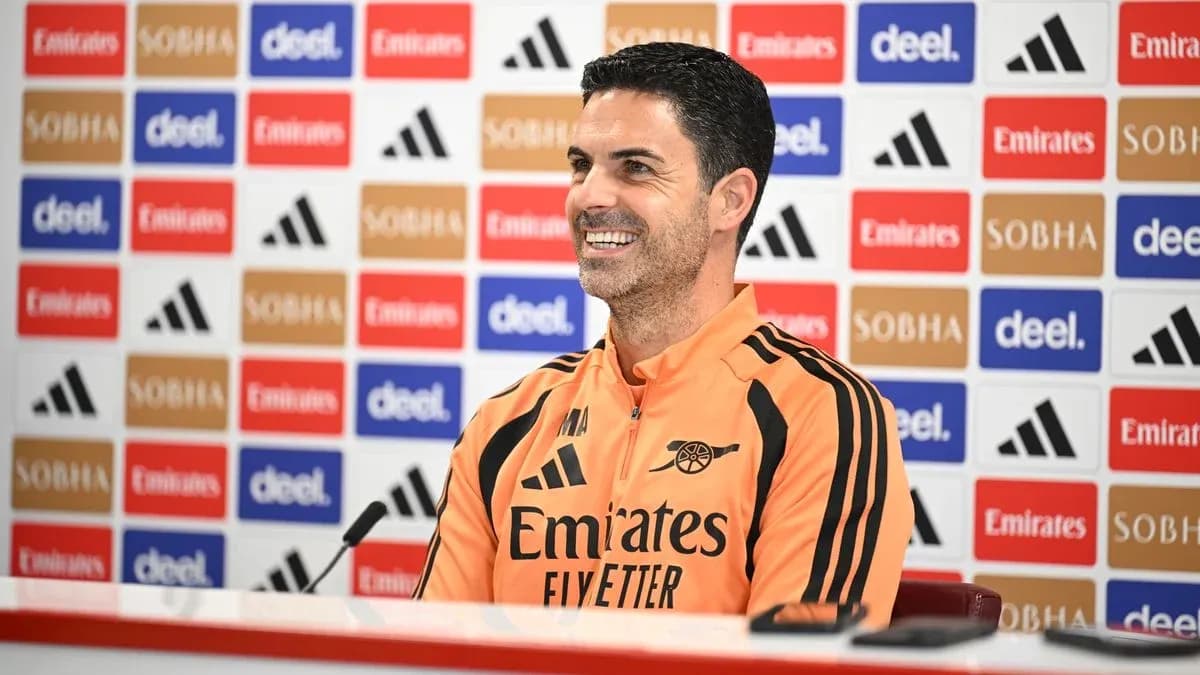
Mikel Arteta walked into the press room before Arsenal’s trip to Brighton with his team flying, the questions circling around injuries, records, referees and the future of a club trying to stay at the very top.
Timber, Hincapie, Mosquera and White: fitness picture bright
The first concern was predictable: bodies.
“All good,” Arteta said when asked about Ben White, before widening the update. Another training session awaited in the afternoon, but the message was clear – optimism. Jurrien Timber, Cristhian Mosquera and Piero Hincapie are all pushing to be involved, all “willing to be part” of that final session to prove they are ready.
Arsenal head to Brighton chasing an eighth straight win in all competitions to start the season. The club say they have not managed that since 1903. Arteta refused to be seduced by the stat.
“We’ve got a really tough opponent tomorrow so we’re going to have to earn the right to win the game,” he said. The mindset, he insisted, would not change.
“Defend my club”: Arteta on referees and Sunderland fallout
The shadow of Sunderland still lingers. Arsenal have been in contact with Pro Ref over decisions in that game, but Arteta kept the details locked away.
“This is a conversation that will remain private as usual,” he said. What mattered to him was not an apology, unlike the one Manchester United have received in a separate case, but clarity. “It’s just agreeing that the decision should have been different or not… and try to improve and move forward together.”
When it was put to him – via Jamie Carragher’s comparison – that he now has a Sir Alex Ferguson-style influence over referees, Arteta pushed that away.
“No,” he replied. “I’m here to try to give my opinion, to defend my club, to give the very best to our players.” He accepted he would “make mistakes sometimes” but stressed he tries to be “as fair as possible”.
Inside the press room, the wider debate about officiating, accountability and the game’s direction rumbled on. Arteta framed it as a shared duty. Managers, media, officials – “everybody’s duty to try to improve the game”.
Contract calm and a new international break
Off the pitch, his own future remains a running storyline. Arsenal want him to sign a new deal. He wants to sign. The fans want it. So when?
“I think we are all very much aligned,” he said. “Whenever the time is right, we’ll get that done. There is nothing to be concerned about.”
He would not be drawn on whether, as two years ago, an international break would again be the moment news emerges. The ambition is shared, he said. The timing will take care of itself.
That international break is now longer than before, a structural change that will test clubs and countries. Arteta is reserving judgement.
“It’s something that we’ll have to experience,” he said. Different national teams are taking different approaches to squad sizes and travel, some staying local, others heading around the world for more than two weeks. For him, the key is communication – clarity on where players are physically, what Arsenal expect and what national coaches expect. “Work together, that’s the best way always.”
Same Arsenal, home or away
Brighton away will be Arsenal’s fourth consecutive match on the road. It has not blunted them.
“That’s one of the challenges of the schedule, and the team has responded so well,” Arteta said. He wants the same Arsenal everywhere: “Playing with such dominance, it doesn’t really matter if we play at home or away; we want to be the same team.”
Three away wins have set up the chance for a fourth. Brighton, he knows, stretch you in different ways. He called it a “beautiful game to watch” in prospect and paid warm tribute to Fabian and the work done at Brighton, noting the respect between the clubs after past comments were smoothed over privately.
Leadership in a split second
One moment from the cup win at Sunderland stuck with him. Marli Salmon, just 16, made an error. Gabriel sprinted straight to him, arm round the youngster, lifting him back up.
“You cannot cause that. You have it, or you don’t, because it’s a split second,” Arteta said. “It’s just a very emotional reaction when you’re in the middle of the game, and I absolutely loved it.”
For a teenager, that support can define what happens next. “The confidence that it gives to a 16-year-old to go again and deliver in the next action, it’s huge.” That, to Arteta, is the sign of a dressing room that looks after its own.
Bruno’s role and a midfield built on flexibility
Bruno Guimaraes’ role was another tactical thread. At Newcastle he has often played on the right of midfield; for Arteta, the Brazilian is a moving piece.
“He can play on the left, on the right, in the middle, he can rotate from there,” he said. A “dynamic, versatile” player whose position will depend on what the team needs on the day, the relationships with other midfielders, and the opponent’s structure.
Arteta’s midfield, like much of his team, is being built on flexibility rather than fixed roles.
Raya’s rise and a “tremendous signing”
David Raya’s journey – from non-league to a Premier League title contender and Golden Glove favourite – was framed as a beacon for any young player.
“That’s a great story,” Arteta said. He pointed to the modern reality: one game, one scout, and a career can change in two or three years. With Raya, he credits mentality as much as talent.
“He has overcome a lot of difficulties and a lot of challenges to reach this point,” Arteta explained. Even at Arsenal, “it wasn’t easy at the beginning. He really has to dig in and improve himself.”
He highlighted the daily work with goalkeeping coach Iñaki and the support of team-mates. Now, Arteta says, Raya has “the right to be one of the best”.
Is he Arteta’s best signing? The manager refused to rank him, but didn’t hold back on the impact. “He’s been a tremendous signing. There’s no question about that… I think he has elevated the team, the club to a different level and now we need to maintain that level.”
Chasing rhythm, ignoring Invincibles talk
The new international calendar, with fewer but longer breaks, could help teams build rhythm. Or disrupt them in new ways. Arteta is waiting to see.
“Let’s see how it pans out,” he said, noting the different travel demands on different national teams. For now, he is more concerned with Brighton than with calendars or computers.
Asked whether this Arsenal side, five wins from five in the league, might be the next Invincibles, he cut it off quickly. “We just have enough on the plate today to prepare the game against a really good Brighton tomorrow.”
The task, as he sees it, is simple. “Earn the right to win it, that’s it.”
Viktor’s moment and the value of minutes
Viktor, facing one of his former clubs this weekend, has not yet hit top form in the Premier League. Arteta does not see a crisis of confidence.
“Especially in the Premier League, he hasn’t played that many minutes,” he pointed out. Viktor did play well away at Napoli last week, and the manager stressed this is “about moments”.
“We need to give him all the support and confidence that he needs to deliver because we know the player that we have, the capacity that he has to score goals and what he can give to the team.”
Adaptation remains a two-way process. The team is evolving tactically, not just Viktor. “That’s a constant evolution, player and team,” Arteta said. His job is to “find those connections and that level of confidence for the player to give his best for the team.”
A spell with Sweden might help. Arteta recalled how Viktor returned from international duty in March “with energy” and goals. For a striker, the formula is eternal. “They need minutes and they need goals. That’s what really boosts the energy of them.” Brighton offers another chance.
Building for tomorrow: youth, recruitment and retention
Behind the first team, Arsenal’s youth strategy is shifting. Per has moved on, Pascal has come in. Signings like Victor in January and Andria Bartishvili underline a push to secure elite talent early.
“It’s together as a club,” Arteta said. To maintain this level, he believes Arsenal must be “one of the best in the world at recruiting” – both in England and abroad. The ideal pathway is already “in-house”, through the academy and youth teams.
Holding on to the best is another battle. Some promising youngsters – Chido, Ayden, and this summer Nduka – have moved on, while others such as Max and Marli have committed to new deals.
“That is challenging because there are a lot of parties there,” Arteta admitted. The system creates “gaps” where big decisions must be made, and those decisions often rest with players, agents and families as much as clubs. “We’re going to try, for sure, to keep the best talent in-house.”
Seven wins, unknowns after the World Cup – and Max kicking down the door
Seven straight wins after a World Cup, with almost no time to work with the squad, is no small feat. Arteta knows how fragile it is.
“We know how complicated it is to win a football match at this level,” he said. To win seven “tells the story”. After the World Cup, there were “a lot of unknowns” about how players would react. What impressed him from day one was the attitude. Performances followed, with “a bit of luck as well” to get over the line in four of those games. Now they want “another one for sure tomorrow”.
If form is the loudest argument, Max Dowman is shouting. Two goals and a standout display at Ipswich Town have put his name right in front of the manager.
“That’s the best way to knock on the door: to do it on the pitch, not in the office,” Arteta said. When a player delivers “every single day in training” and in matches, the manager is “left out of arguments”. Team-mates start demanding that player in the XI.
Arteta praised not just Max’s football but his growth. Being around senior professionals, he said, changes a youngster’s habits. “The level of attention they put to any detail, the way they look after themselves, the standard that they set… when that becomes a normality, then you will hit another level.” That, in his eyes, is where Max is now.
Eze, Tzolis and a left flank reshaped
With Martinelli and Trossard gone, the left wing has a new face. Eze has played all his minutes there this season, and Arteta sees him in his natural zone.
“He’s always played there,” the manager said. “His biggest moments in his career and the highlights of his career have come” from that side. Eze can drift into different spaces, but the left flank is where he has created “big moments for previous clubs to win matches”.
He shares that lane with Tzolis. How does Arteta choose?
Form. The opponent. The chemistry within that unit. “There are a lot of factors,” he said. Each game has its own profile; some are Eze games, some are Tzolis games.
Konsa, Gabriel and a partnership that clicks
At the back, Ezri Konsa’s integration has been rapid. Thrown into a physical battle against Sunderland’s Brobbey, he impressed alongside Gabriel.
Arteta had heard “great things” before Konsa arrived, but daily contact has underlined “the magnitude of the player that we signed. Not only the player, but the person.” He highlighted the way Konsa connects with people, and the sight of him and Gabriel chatting in the corridors “like they’ve been here for a long, long, long time together”.
On the pitch, that matters. “That’s a partnership that, in my opinion, is extremely important on the field,” Arteta said. Konsa’s attributes and quality, he believes, “really make us better”.
Arsenal head to Brighton chasing a slice of history, with a manager who refuses to talk about records, Invincibles or supercomputers. His focus is narrower, more ruthless: one more away game, one more tough opponent, one more chance for this evolving team to prove that their fast start is not a surge, but a standard.