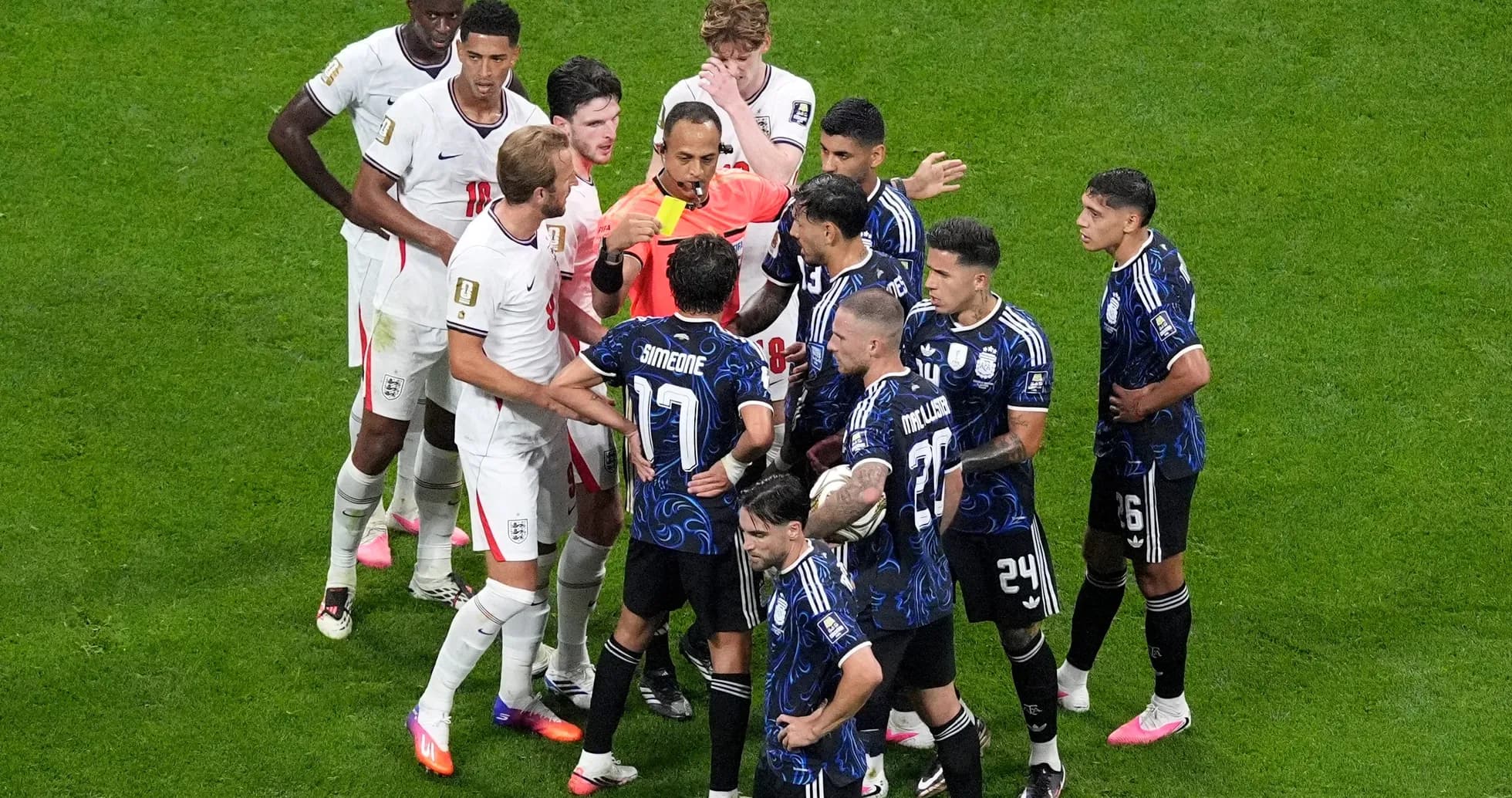
Argentina Overcomes England in Tactical Clash at Mercedes-Benz Stadium
England’s 1-2 defeat to Argentina at Mercedes-Benz Stadium was defined by a clash of structures and territory. England, under T. Tuchel in a 4-2-3-1, tried to compress the game without the ball and strike in transition. Argentina, in L. Scaloni’s 4-4-2, dominated the ball, gradually tilting the pitch until late pressure overturned a 0-1 deficit.
Argentina’s control is written clearly in the numbers: 64% possession, 590 passes with 537 accurate (91%).
Their 4-4-2 behaved more like a 4-3-3/4-2-3-1 in long phases, with Enzo Fernández and Alexis Mac Allister stepping inside from midfield and half-spaces, and Lionel Messi drifting between the lines to overload central zones. Leandro Paredes anchored the circulation, giving Argentina a stable base to recycle and re-attack.
England’s 4-2-3-1 was set up to suffer without the ball but remain compact. With only 36% possession and 324 passes (272 accurate, 84%), Tuchel’s side accepted long defensive spells. Declan Rice and Elliot Anderson formed a screening pair in front of a narrow back four, trying to deny vertical passes into Messi and Julián Álvarez. The cost of that compactness was territorial: Argentina finished with 15 total shots to England’s 5, including 7 efforts inside the box to England’s 2.
First Hour
The first hour showed England’s plan working. Argentina’s early possession was largely sterile, forced into 8 shots from outside the box as England’s block protected the central penalty area. Cristian Romero and Lisandro Martínez held a high line, but England’s front four of Morgan Rogers, Jude Bellingham, Anthony Gordon and Harry Kane were disciplined, rarely pressing high, instead waiting for triggers to jump on sideways passes.
England’s attacking structure relied on quick vertical connections once they regained the ball. The breakthrough on 55 minutes encapsulated that idea: Gordon’s goal, assisted by Rogers, came from England springing forward from a compact base, exploiting the space behind Argentina’s advanced full-backs. With only 5 total shots but 0.53 xG, England’s chances were limited but reasonably efficient in quality relative to volume.
Defensive Performance
Out of possession, England were aggressive enough to disrupt, committing 11 fouls and taking a single yellow card (Elliot Anderson for “Foul” at 37'). The back four was initially stable: Reece James and Djed Spence offered width and recovery speed, while John Stones and Marc Guéhi protected the central lane. However, as Argentina increased the tempo, England’s defensive line was pushed deeper, compressing the space for counters and isolating Kane.
Tactical Changes
The turning point tactically came with Argentina’s substitution wave around the 64th–72nd minute. Nicolás González (IN) came on for Leandro Paredes (OUT) at 64', and then Scaloni reshaped almost his entire left and right defensive flanks at 72': Nicolás Otamendi (IN) for Lisandro Martínez (OUT), Gonzalo Montiel (IN) for Nahuel Molina (OUT), and Rodrigo De Paul (IN) for Giuliano Simeone (OUT). These changes added fresh legs, more direct running and higher crossing volume from wide areas, intensifying the pressure on England’s box. Later, Lautaro Martínez (IN) for Nicolás Tagliafico (OUT) at 81' pushed Argentina into a more aggressive, striker-heavy shape.
Tuchel’s response was more reactive and defensive. At 72', Ezri Konsa (IN) replaced Anthony Gordon (OUT), effectively turning England’s left side into a more conservative, defensively secure flank and reducing their direct dribbling threat in transition. At 82', Dan Burn (IN) for Reece James (OUT) and Nico O'Reilly (IN) for Declan Rice (OUT) further altered the balance. Burn’s introduction added aerial presence but reduced mobility against Argentina’s increased tempo; losing Rice’s screening at the base of midfield made it harder to manage second balls at the edge of the box, precisely where Argentina were now concentrating their attacks.
Late Goals
The late goals reflect this shift. Argentina’s 1-1 equaliser by Enzo Fernández on 86', assisted by Messi, came after sustained pressure and second-phase control around England’s area. With England’s midfield screen altered and tiring, Fernández found space to shoot as Argentina’s 7 shots inside the box and 3 blocked efforts illustrate repeated entries into dangerous zones. The 90+2' winner from Lautaro Martínez, again assisted by Messi, was the culmination of that territorial siege: Argentina’s numerical presence in the box and Messi’s freedom between lines finally broke England’s compactness.
Goalkeeper Performance
Goalkeeper performance underlined the tactical story. J. Pickford (England) faced 5 shots on goal and made 3 saves, with 0.02 goals prevented, reflecting that he delayed but could not fully resist the mounting Argentine threat. E. Martínez (Argentina), by contrast, had a quieter evening: England produced just 2 shots on goal, and he needed only 1 save, also with 0.02 goals prevented. Argentina’s territorial dominance limited the exposure of their goalkeeper, while England’s deep block left Pickford under more frequent, if not constant, pressure late on.
Discipline and Stats
Defensively, both teams walked a fine line with discipline. Argentina committed 15 fouls and collected three yellow cards: Lisandro Martínez (“Foul” at 42'), Cristian Romero (“Foul” at 51') and Rodrigo De Paul (“Argument” at 90+4'). Those bookings underline how often Argentina had to counter-press aggressively after losing the ball high up the pitch, especially with full-backs and centre-backs stepping into midfield. England’s single yellow for Anderson, also for “Foul”, reflects a more controlled but still physically committed approach in midfield.
Set-piece and territorial stats further emphasise Argentina’s control: 6 corner kicks to England’s 1, and 3 offsides to England’s 1, pointing to a side consistently playing on the front foot and pushing the last line. England’s limited corners and offsides tally mirror their reactive posture.
Conclusion
In summary, this semi-final was a structural duel where England’s compact 4-2-3-1 and transition focus delivered a lead but could not withstand Argentina’s sustained, possession-heavy 4-4-2 evolution. Scaloni’s aggressive, multi-position substitution wave shifted the game decisively, while Tuchel’s more defensive changes gradually blunted England’s counter-attacking edge. The statistical profile—Argentina’s superiority in shots, xG (1.84 to 0.53), possession and passing—aligns closely with the late scoreboard swing that sent Argentina through.