U.S. Soccer Advances to Knockout Round Without Pulisic
SEATTLE — The United States came to this World Cup insisting it was more than just Christian Pulisic and a supporting cast. On a cool Friday night in Seattle, that claim held up under the harshest inspection.
No Pulisic. No problem. Not yet, anyway.
With their star forward sidelined by a calf injury, the Americans still punched their ticket to the knockout round, beating Australia 2-0 and sealing qualification after only two group matches for the first time in their World Cup history as hosts.
Life without Pulisic
The team sheet told the story before a ball was kicked. No No. 10. No AC Milan playmaker with 33 goals in 87 international appearances. The U.S. attack, so often funneled through Pulisic’s left boot, had to find a different route.
It did so early.
In the 11th minute, Folarin Balogun picked up where he left off after his two-goal performance in the 4-1 win over Paraguay on June 12. Driving hard down the left sideline, he carved open Australia’s back line and whipped a low ball into the box, aimed for Ricardo Pepi, who had stepped into the starting role in Pulisic’s absence.
Pepi never touched it. He didn’t have to.
Australia defender Cameron Burgess, stretching to cut out the cross, diverted the ball past his own goalkeeper and into the Socceroos’ net. The deflection silenced the traveling Australian support and sent a roar rolling around the stadium. The U.S. led 1-0, and the tone of the night changed.
The goal went down as an own-goal, but it was born of Balogun’s aggression and the Americans’ intent to attack, even without their most decorated forward on the field.
Freeman’s moment
The pressure didn’t ease. The U.S. pressed high, moved the ball with confidence, and forced Australia deeper and deeper. Just when the game seemed to be drifting toward halftime with a fragile one-goal margin, the youngest player on the roster stepped into the spotlight.
Alex Freeman, 21 years old and already carrying the weight of a famous surname as the son of Super Bowl champion Antonio Freeman, made the night his own.
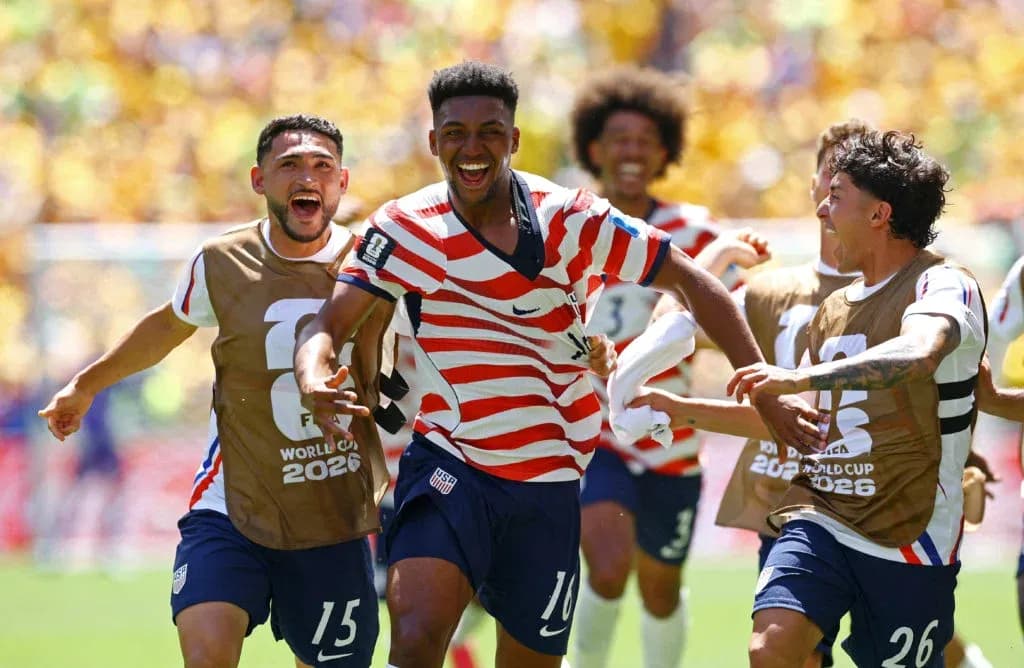
In the 43rd minute, off a set piece, Sergiño Dest found space and unleashed a shot that ricocheted inside the box. The ball popped up, chaos all around it. Freeman reacted first. He rose, met the deflection cleanly, and steered a header into the net for a 2-0 lead and his first career World Cup goal.
For a moment, the celebration paused. A video review checked the play, the stadium holding its breath. The confirmation came, and with it a release of noise and relief. Two goals to the good, the U.S. had one foot, then almost the entire body, in the knockout rounds.
A different kind of host
The last time the United States hosted a World Cup, back in 1994, the path to the knockouts felt tentative. That team slipped through as one of the best third-place finishers before bowing out to eventual champion Brazil in the round of 16.
This version moved with more authority. Two games, two wins, and a place in the knockout stage secured with a match to spare. No reliance on other results. No nervy final-day calculations.
The absence of Pulisic remains the looming question. A calf injury kept him out of this one, and the Americans will want their leading scorer back when the opposition sharpens and the margins tighten. His record — 33 goals in 87 caps — underlines how central he is to this era of U.S. soccer.
But this night belonged to the supporting cast that refused to see itself that way. Balogun tearing down the flank. Pepi occupying defenders in the box. Dest driving play from the back. Freeman, the youngest of them, turning a half-chance into a defining moment.
The U.S. arrived at this World Cup with talk of depth and evolution. Against Australia, under the lights in Seattle, that depth carried them through. The knockout rounds await, and now the question shifts from whether they can survive without Pulisic to just how far this broader, bolder group can go when he returns.