Trabzonspor vs Ferencvarosi TC: Tactical Analysis of a UEFA Europa League Defeat
Trabzonspor’s 0-1 home defeat to Ferencvarosi TC at Papara Park was defined by a stark contrast between territorial dominance and penalty-box efficiency. In a UEFA Europa League Play-offs tie where the hosts controlled the ball and the geography of the game, the visitors managed the key spaces better, struck early, and then turned the match into a controlled defensive operation. The statistical pattern is clear: Trabzonspor had 66% possession, 3 shots on goal and 7 corners, yet never broke through; Ferencvarosi TC, with just 34% possession and 4 shots on goal, converted their best attacking moment and then leaned into structure, aggression, and game management to protect the lead.
I. Executive Summary of the Tactical Pattern
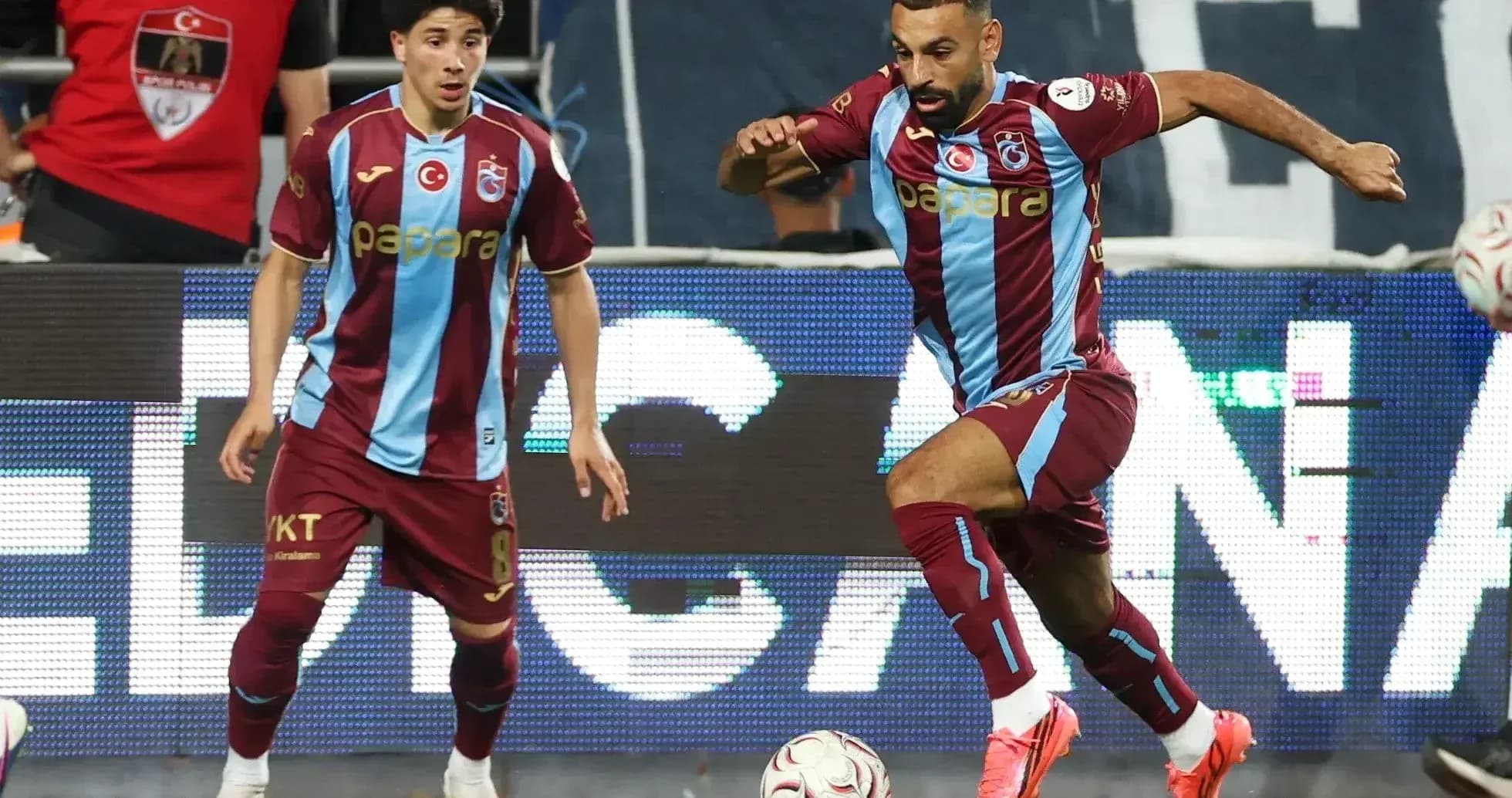
Trabzonspor set up in a 4-2-3-1 under Fatih Tekke, with P. Onuachu as the reference point and a band of three – N. Saviolo, M. Salah, and U. Nayir – tasked with finding pockets between Ferencvarosi’s lines. The double pivot of B. Bouchouari and M. Kabasakal was designed to control circulation and counter-press. Ferencvarosi TC, in a 4-4-2 under Balazs Borbely, accepted a low-possession game from the outset, pairing Dele and L. Joseph up front with a compact four-man midfield that narrowed central spaces and protected the half-spaces.
The game’s tactical story is that Trabzonspor won the ball but lost the battle for high-value territory. Their 15 shots off goal and 6 blocked efforts show volume without precision, while Ferencvarosi TC’s more modest shot count was concentrated in clearer situations, epitomised by the decisive 17th-minute goal.
II. Scoring Sequence & Disciplinary Dynamics
The only goal arrived at 17', and it shaped everything that followed:
17' K. Zachariassen (Ferencvarosi TC) — assisted by O. Nagy → Trabzonspor 0-1 Ferencvarosi TC.
From that moment, Ferencvarosi TC’s tactical lens shifted fully towards protecting the lead, while Trabzonspor were forced into a more aggressive, risk-heavy posture.
The card profile underlines the contrast in approaches and defensive styles. Ferencvarosi TC accumulated five yellow cards, all tied to intense physical engagement and game disruption, while Trabzonspor finished with a single, late red card:
- 29' Dele (Ferencvarosi TC) — Roughing
- 43' K. Zachariassen (Ferencvarosi TC) — Roughing
- 50' P. Rommens (Ferencvarosi TC) — Holding
- 89' A. Osvath (Ferencvarosi TC) — Roughing
- 90+1' G. Kanichowsky (Ferencvarosi TC) — Unsportsmanlike conduct
- 90+6' C. Nwaiwu (Trabzonspor) — Roughing (Red Card)
Totals: Trabzonspor 1 card (1 red), Ferencvarosi TC 5 cards (5 yellow), overall 6 cards. The numbers match the tactical reality: Ferencvarosi TC were content to foul and fragment the game (24 fouls to Trabzonspor’s 3) to protect their structure and lead.
III. Tactical Breakdown & Personnel
Trabzonspor: Possession Without Penetration
In their 4-2-3-1, Trabzonspor built from the back through C. Nwaiwu and C. Ozkacar, with full-backs S. Lopes Cabral and W. Pina providing width. The double pivot was meant to progress play quickly into the attacking three, but Ferencvarosi TC’s compact 4-4-2 mid-block forced much of Trabzonspor’s circulation into lateral or long-range options.
The attacking pattern is reflected in the shooting profile: 3 shots on goal but 15 off target and 6 blocked. Trabzonspor reached the final third frequently, yet Ferencvarosi’s narrow block squeezed shooting lanes, forcing attempts from suboptimal angles or distances. Onuachu’s presence as a target man generated crosses and second balls, but central occupation around him was not sharp enough to create clear, close-range chances.
Fatih Tekke’s adjustments at half-time were aggressive. At 46', B. Bouchouari (OUT) was replaced by R. Malinovskyi (IN), and U. Nayir (OUT) made way for A. Simsir (IN). The intent was clear: inject more creativity and vertical passing from midfield and add a more mobile, line-breaking presence between the lines. Later, at 64', N. Saviolo (OUT) was replaced by E. Muci (IN), further increasing technical quality and attacking risk. At 83', W. Pina (OUT) was replaced by M. Eskihellac (IN), hinting at a push from full-back zones to overload wide areas.
However, despite the structural tilt towards attack, Trabzonspor’s shot quality did not markedly improve. The late red card for C. Nwaiwu at 90+6' — Roughing — symbolised the frustration of a side that had controlled the game territorially but failed to convert that control into scoreboard pressure.
Ferencvarosi TC: Compact 4-4-2 and Calculated Aggression
Ferencvarosi TC’s 4-4-2 was fundamentally reactive but well-drilled. The back line of Cadu, T. Raemaekers, M. Gomez and O. Nagy stayed narrow, with the wide midfielders C. O'Dowda and M. Corbu pinching in to clog the half-spaces where Trabzonspor’s No. 10s wanted to operate. P. Rommens and K. Zachariassen anchored central midfield, shuttling laterally to close passing lanes into Onuachu’s feet.
The goal at 17' was a textbook execution of their plan: win the ball, break quickly, and exploit the spaces behind Trabzonspor’s advancing lines. O. Nagy’s assist to K. Zachariassen underscored the importance of full-back involvement in transition.
From there, Ferencvarosi TC leaned into controlled aggression. Their 24 fouls and five yellow cards — all for Roughing, Holding, or Unsportsmanlike conduct — were not indiscipline so much as a tactical choice to break rhythm, stop counters, and slow the tempo whenever Trabzonspor threatened to accelerate.
Substitutions were used to maintain energy and preserve the block. At 61', Dele (OUT) was replaced by A. Nagy (IN), and P. Rommens (OUT) by G. Kanichowsky (IN), refreshing legs in the front line and midfield. At 78', K. Zachariassen (OUT) made way for A. Osvath (IN), and L. Joseph (OUT) for K. Lisztes (IN), again targeting central and forward zones. At 89', Cadu (OUT) was replaced by N. Zohore (IN), a late defensive adjustment to see out the final minutes.
IV. Statistical Verdict
The raw numbers crystallise the tactical contrast. Trabzonspor: 66% possession, 3 shots on goal, 15 shots off goal, 6 blocked shots, 7 corners, only 3 fouls, and 1 red card. Ferencvarosi TC: 34% possession, 4 shots on goal, 3 shots off goal, 4 blocked shots, 5 corners, 24 fouls, and 5 yellow cards.
Possession and territorial dominance clearly belonged to Trabzonspor, but Ferencvarosi TC owned the decisive moments. The visitors’ slightly higher shots on goal (4 vs 3) despite much less of the ball point to better shot selection and more incisive counter-attacks. The foul and card counts reveal a side willing to sacrifice cleanliness for control, repeatedly disrupting Trabzonspor’s rhythm and preventing sustained pressure in truly dangerous zones.
In tactical terms, this was a classic low-block, transition-based away performance in European competition: concede the ball, protect the box, foul when necessary, and maximise the few attacking windows available. Trabzonspor’s inability to translate volume into high-quality chances meant that, despite their dominance on the ball, Ferencvarosi TC’s single, well-executed attack was enough to decide the Play-offs fixture.