AC Milan vs Benfica: Europa League Match Analysis
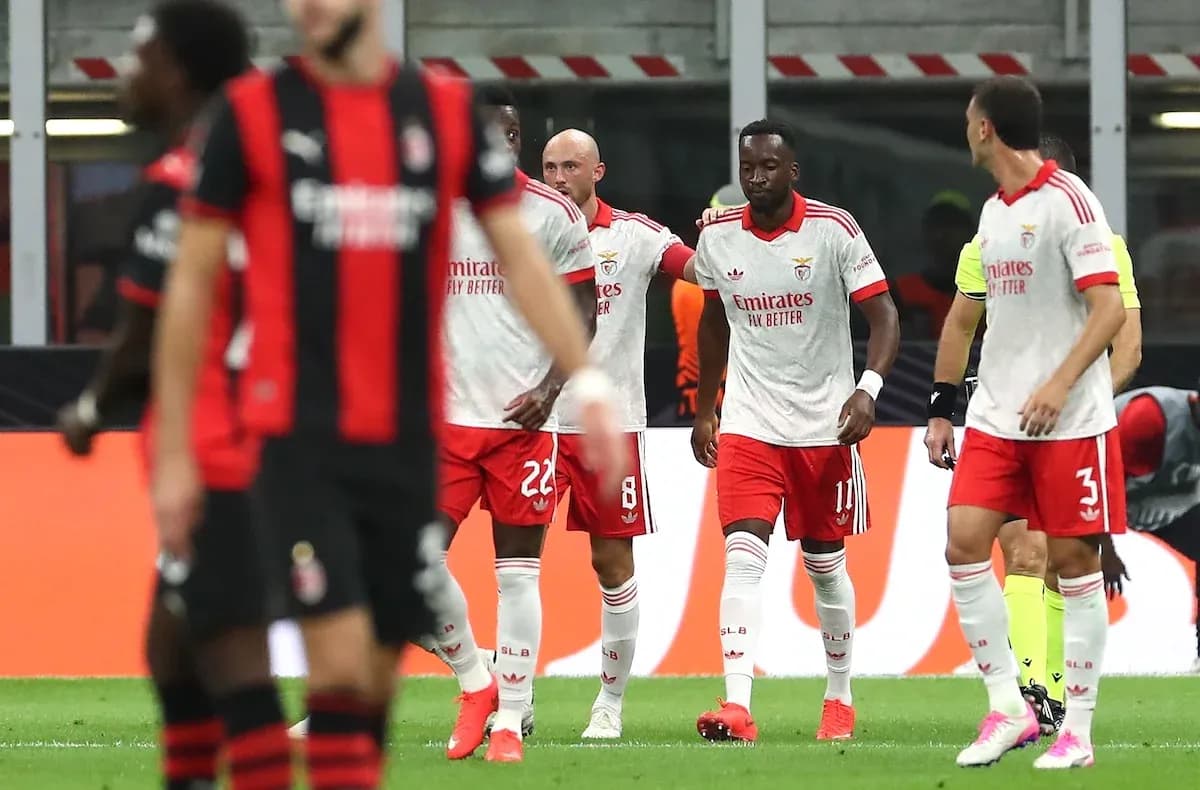
Under the San Siro lights, the opening League Stage night of the UEFA Europa League turned into a stark lesson in European efficiency. AC Milan, in a bold 3-4-2-1 under Ruben Amorim, were outmanoeuvred 2-0 by a Benfica side that arrived with numbers, rhythm and a clear idea of who they are.
Following this result, the standings tell a blunt story. Milan sit 31st in the league table, with 0 points, 0 goals scored and 2 conceded in total across 1 match. At home they have played 1, lost 1, with 0 goals for and 2 against, their goal difference at San Siro already -2. Benfica, by contrast, slot into 7th place with 3 points and a total goal difference of +2, having scored 2 and conceded 0 in their only Europa League outing so far. On their travels, they have played 1, won 1, with 2 goals for and none against.
I. The Big Picture – Two Identities, One Gap
Milan’s seasonal profile in Europe is embryonic but worrying. Overall, they have played 1, lost 1, with 0 wins and 0 draws. Their total goals for is 0, with an overall scoring average of 0.0. Defensively, they have conceded 2 in total, an overall average of 2.0, all of them at home. They have yet to keep a clean sheet and have already failed to score once, again at San Siro. The early pattern is of a side still translating Amorim’s aggressive back-three blueprint into continental reality.
Benfica, by contrast, arrive as a fully formed Europa League machine. Across the season they have played 7 matches in total, winning 5, drawing 1 and losing 1. They have scored 21 goals overall, with a total average of 3.0 per game. At home that rises to a remarkable 4.7, while on their travels they still carry a serious threat at 1.8 goals per away match. Defensively, they have conceded just 6 in total, an overall average of 0.9, with 2 at home and 4 away. They have kept 2 clean sheets overall, one at home and one away, and have yet to fail to score in any Europa League game.
This is a side that marries firepower with control. Their biggest home win so far is a 6-1, while on their travels they have a 3-1 as their standout scoreline. Even their only away defeat, a 2-1, hints at a team that always carries a punch.
II. Tactical Voids – Absences and Discipline
Benfica’s one clear absentee at San Siro was A. Bah, ruled out as a “Missing Fixture” through injury. His absence removed a dynamic wide option from Marco Silva’s arsenal, particularly in the full-back lane, but the Portuguese side absorbed the loss with little visible disruption. The back four of D. Banjaqui, A. Circati, T. Araujo and S. El Karouani kept their structure, screening A. Trubin effectively and limiting Milan’s central combinations.
From a disciplinary standpoint, Milan’s European campaign has begun with a single yellow card, and it arrived early: 100.00% of their bookings so far have come between 0-15 minutes. That speaks to a side that starts with intensity, perhaps even overexcitement, before settling. Benfica’s yellow-card distribution, by contrast, is spread and strategic: 10.00% in the opening 15 minutes, 20.00% between 16-30, another 20.00% from 31-45, 10.00% from 61-75, and a sharp late-game spike with 30.00% between 76-90, plus 10.00% from 91-105. They foul with purpose, especially as matches stretch and game management becomes paramount.
Notably, Benfica’s penalty record is spotless: 4 penalties taken, 4 scored, 0 missed in total. Milan have not yet been awarded a penalty in this Europa League campaign, and thus have no cushion from the spot to offset their lack of open-play cutting edge.
III. Key Matchups – Hunter vs Shield, Engine Room vs Engine Room
In Amorim’s 3-4-2-1, the spine was clear. M. Maignan anchored a back three of F. Terracciano, K. De Winter and S. Pavlovic, tasked with stepping into midfield and covering the wide spaces vacated by the wing-backs. Ahead of them, the double axis of A. Jashari and Y. Musah was supposed to give Milan vertical thrust and control, with S. Chukwueze and D. Bartesaghi providing width and underlaps. Up front, a fluid trio of O. Hutchinson, A. Cisse and G. Ramos offered mobility more than pure penalty-box presence.
The problem was the opponent. Benfica’s “hunter” line in the 4-2-3-1 is as balanced as it is dangerous. J. Duran led the line, but the true menace came from the band of three: D. Lukebakio on the right, G. Sudakov centrally and J. Kaminski on the left. Lukebakio arrives in this campaign with 1 goal from 4 appearances, 3 shots all on target, and an impressive rating of 8.5. He wins 7 of his 10 duels, has attempted 2 dribbles with 1 successful, and draws fouls in advanced areas. Against Milan’s wide centre-backs, his directness and timing were always likely to expose the outer channels of the back three.
On the opposite flank, Kaminski is both scorer and creator. In total, he has 1 goal and 1 assist in 6 Europa League appearances, with 3 key passes from 30 total passes and an accuracy of 76. He is already among the league’s top scorers and top assist providers, and his ability to arrive late into the box or drift inside to link with Sudakov adds a layer of unpredictability that Milan’s midfield struggled to track.
Behind them, the “engine room” duel tilted decisively Benfica’s way. The double pivot of F. Aursnes and J. Palhinha provided the perfect blend of circulation and destruction. Palhinha, in particular, is the enforcer who allows the front four to stay high; his screening of the central lanes blunted Musah’s surges and forced Milan to play around the block rather than through it.
Silva’s bench only deepened that advantage. Rafa Silva, L. Barreiro, V. Pavlidis and C. Echeverri offered varied profiles: a roaming creator, a combative midfielder, a penalty-box presence and a young dribbler. Barreiro, with 2 yellow cards in total and 2 duels won from 3, embodies Benfica’s controlled aggression in midfield. Pavlidis, who has 2 yellow cards and no goals yet but 1 key pass from 4 total passes at 100% accuracy, is the kind of physical forward who can close out games by occupying centre-backs and drawing fouls.
Milan’s bench, on paper, had experience and technical quality: L. Modric to dictate tempo, R. Loftus-Cheek to add vertical power, C. Pulisic and A. Saelemaekers to attack the half-spaces, and F. Tomori to tighten the back line. But the underlying issue was structural rather than individual. The 3-4-2-1 requires relentless wing-back running and precise timing in the press; against Benfica’s well-oiled 4-2-3-1, the distances were too great, the gaps too inviting.
IV. Statistical Prognosis – A Tale of Two Trajectories
From a numbers standpoint, the trajectory of these two squads in this Europa League season could hardly be more different.
- Matches played in total: 1
- Wins: 0
- Draws: 0
- Losses: 1
- Total goals for: 0 (average 0.0 overall)
- Total goals against: 2 (average 2.0 overall)
- Clean sheets: 0 in total
- Failed to score: 1 in total
Benfica’s overall figures:
- Matches played in total: 7
- Wins: 5
- Draws: 1
- Losses: 1
- Total goals for: 21 (average 3.0 overall)
- Total goals against: 6 (average 0.9 overall)
- Clean sheets: 2 in total (1 at home, 1 away)
- Failed to score: 0 in total
The “hunter vs shield” equation is brutally clear: a side averaging 3.0 goals per match against one that has yet to score and concedes 2.0 per game. Even without explicit xG values, the volume and consistency of Benfica’s output, combined with their ability to keep matches under 1 goal conceded on average, point to a team whose underlying process is strong.
For Milan, the tactical challenge is twofold. First, to convert the 3-4-2-1 from a theoretical superiority in numbers between the lines into actual chances for G. Ramos and his support cast. Second, to protect the wide channels of the back three, where runners like Lukebakio and Kaminski thrive. The early yellow-card spike suggests they start with fire; they now need structure to match.
For Benfica, this match at San Siro felt less like a surprise statement and more like confirmation. With Kaminski and Lukebakio already among the competition’s most productive wide players, and with Palhinha and Aursnes locking down the middle, Marco Silva’s side looks built for the long Europa League road. Their clean sheet on their travels here extends a pattern: they can go away, score, and shut the door.
Following this result, Milan’s Europa League story begins with a stumble, Benfica’s with a stride. The numbers say one is searching for an identity, the other is already playing like a contender.