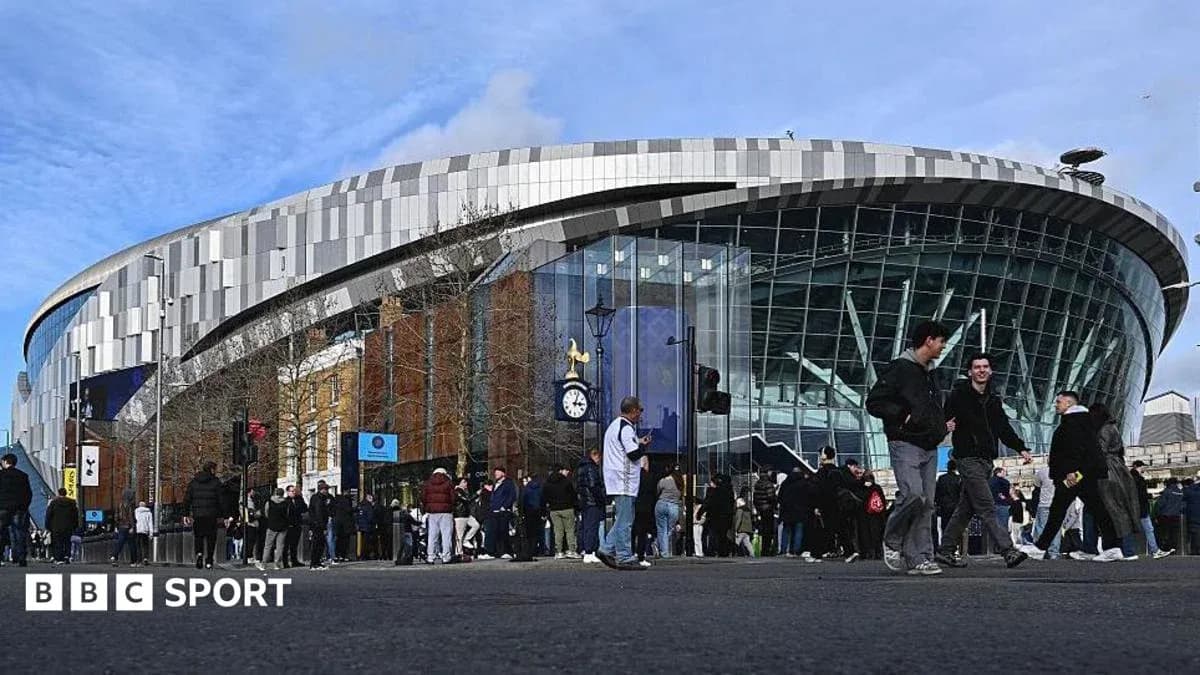
Tottenham's Financial Powerhouse: The Stadium That Prints Money
Tottenham’s season on the pitch was a slog. Another manager gone, key players in the treatment room, and a final day spent peering anxiously over their shoulders as the ninth-richest club in the world clung on to Premier League status. Seventeenth, again. For a club of their resources, that is not a blip. It is a warning.
Yet walk through the turnstiles of their gleaming home and you step into a very different story.
The stadium that prints money
Tottenham’s new ground has turned them into a financial powerhouse, even as the team falters. The numbers are stark.
“Spurs’ matchday income has increased from £45m in 2016-17, the season they left White Hart Lane, to £126m in 2024-25,” says football finance expert Kieran Maguire. “So you've less than doubled the size of the stadium and yet the matchday revenue is up by two and a half times.”
That is the heart of the model. Not just more seats, but a place people want to spend time in.
“What Spurs have done is they've created a welcoming environment,” Maguire explains. “So if people are spending an extra 40 to 50 minutes in the stadium itself they're not just spending time - more importantly they're spending money.”
The club has built a venue, not just a ground. Bars, food outlets, premium areas and experiences keep fans inside the bowl long before kick-off and long after the final whistle. The tills keep ringing.
And it doesn’t stop with football.
A 62,000-seat events machine
Spurs can stage up to 30 non-football events a year at full capacity. That is a staggering amount of inventory for a modern arena in a major city.
The stadium has already hosted NFL games, major concerts and boxing world title fights, including Anthony Joshua’s heavyweight clash with Oleksandr Usyk in 2021. Since 2023 it has also been the setting for rugby union’s Saracens against Harlequins in the London derby.
Each event means more hospitality, more food and drink, more sponsorship activation. More money.
The impact shows up clearly on the balance sheet. Commercial revenue has rocketed from £73m in 2016-17 to £277m in 2024-25. That kind of jump changes what a club can do in the transfer market.
It is why Spurs could go out last month and land Sandro Tonali for a club-record fee that could hit £100m. A struggling side, but a stadium allowing them to shop at the top end of the market.
And the timing could hardly be better.
New rules, new game
This summer, the Premier League is ripping up its profitability and sustainability rules and replacing them with a new financial framework built around two pillars: squad-cost ratio (SCR) and sustainability and systemic resilience (SSR).
Strip away the jargon and SCR is simple enough. It caps how much of a club’s revenue can be spent on the playing squad. Wages, transfer amortisation – the accounting practice of spreading a transfer fee across the length of a contract – and agent fees all count towards the limit.
One thing does not.
“Crucially though, stadium infrastructure costs are not included in the SCR calculation,” says Maguire. “In the case of Spurs, their infrastructure costs are around £70m a year - but those are excluded. Any money that you invest in stadiums is completely ring-fenced and excluded from your ability to invest in players.”
So Tottenham carry a large annual bill for their new home, but that cost sits outside the key metric that will govern squad spending. The club also locked in borrowing at “spectacularly cheap interest rates,” as Maguire puts it, softening the blow of the initial outlay.
The conclusion is obvious. From a financial point of view, the benefits of their expensive new stadium dwarf the drawbacks.
“In order to be competitive, you need to have a significant increase in matchday income,” Maguire says. “You could only do that from either increasing prices, which isn't going to go down well, or increasing the size of the stadium with a greater proportion of the tickets going to the non-season ticket fanbase.”
Tottenham chose the latter. Others are now weighing the same decision.
The Premier League’s stadium dilemma
Everton and West Ham have already moved into new homes, chasing the same long-term financial upside. The transition has not always been smooth for supporters, who have had to trade history and routine for glass, steel and naming rights.
Other clubs stand at the crossroads. Renovate or relocate?
Renovation offers a cheaper route on paper, but there is a catch: where do you play if your ground is a building site? A season or more away from home can be a competitive and commercial handicap.
Moving to a new stadium presents the opposite problem. The upfront cost is huge, and fans fear leaving behind the identity and emotion wrapped up in their old home. The numbers might add up. The hearts do not always follow.
At Manchester United, Sir Jim Ratcliffe has made his intention clear. He wants a new stadium to be the defining symbol of his era at the club.
The vision is bold: a 100,000-capacity arena with extensive corporate areas. It would dwarf Old Trafford’s current matchday earnings and open up the kind of premium inventory that drives modern football finances. Bigger crowds, more hospitality, more commercial deals – and, in theory, a stronger senior squad.
But the grand design carries its own complications.
United’s big build question
The initial plans unveiled in March 2025 featured a huge canopy, an architectural statement as much as a practical feature. That comes at a price.
The canopy and everything beneath it would sit within United’s footprint, meaning the club shoulders the cost and responsibility for maintaining it. The question hangs in the air: will the visual impact justify the long-term expense?
Club officials argue that large parts of the structure could be built off site and then transported in, a method that should reduce costs compared to doing everything in and around Old Trafford itself.
The proposed location, just down the road from the current ground, neatly solves another headache. United would not have to find a temporary home while construction is under way. They could simply switch from old to new once the stadium is ready.
The alternatives are grim. None of Manchester City, Liverpool or Everton’s stadiums are ideal from a security standpoint. All have smaller capacities than Old Trafford and would be expensive to hire, even if the clubs involved were willing.
United’s plan avoids that mess. They stay in Old Trafford until the new arena is complete, then walk down the road into a new era.
Not every club has that luxury.
Newcastle’s fork in the road
Newcastle United have already felt the sharp edge of the new financial landscape. This summer, they have effectively been forced to sell some of their best players simply to stay within the rules.
For them, the argument for a new, purpose-built stadium is not just attractive. It is compelling.
The gap is brutal. “For the 2024-25 season Newcastle's matchday income was £52m. Manchester United's was £160m, Arsenal's £154m, Spurs' was £126m,” says Maguire.
“If you're £100m behind your competitors, the only way to address that is either to be super smart or to charge more money for the product.”
Newcastle’s problem is that St James’ Park, magnificent and atmospheric as it is, was not designed with the corporate age in mind.
“How can Newcastle increase the yield per fan and still be loyal to the Gallowgate hardcore?” Maguire asks. “You need to be able to offer a different product and St James' Park wasn't built for a corporate audience.”
The business case points one way. The emotional pull drags the other.
Newcastle supporter Charlotte Robson captures that tension.
“I think we can host gigs at St James' Park but probably not on the scale of Spurs or West Ham's London Stadium,” she says. “I don't think it would be stupid to move from the ground but I think there is so much identity for Newcastle fans who are attached to St James' Park that it would break a lot of hearts to move the ground in any significant way.”
That is the battle every traditional club faces: maximise revenue or protect identity. Modern football rarely lets you have both.
London advantage, national question
Any club eyeing Tottenham’s model must also recognise what makes it unique.
“Spurs have got the advantage that they're in London - a huge tourist trap,” Maguire points out. “They are also a club with a global fanbase, so it works there.”
The capital brings a constant flow of visitors, a deep corporate market and a global brand appeal that can fill premium seats and sell out concerts with ease.
“Is that going to work elsewhere in the country where you've got a more localised fanbase and where there is resistance to putting up prices for tickets? Then it becomes more challenging,” Maguire warns.
Construction costs have surged. Land is expensive. Labour and materials are not getting cheaper. Yet clubs, owners and investors still circle the same idea: build bigger, build better, and let the stadium pay for the squad.
There is, undeniably, still an appetite for it.
The question now is who dares to follow Spurs down this path – and who decides that the soul of their old home is worth more than the millions a new one might bring.