Torino's Tactical Triumph Over Sassuolo in Serie A
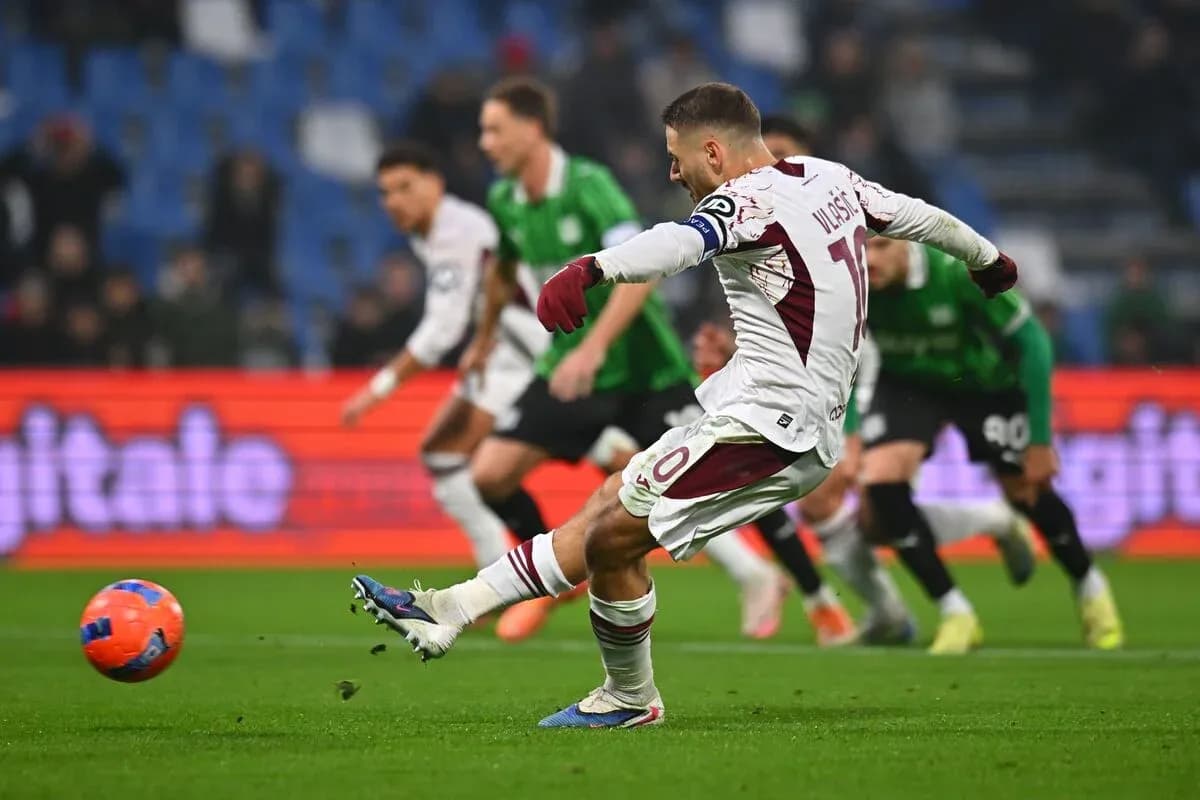
Torino’s 2–1 comeback over Sassuolo at Stadio Olimpico Grande Torino in Serie A Round 36 unfolded as a game of structural control versus vertical threat, ultimately decided by Torino’s superior in-box volume and more incisive wing use within their 3-4-2-1.
Disciplinary Ledger:
- 38' Luca Lipani (Sassuolo) — Foul
- 51' Luca Marianucci (Torino) — Foul
- 63' Matteo Prati (Torino) — Foul
- 86' Kristian Thorstvedt (Sassuolo) — Foul
- 89' Niels Nkounkou (Torino) — Foul
- 90+3' Gvidas Gineitis (Torino) — Foul
Torino: 4 yellow cards, Sassuolo: 2, Total: 6.
Sassuolo struck first on 51' through K. Thorstvedt, assisted by L. Lipani, capitalising immediately after Marianucci’s booking and briefly tilting the tactical narrative towards Grosso’s 4-3-3. Torino’s response was structural and personnel-based rather than emotional: a double substitution at 59' saw D. Zapata (IN) come on for A. Njie (OUT) and M. Pedersen (IN) come on for V. Lazaro (OUT), signalling a clearer target-man reference and more aggressive wing occupation.
The match then pivoted rapidly. At 63', Matteo Prati’s yellow for Foul coincided with Sassuolo’s own reshaping: C. Volpato (OUT) was replaced by D. Berardi (IN), and L. Lipani (OUT) by I. Kone (IN), moving Sassuolo towards a more individually creative, less structurally disciplined midfield. Three minutes later, Torino levelled: on 66', G. Simeone scored, assisted by E. Ebosse, finishing a move that highlighted Torino’s use of the wide centre-back stepping into advanced lanes. Immediately after, Torino changed the midfield pivot again, with M. Prati (OUT) replaced by E. Ilkhan (IN) at 67', adding fresh legs to sustain the press and protect transitions.
The decisive goal came on 70': M. Pedersen scored, assisted by D. Zapata, directly validating Colucci’s 59' double change. Sassuolo’s response was a flurry of substitutions aimed at refreshing both flanks and midfield stability: J. Doig (OUT) for U. Garcia (IN) at 75', A. Pinamonti (OUT) for M. Nzola (IN) at 76', and N. Matic (OUT) for D. Bakola (IN) at 84'. Yet the late rhythm was defined more by discipline than chance creation. Thorstvedt was booked at 86' (Foul), just as Torino sought to secure the result by removing their goalscorer and a wingback: G. Simeone (OUT) for S. Kulenovic (IN) and R. Obrador (OUT) for N. Nkounkou (IN), both at 86'. Torino’s late-game aggression without the ball produced two more bookings: Niels Nkounkou at 89' and Gvidas Gineitis at 90+3', both for Foul, but also underscored a shift towards a low block with high-contact defending.
Tactical Analysis
Tactically, Torino’s 3-4-2-1 functioned as a territorial machine. With 48% possession to Sassuolo’s 52%, they did not dominate the ball but controlled where the game was played. Torino generated 18 total shots (13 inside the box) against Sassuolo’s 14 (11 inside), a volume advantage consistent with their 2.82 xG versus Sassuolo’s 2.1. The three centre-backs, anchored by S. Coco and E. Ebosse, allowed wingbacks V. Lazaro and R. Obrador (later M. Pedersen and N. Nkounkou) to push high and wide, pinning Sassuolo’s full-backs and forcing the 4-3-3 into longer build-up sequences.
In possession, the double “2” line of N. Vlasic and A. Njie behind G. Simeone gave Torino vertical lanes between Sassuolo’s midfield and defence. Early on, Sassuolo’s 4-3-3, with L. Lipani and N. Matic flanking Thorstvedt, coped by compacting centrally and forcing Torino to cross. But the shot profile — 4 shots on target from 18 attempts for Torino, versus 7 from 14 for Sassuolo — indicates Torino’s attacks were more repetitive and territorial, while Sassuolo’s were more selective and direct.
The substitutions were decisive in rebalancing the forward line. Zapata’s introduction created a focal point for direct play, enabling Simeone to attack second balls and half-spaces rather than operate as a pure reference. That dynamic is precisely reflected in the goals: Ebosse assisting Simeone from a wide-centre-back lane, then Zapata assisting Pedersen, a wingback-turned-wide-midfielder, for the winner. Colucci effectively converted the original 3-4-2-1 into a 3-4-1-2/3-5-2 hybrid, with more penalty-box presence and stronger far-post occupation.
For Sassuolo, Grosso’s 4-3-3 was built around structured progression and the wide threat of A. Lauriente and C. Volpato (later D. Berardi). Their 52% possession, 480 total passes, and 87% passing accuracy (versus Torino’s 439 passes at 85%) show a technically secure side. Yet the negative goals prevented figure (-0.25) for A. Muric, matched by Torino’s A. Paleari at -0.25, suggests both goalkeepers slightly underperformed relative to the quality of shots faced. Muric made 2 saves to Paleari’s 5, aligning with Torino’s heavier defensive workload once they led and Sassuolo’s late push.
Defensively, Torino’s 13 fouls and 4 yellow cards indicate a high-contact, risk-accepting approach, especially in the closing stages, whereas Sassuolo committed 9 fouls with 2 bookings. Torino’s Defensive Index in this match is characterised by volume defending and penalty-box protection rather than low foul counts; they accepted disciplinary risk to defend the lead.
Statistical Summary
Statistically, the verdict is clear: Torino’s higher xG (2.82 to 2.1), greater shot volume, and more corners (7 to 5) justify the 2–1 scoreline, even if Sassuolo’s passing metrics and possession suggest a more aesthetically controlled performance. In terms of Overall Form within this single-game snapshot, Torino showed resilience and tactical adaptability — turning a 0–1 deficit into a 2–1 win through targeted substitutions and structural tweaks — while Sassuolo’s inability to convert technical superiority into territorial dominance ultimately defined the outcome.