Top 10 World Cup Legends: Messi, Pelé, Mbappé and More
The World Cup stands as the ultimate stage in football, where stars are born, dreams vanish, and legends become immortal. Sometimes, a single moment—be it a goal, a pass, or a save—can transform a player into a national icon forever engraved in history.
Who truly ranks among the finest to have graced multiple World Cups? Below, GOAL ranks ten players whose impact on the tournament transcends generations. The list inevitably excludes many greats like Garrincha, Romario, Maldini, and Johan Cruyff, making the selection all the more challenging.
10. Miroslav Klose (Germany)
Klose might not be hailed as one of the greatest at club level, but on the international stage, he was exceptional. With 71 goals in 137 games for Germany, 16 came during World Cups, allowing him to surpass Ronaldo as the tournament’s top scorer by 2014. His consistency was unmatched, playing in four straight World Cup semi-finals and finishing his career with a winner’s medal in 2014 against Argentina. Although Lionel Messi has now equaled his record, Klose openly admires the Argentine star. Known for his aerial prowess—he scored five headed goals in the 2002 World Cup alone—Klose was a clinical finisher who never let Germany lose when he found the net.
9. Zinedine Zidane (France)
Zidane combined elegance with volatility, embodying the flawed genius. His 1998 World Cup debut nearly ended early after a red card, yet he returned to guide France to a historic victory over Brazil in the final, scoring twice. Despite early exits in 2002, Zidane returned from retirement for the 2006 tournament, dazzling fans before a notorious headbutt on Marco Materazzi in the final led to his sending off. His vision and skill earned him the Golden Ball that year, a testament to his brilliance despite his temper.
8. Gerd Muller (Germany)
Muller is widely regarded as the ultimate goal-poacher. Quick off the mark and strong in the air, he terrorized defenses with uncanny instincts inside the penalty area. Scoring 69 goals in 62 appearances for Germany, he netted 14 goals across just two World Cups. His winning goal in the 1974 final cemented his legacy. While he claimed to have scored better goals, none meant more than the one that made Germany world champions.
7. Cafu (Brazil)
Nicknamed "Il Pendolino" in Italy for his relentless runs up and down the right flank, Cafu was a pioneer of the attacking full-back role. Known for incredible stamina—Sir Alex Ferguson joked he must have had two hearts—he played in four World Cups and started three finals. He helped Brazil secure titles in 1994 and captained the victorious 2002 team, lifting the trophy in an unforgettable image symbolizing his career’s pinnacle.
6. Franz Beckenbauer (Germany)
Called "Der Kaiser," Beckenbauer transformed the sweeper role and shone across three World Cups during a time of football evolution. A versatile player admired for both style and substance, he helped West Germany reach the 1966 final and famously played with a dislocated arm in the epic 1970 semi-final defeat. Finally, he led his country to victory in 1974 against the Netherlands, earning praise as the perfect footballer.
5. Kylian Mbappe (France)
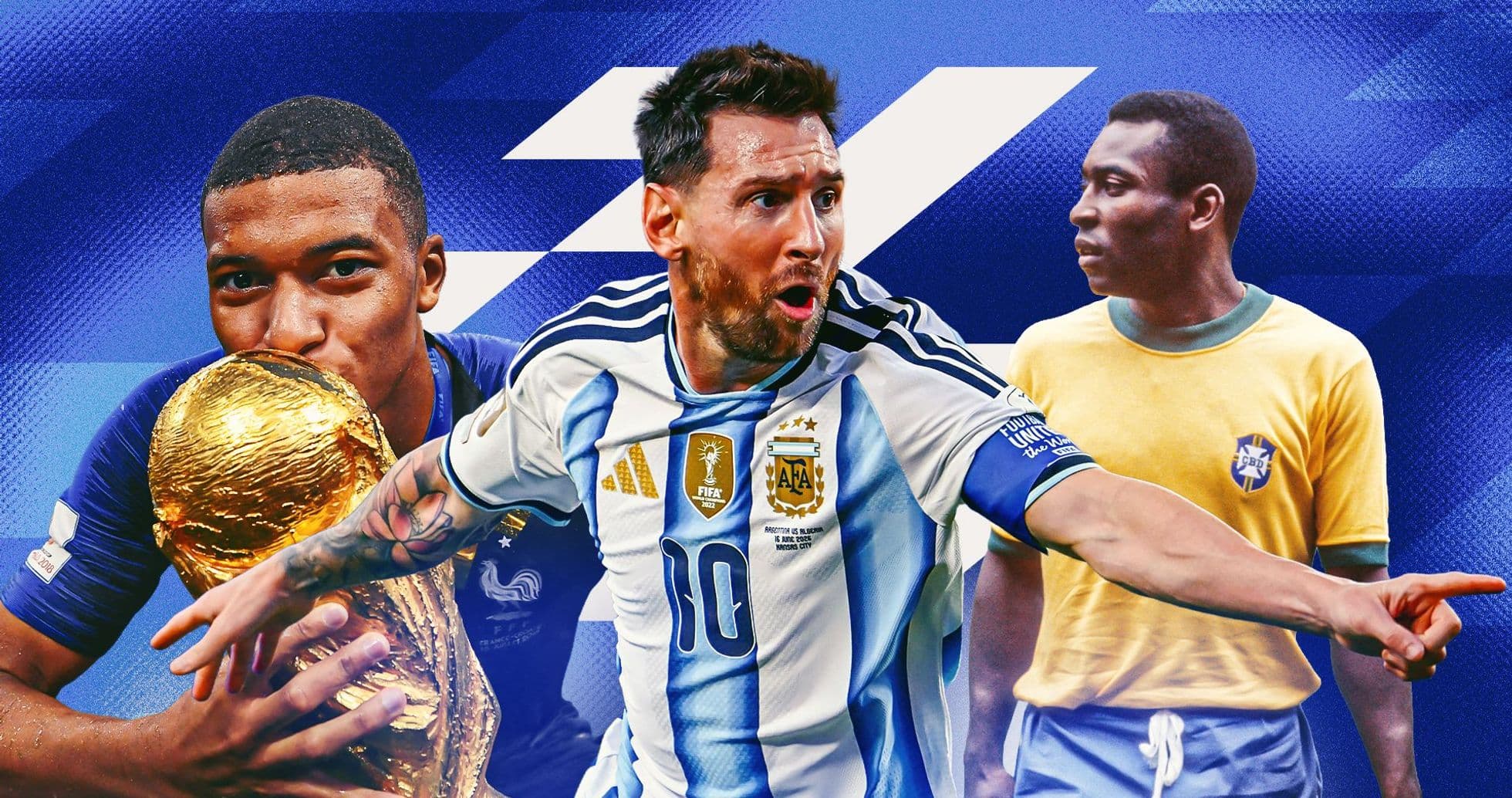
At only 27, Mbappe’s World Cup status is undeniable. Debuting in 2018, he won Young Player of the Tournament and scored in the final, becoming the first teenager since Pelé to do so. Four years later, Mbappe scored a rare hat-trick in the final, securing the Golden Boot despite France falling short. In 2026, he became the tournament's all-time leading scorer with 22 goals in 22 matches and captured a second Golden Boot, feats no one else had achieved before.
4. Ronaldo (Brazil)
The 1998 final remains a mystery due to Ronaldo’s pre-match convulsive fit, yet he was the most feared striker then. Nicknamed "O Fenômeno," his blend of speed, power, and skill was unmatched. Although overshadowed in 1998, he shone in 2002, scoring eight goals including two in the final. After overcoming injuries and setbacks, his fifth World Cup win crowned a remarkable comeback.
3. Diego Maradona (Argentina)
Maradona’s 1986 World Cup run was unparalleled. At his physical peak and fully focused, he led Argentina to their second title, contributing directly to ten of their 14 goals. His quarter-final performance against England featured the infamous "Hand of God" goal and a stunning solo effort. Despite controversies and a failed doping test in 1994, his dominance in Mexico 1986 remains legendary.
2. Lionel Messi (Argentina)
Messi’s sustained excellence over 15 years faced scrutiny without a World Cup trophy until 2022. After a near miss in 2014, he delivered a masterful campaign in Qatar, scoring in every knockout round and winning his second Golden Ball. Defying age, he led Argentina to victory, then surprisingly returned for a sixth World Cup in 2026, guiding his team to another final with eight goals and four assists. For many, this solidifies his claim as the greatest ever.
1. Pelé (Brazil)
Pelé stands alone as the King of the World Cup. The only player to win three tournaments, his role in 1962 was limited by injury, but he starred brilliantly in 1958 and 1970. At just 17 in Sweden, he scored crucial goals en route to Brazil’s first title. In Mexico ’70, he was the centerpiece of arguably the finest international team ever, scoring four goals including one in the final. Even opponents respected his greatness, with France’s Fontaine saying Pelé made him consider retiring.