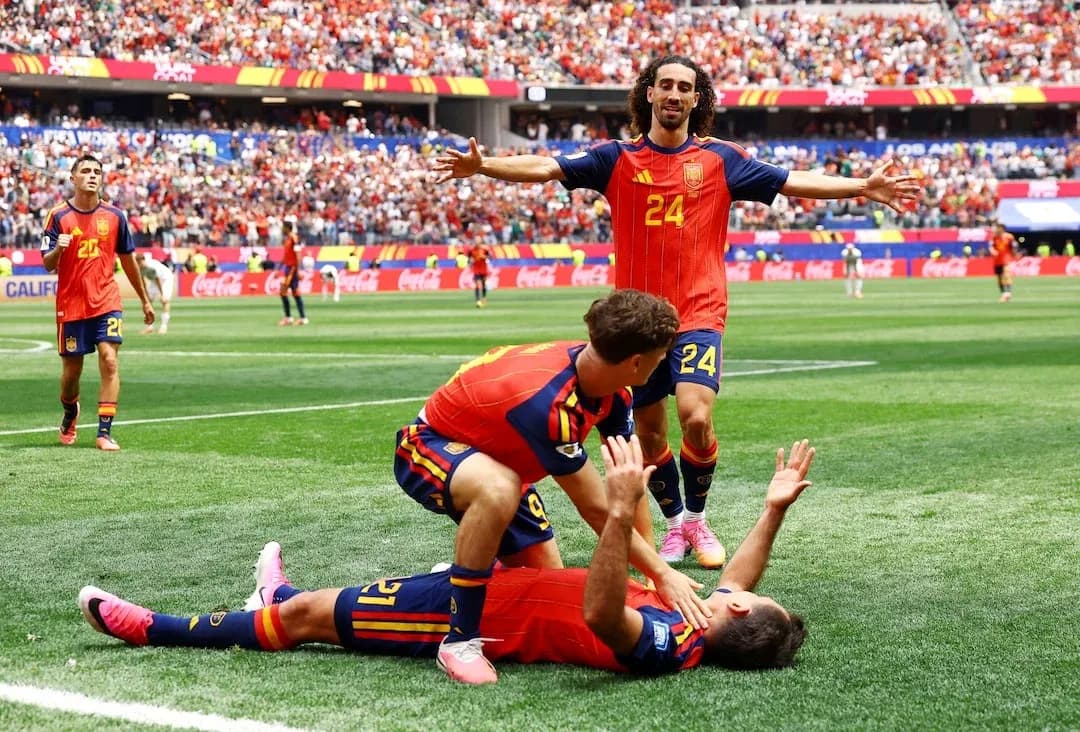
Spain Dominates Austria 3-0 in World Cup Knockout Stage
Spain 3-0 Austria at SoFi Stadium sends Luis de la Fuente’s side into the World Cup Round of 16 with authority, extending their unbeaten run and underlining their status as one of the tournament’s form teams. Spain convert a dominant territorial and chance advantage into a clear margin, while Austria’s campaign ends with a comprehensive defeat that exposes their limits against elite possession sides.
Match Report
The match opened with Spain quickly imposing their rhythm, circulating the ball with patience and pinning Austria deep. The breakthrough arrived on 36': Spain goal — Mikel Oyarzabal (assisted by Marc Cucurella). The forward timed his movement well to meet Cucurella’s delivery, rewarding Spain’s sustained pressure and giving them a 1-0 lead at the interval.
At half-time, Austria reacted with a double change to try to alter the midfield dynamics. On 46', Carney Chukwuemeka replaced Nicolas Seiwald (Austria), adding more ball-carrying from deep. Simultaneously on 46', Florian Grillitsch replaced Xaver Schlager (Austria), providing a more composed passer at the base of midfield as Ralf Rangnick sought to gain a foothold in possession.
Austria’s adjustments brought a brief spell of higher pressing, but Spain continued to find spaces between the lines. On 60', Rangnick made a further attacking gamble: Marko Arnautovic replaced Michael Gregoritsch (Austria), changing the profile of the centre-forward to one more comfortable linking play; at the same minute, Saša Kalajdžić replaced Romano Schmid (Austria), giving Austria additional aerial presence and a more direct option.
Spain, however, remained in control and doubled their advantage on 66': Spain goal — Pedro Porro (assisted by Alex Baena). The right-back arrived from deep to finish after Baena’s intelligent pass, a move that typified Spain’s ability to overload wide areas and exploit Austria’s stretched back line, taking the score to 2-0.
With a two-goal cushion, De la Fuente turned to his bench to manage minutes and maintain intensity. On 71', Ferran Torres replaced Alex Baena (Spain), adding fresh running on the flank after Baena’s creative shift. In the same minute, Mikel Merino replaced Dani Olmo (Spain), reinforcing central control and providing extra physicality in midfield for the closing stages.
Austria’s frustration began to show as they struggled to create clear chances. On 83', Stefan Posch (Austria) — yellow card (Holding) — was booked for a cynical foul, emblematic of Austria’s difficulties in stopping Spain’s rotations down the flanks.
Spain continued to refresh their attacking line. On 85', Gavi replaced Lamine Yamal (Spain), introducing fresh energy and pressing from the right side. Austria also adjusted their back line on 85', as Alexander Prass replaced Stefan Posch (Austria), a like-for-like change at full-back after the defender’s booking.
Spain then added a late flourish on 89': Spain goal — Mikel Oyarzabal (assisted by Marc Cucurella). Once again the combination between the left-back and the forward undid Austria, with Oyarzabal finishing clinically to make it 3-0 and complete his brace.
In stoppage time, Spain made two final substitutions to see out the match. On 90+3', Fabián Ruiz replaced Pedri (Spain), adding fresh legs in midfield. Also on 90+3', Marc Pubill replaced Aymeric Laporte (Spain), a defensive rotation to close out a contest that had long been decided.
Fixture Statistics & Tactical Audit
- xG: Spain 2.84 vs 0.32 Austria
- Possession: Spain 65% vs 35% Austria
- Shots on Target: Spain 10 vs 0 Austria
- Goalkeeper Saves: Spain 0 vs 6 Austria
- Blocked Shots: Spain 7 vs 1 Austria
The scoreline was fully aligned with the underlying numbers: Spain’s attacking performance was clinical (3 goals from 2.84 xG and 10 shots on target), while Austria failed to register a single effort on target despite five attempts. Spain’s 65% possession and 629 completed passes at 91% accuracy allowed them to suffocate Austria, repeatedly working the ball into the box (15 shots inside the area) and forcing Alexander Schlager into six saves. Austria, by contrast, were limited to sporadic breaks, produced just 0.32 xG and no corners, highlighting how rarely they sustained pressure in the final third. The blocked shots tally (7-1 in Spain’s favour) further underlines how often Austria were defending deep and reacting to waves of attacks rather than dictating play.
Standings Update & Seasonal Impact
Spain, who entered the Round of 32 having topped Group H with 7 points, now move to 10 points in the overall tournament record, with their goals for rising from 5 to 8 and goals against remaining at 0, improving their goal difference from +5 to +8. The clean sheet and three-goal margin reinforce their status as one of the most balanced sides left in the World Cup, combining defensive solidity with sustained attacking output as they advance to the Round of 16.
Austria, second in Group J with 4 points and a neutral goal difference before this tie, exit the competition with 4 points overall. Their goals for total stays at 6, but goals against increase from 6 to 9, shifting their goal difference from 0 to -3. The manner of defeat — failing to test the opposition goalkeeper and conceding territorial control — exposes the gap they still need to bridge to consistently compete with top-tier nations in the knockout rounds.
Lineups & Personnel
Spain Starting XI
- GK: Unai Simón
- DF: Pedro Porro, Pau Cubarsí, Aymeric Laporte, Marc Cucurella
- MF: Rodri, Pedri, Lamine Yamal, Dani Olmo, Alex Baena
- FW: Mikel Oyarzabal
Austria Starting XI
- GK: Alexander Schlager
- DF: Stefan Posch, Kevin Danso, David Alaba, Konrad Laimer
- MF: Nicolas Seiwald, Xaver Schlager, Romano Schmid, Paul Wanner, Marcel Sabitzer
- FW: Michael Gregoritsch
Post-Match Verdict
Spain delivered a dominant performance (65% possession, 23 total shots, 2.84 xG) built on structured pressing, intelligent use of width and relentless circulation. Their left flank, in particular, was decisive: Marc Cucurella’s two assists to Mikel Oyarzabal showcased a clear tactical pattern of overloading the channel and exploiting Austria’s full-back. Pedro Porro’s goal from the opposite side underlined how both full-backs were empowered to attack, supported by Rodri’s screening in midfield.
Defensively, Spain were controlled and compact, restricting Austria to just five shots and 0.32 xG, with Unai Simón not required to make a single save. The high line and coordinated pressing denied Austria the chance to play through midfield, forcing long balls that Laporte and Cubarsí dealt with comfortably.
Austria’s display, by contrast, was vulnerable (0 shots on target, 0.32 xG, 0 corners) in both phases. Their initial 4-2-3-1 struggled to get pressure on the ball, and even after the half-time reshuffle, they rarely disrupted Spain’s build-up. Offensively, they lacked connections between midfield and attack, with Gregoritsch and later Arnautovic and Kalajdžić feeding on limited and low-quality service. The high foul count (15) and Posch’s yellow card for holding were symptomatic of a side often a step late to Spain’s rotations.
Overall, this was a clinical knockout win for Spain (3 goals from 10 shots on target) that validates De la Fuente’s possession-based blueprint, while Austria’s exit highlights the tactical and technical demands of facing a top-tier opponent at this stage of the World Cup.