Southampton vs Middlesbrough: Play-Off Tie in Limbo After Controversial Win
The final whistle went, but nobody really knew if anything had been settled.
Southampton’s players took the applause, Middlesbrough’s stared hollow-eyed back at their travelling support, and yet the question hung in the air at St Mary’s: is this actually the end of this play-off tie?
On the grass, at least, it felt definitive. Saints had dragged themselves to Wembley with a 2-1 win on the night and 2-1 on aggregate, Shea Charles deciding it with a late, skidding cross-shot in extra-time that skipped through a thicket of legs and inside the far post. In any other year, that would be the story. A dramatic home comeback, a place booked against Hull City in the Championship play-off final on 23 May, and the celebrations to match.
Not this year. Not after Rockliffe Park.
The entire tie now sits in the shadow of last Thursday’s events at Middlesbrough’s training ground, where Southampton were charged by the EFL with spying – an allegation the club has not denied. The football has been played. The disciplinary process has barely begun.
This is the 40th season of the play-offs, a competition built on jeopardy and late twists, but it has never seen anything like this. For the first time, a semi-final may yet be decided not by a decisive tackle or a nerveless finish, but by an independent commission poring over evidence in a hearing room.
Saints have asked for more time as they carry out an internal review into what happened. Ordinarily, they would have 14 days to respond to the charges. The EFL, though, has already pushed for “a hearing at the earliest opportunity”, urging the independent disciplinary commission to move quickly. Late on Tuesday, a spokesperson stressed that the commission is following due legal process and would not commit to any timetable.
That leaves the whole tie in limbo. The range of potential sanctions is wide: a fine, a points deduction, even expulsion from the play-offs. Each outcome carries a different kind of chaos.
You could feel that uncertainty in the way the night ended. There was no surge of supporters onto the pitch, no long, lingering party in the stands. The noise at full-time was loud, but not wild. It was as if everyone inside St Mary’s understood that the final word might be delivered somewhere else, by someone else.
Southampton should be throwing everything into preparing for what is routinely called the richest game in English football, 10 days out from Wembley. Instead, a nagging doubt sits over every planning meeting and every training session. Are they plotting for Hull, or waiting for a verdict that could rip the final away from them?
Middlesbrough, meanwhile, fly back to Teesside on Wednesday beaten but not entirely beaten. On the pitch, their season is over. On paper, it might not be. Players who would normally be scattering to summer holidays must now wait, bags half-packed, to discover whether the tie really is finished.
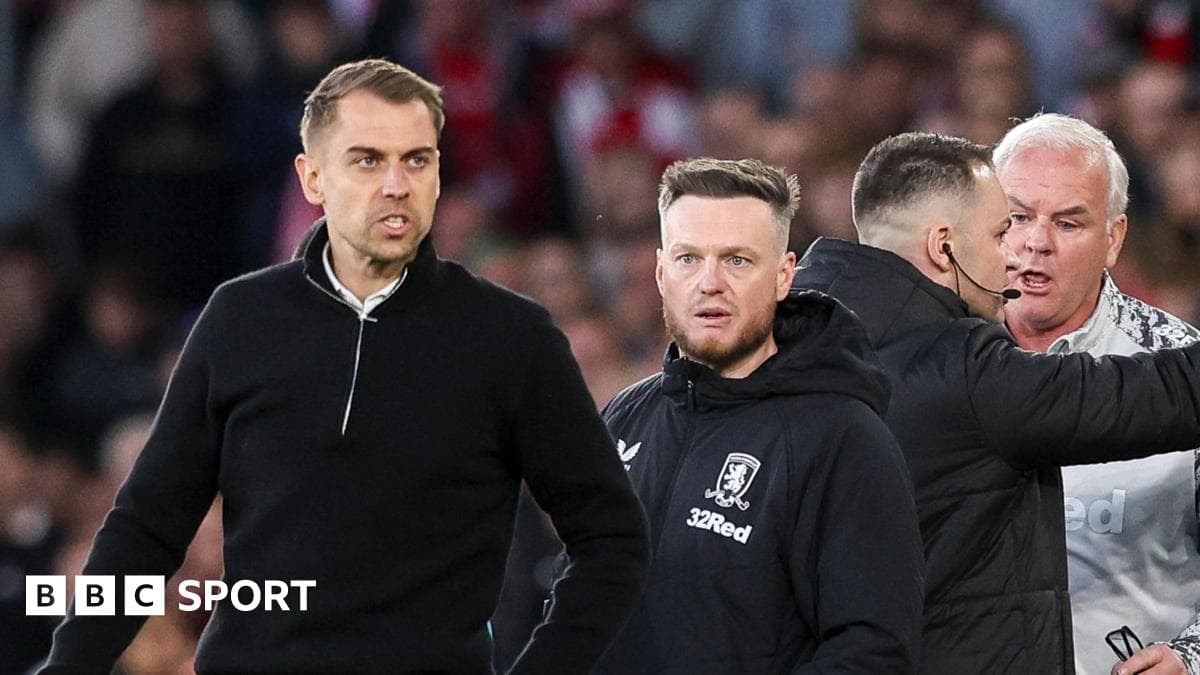
Their head coach Kim Hellberg has never tried to hide what he thinks. After Saturday’s goalless first leg, he spoke bluntly about the alleged spying, describing “someone who makes decisions to go and try to cheat”. After the second leg, with his team knocked out in extra-time, the emotion in his voice sharpened.
This is his first job in England, a Swede who has carried the dream of working in the Premier League for 15 years. He talked about the hours he poured into this semi-final, nights spent watching Southampton’s games on video instead of being at home with his young family.
“If we hadn’t caught that man that they sent up five hours to drive, you would sit there and say well done in the tactical aspect of the game and I would go home and feel like I’ve failed,” he said. “When that is taken away from you – we’re not going to watch every game, we’re going to send someone instead and film the sessions and hope they don’t get caught – it breaks my heart in terms of all the things I believe in.”
On the pitch, his team had done plenty right. Riley McGree’s early goal gave Boro the lead on the night and in the tie, a reward for a sharp, confident first-half display. They pressed, they passed, they quietened St Mary’s. For a while, it looked like the perfect away performance.
Then came the punch they could not afford to concede. Right at the end of the first half, Ross Stewart stole in to level, and the whole balance of the evening shifted. From that moment, Southampton grew. Middlesbrough’s legs began to fade.
Saints took control of territory and tempo, pushing Boro deeper, asking them to defend longer and longer spells. Yet they still needed a break of the ball, a deflection, a half-mishit cross-shot from Charles in extra-time to finally break them. It was the kind of goal that decides seasons, the kind that usually sends one club into delirium and the other into a long, quiet summer.
For Middlesbrough, the pain runs deeper than one night. They had already endured a brutal run at the worst possible time, slipping out of the automatic promotion race on the final day after a season that had promised so much more. To come through that and then fall in extra-time, with a disciplinary storm swirling in the background, leaves a particular kind of scar.
Hellberg knows the scale of the task he took on. “When I took the Middlesbrough job, I know there are clubs with bigger resources, parachute teams that can spend more money, that are teams with bigger squads than us,” he said. “What you have as a coach is the tactical element of the game and where we can beat the opponent. You have to find a way of getting an advantage. That’s what you always try to do as we can be better in that element. And when that is taken away from you…”
He did not need to finish the sentence. Everyone listening understood what he meant.
So the play-off semi-final sits in a strange space: decided and undecided, complete and incomplete. Southampton have their win, their moment, their match-winner. Middlesbrough have their grievances, their exhaustion, their sense of something precious being compromised.
The next move belongs not to a manager on a touchline or a player under a dropping ball, but to an independent panel behind closed doors. In the 40th year of the play-offs, the most important result may yet come from a room with no goals, no crowd and no clock.