Slovan Bratislava vs Celje: Tactical Stalemate in Champions League Play-Offs
Slovan Bratislava and Celje produced a finely balanced Champions League Play-offs first leg at Tehelne Pole Stadion, a match defined more by structure and control than chaos. Both sides finished with 50% possession, and the 1-1 scoreline reflected a tactical stalemate where each coach imposed a clear plan and then adjusted selectively rather than radically. Yaya Toure’s Slovan leaned into a 4-3-3 that sought territorial dominance and width, while Vitor Campelos’ Celje used a 4-2-3-1 that morphed into a compact mid-block, prioritising vertical efficiency over volume of attacks.
Slovan’s 4-3-3 was built on steady circulation and territorial pressure. With 465 passes and 82% accuracy (380 accurate), they aimed to progress methodically, using the back four as a stable platform. Full-backs C. Blackman and S. Cruz held relatively conservative starting positions, helping to keep rest defence intact against Celje’s transitions. In front of them, P. Pokorny and A. Mustafic, supported by C. Martinez between the lines, formed a three-man midfield tasked with controlling central zones and feeding the front line.
The structure generated a steady flow of attempts: 14 total shots, including 9 from inside the box. That shot map underlines Slovan’s ability to reach advanced zones, but the detail that 6 of those efforts were blocked shows how often Celje’s back line and double pivot were in position to contest shooting lanes. Only 2 of Slovan’s 14 attempts hit the target, a sign that while the positional play was sound, the final action lacked precision or was smothered by Celje’s compactness.
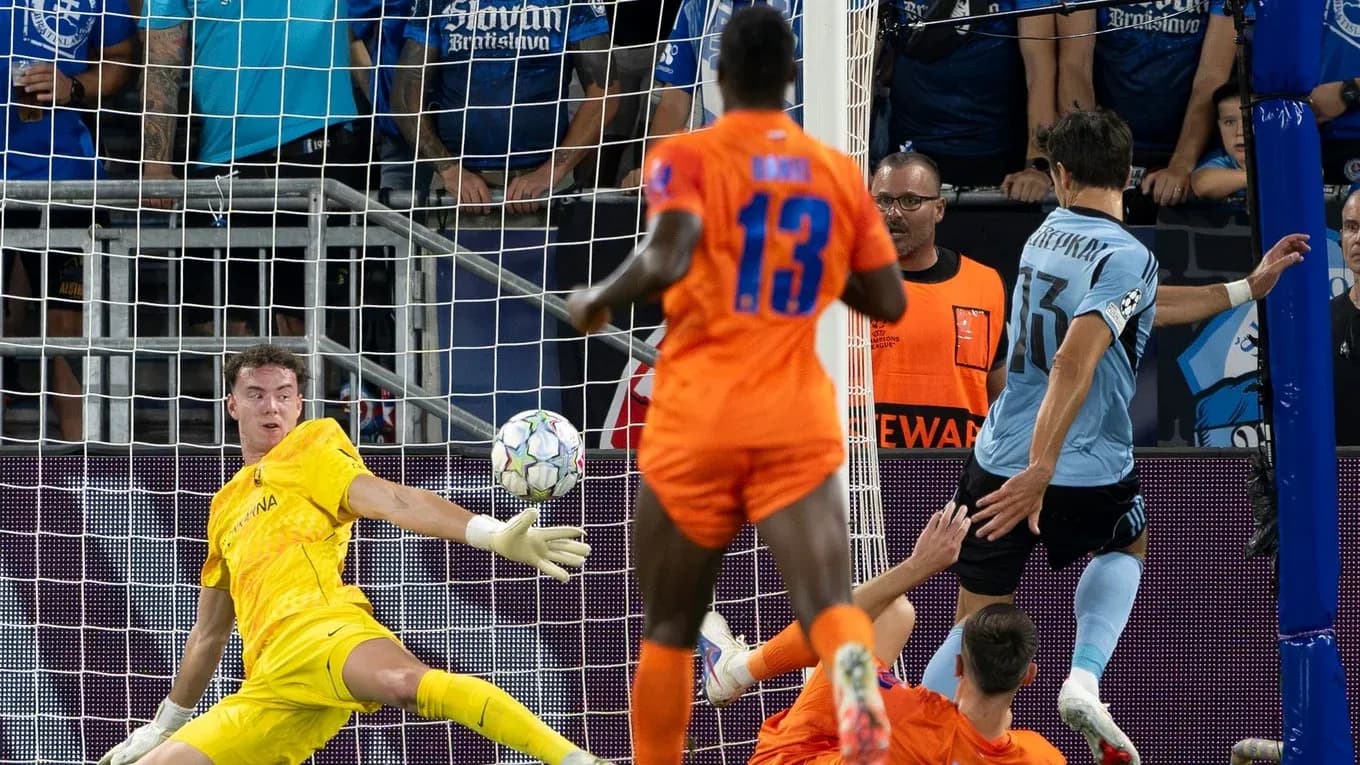
The front three of T. Barseghyan, R. Cerepkai and S. Camara were tasked with stretching Celje horizontally. Cerepkai’s movement was especially important early on, dropping and drifting to combine with Martinez. That understanding produced the breakthrough at 15': C. Martinez found the forward, and R. Cerepkai converted to make it 1-0. It was a textbook example of Slovan’s plan: progression through midfield, a creative link in the half-space, and a forward finishing from a central lane.
After the interval, Toure’s changes were clearly aimed at refreshing energy in the front and midfield lines rather than altering the base structure. At 62', A. Yirajang (IN) came on for R. Cerepkai (OUT), followed by D. Matsuoka (IN) for A. Mustafic (OUT) and M. Kianga (IN) for S. Camara (OUT) at 70'. Later, R. Ibrahim (IN) replaced C. Martinez (OUT) and A. Sporar (IN) came on for T. Barseghyan (OUT) at 84'. The pattern of substitutions shows a desire to maintain the 4-3-3 shape while injecting fresh legs and slightly different profiles in the same zones, rather than changing the system.
Out of possession, Slovan were reasonably disciplined, committing 12 fouls and collecting two yellow cards, both for defenders (K. Bajric and C. Blackman, each for “Roughing”). That profile fits a team defending higher up the pitch, occasionally forced into aggressive interventions to stop counters or wide overloads.
Celje’s 4-2-3-1 was more pragmatic and vertically oriented. With 487 passes at 83% accuracy (402 accurate), they matched Slovan in ball circulation but used it differently: fewer total shots (8) and no corners, but 4 shots on goal from just 4 attempts inside the box. This suggests a clear emphasis on creating fewer, but more controlled, penalty-area situations rather than sustained siege.
The double pivot of P. Daniel and M. Zabukovnik shielded the back four and helped Celje maintain a compact block. Ahead of them, the line of three — M. Ivansek, S. Seslar and M. Kvesic — plus lone forward A. Kucys, looked to exploit spaces once Slovan’s full-backs or midfielders committed forward. The equaliser at 41' encapsulated that idea: left-back M. Avdyli advanced and finished after being supplied by M. Kvesic, turning a rare attacking foray into a high-value chance and making it 1-1.
Campelos’ substitutions from 57' onward were geared towards refreshing wide and midfield zones without compromising the defensive structure. B. Verbic (IN) replaced M. Ivansek (OUT) at 57', A. Kotnik (IN) came on for A. Kucys (OUT) at 58', then A. Dionkou (IN) for P. Sirvys (OUT) and I. Calusic (IN) for P. Daniel (OUT) at 77'. Finally, Y. Dukuly (IN) replaced M. Kvesic (OUT) at 86'. Each change preserved the 4-2-3-1 skeleton while rotating the players tasked with pressing, tracking Slovan’s full-backs and offering an outlet in transition.
Defensively, Celje were compact and committed, registering 13 fouls and two yellow cards: M. Avdyli for “Roughing” at 59' and M. Zabukovnik for “Tripping” at 86'. The timing of Zabukovnik’s card, late in the match, reflects Celje’s willingness to disrupt Slovan’s attempts at a late surge.
In goal, D. Takac (Slovan Bratislava) made 3 saves, while Z. Leban (Celje) was called into action less frequently, with 1 save. That split mirrors the shot profiles: Celje produced 4 shots on goal from 8 total attempts, a relatively efficient ratio, while Slovan’s 2 shots on goal from 14 attempts underline their struggles to turn territory and possession into clear, on-target efforts.
Statistically, the match was almost perfectly balanced in macro terms: 1-1 score, 50%-50% possession, and an even card count (two yellows per side). The differences lay in attacking expression. Slovan generated more volume and box entries but ran into a dense, well-organised block that forced many blocked or off-target shots. Celje, by contrast, produced fewer attacks but reached goal with greater clarity when they did, as reflected in their superior number of shots on goal.
With no explicit xG values provided, the best proxy is shot quality: Slovan’s 9 shots inside the box and higher total volume suggest they may have edged the underlying chance count, but Celje’s compact defending and efficient finishing — particularly Avdyli’s goal — ensured that the tie remains finely poised heading into the second leg.