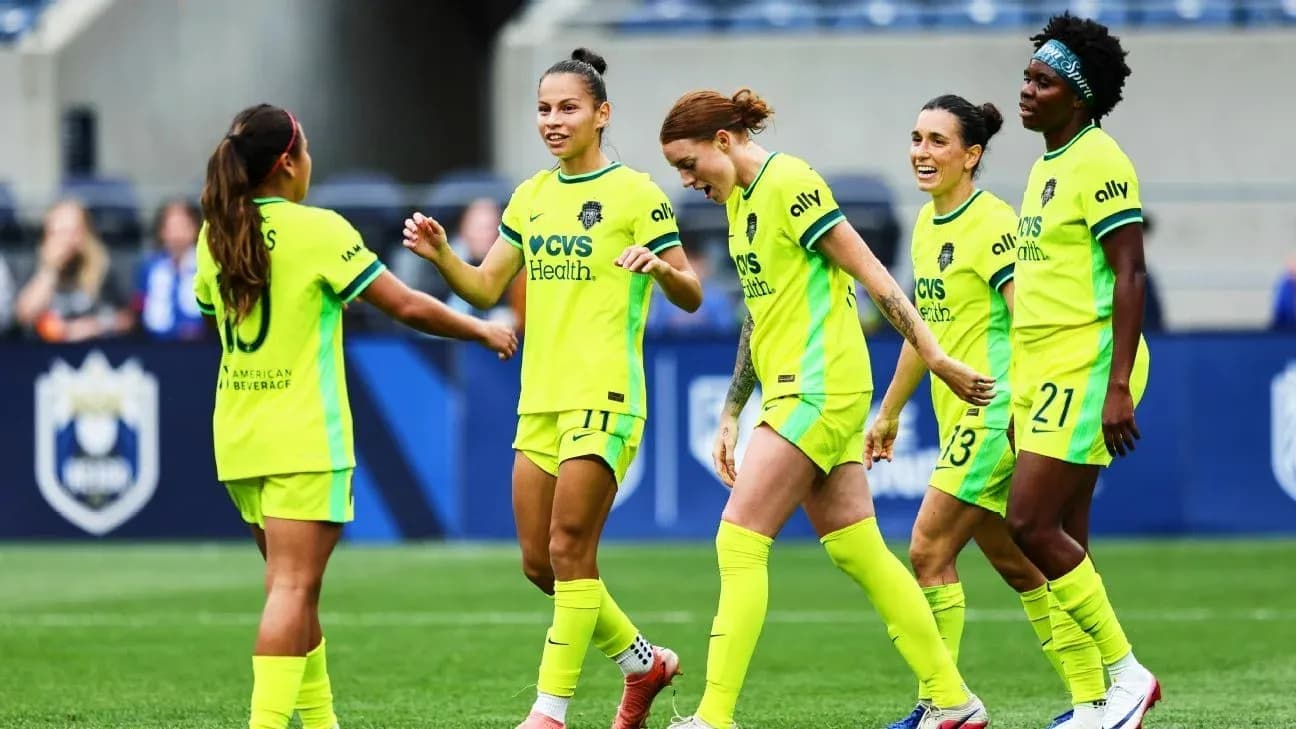
San Diego Wave W vs Washington Spirit W: Tactical Insights and Match Analysis
Under the Friday-night lights at Snapdragon Stadium, San Diego Wave W and Washington Spirit W delivered a fixture that felt far more like a knockout tie than a routine NWSL Women group-stage contest. Heading into this game, the table had framed it as a meeting of heavyweights: San Diego sitting 1st on 21 points with a goal difference of 5, Washington in 3rd on 18 points with a goal difference of 8. The margins at the top were thin, the stakes obvious. By full time, a 2–1 home win had subtly but significantly redrawn the early-season power map.
I. The Big Picture – Two 4-2-3-1s, two very different stories
Both coaches mirrored each other structurally with a 4-2-3-1, but the interpretation of that shape diverged.
Jonas Eidevall leaned into San Diego’s attacking DNA. Across the season, they had averaged 1.4 goals at home and 1.6 on their travels, 1.5 overall, and he set his side up to lean on that firepower. D. Haracic anchored a back four of A. D. Van Zanten, K. Wesley, K. McNabb and P. Morroni. In front of them, the double pivot of K. Dali and K. Ascanio was less about pure protection and more about launching waves of pressure. Ahead, a fluid band of three – Gabi Portilho, G. Corley and Dudinha – fed lone forward T. Byars.
Adrian Gonzalez’s Spirit arrived with one of the league’s most balanced profiles: 16 goals for and 8 against overall, averaging 1.5 at home and 1.7 on their travels in attack, while conceding just 0.5 at home and 1.0 away. Their 4-2-3-1 was built on control and vertical threat. Sandy MacIver stood behind a back line of L. Di Guglielmo, T. Rudd, E. Morgan and G. Carle. The double pivot of R. Bernal and H. Hershfelt underpinned a creative trio of T. Rodman, L. Santos and C. Martinez Ovando, all servicing striker S. Cantore.
The match itself tracked the table’s promise. The 1–1 half-time scoreline reflected two sides trading punches, but San Diego’s capacity to turn home momentum into goals – they had scored 7 and conceded 4 at home heading into this game – ultimately told in the second half as they found the decisive strike for 2–1.
II. Tactical Voids and Disciplinary Edges
With no listed absences, both squads were at something close to full strength, which made the tactical nuances sharper. The main “voids” were therefore structural rather than personnel-based.
For San Diego, the risk lay in how aggressive their full-backs and No. 10s would be. The season data shows only 2 clean sheets at home and away combined and 3 matches overall where they failed to score, underlining a team that accepts defensive exposure to keep numbers high in the final third. P. Morroni in particular embodies that edge. Across the campaign she has committed 16 fouls and drawn 16, collecting 3 yellow cards and even appearing among the league’s top red-card profiles, a sign of how often she lives on the disciplinary line.
Washington’s void was of a different nature: how to maintain their defensive parsimony while still unleashing their creators. With 5 clean sheets overall and only 8 goals conceded in total, their structure is robust. Yet their yellow-card distribution hints at where the strain shows. Heading into this game, 25.00% of their yellows came between 46–60 minutes and another 25.00% between 76–90, the classic windows where intensity dips and games stretch. Players like Bernal (2 yellows) and Rodman (2 yellows) are central to both their buildup and their press; when they are forced into recovery runs rather than proactive positioning, the fouls and cards follow.
San Diego’s own card profile offered a mirror. Their yellows cluster in the 46–60 and 61–75 ranges (each 33.33%), then drop to 16.67% in the 76–90 window. That pattern suggests a side that starts the second half with ferocity – and sometimes oversteps – but regains control late. In a match that finished 2–1, that discipline in the closing phase was crucial; they managed the lead where Washington, chasing the game, had to gamble.
III. Key Matchups – Hunter vs Shield, Engine Room vs Enforcer
Hunter vs Shield
The headline duel was always going to run through Dudinha and Washington’s defensive structure. The Brazilian attacker came into the night with 3 goals and 4 assists, 39 dribble attempts with 23 successful, and 94 duels contested, winning 48. She is San Diego’s chaos agent, constantly attacking the half-spaces and forcing back lines to choose between stepping out or collapsing centrally.
Washington’s shield against that was a collective more than an individual. The back four had conceded just 6 goals on their travels heading into this game, and Bernal’s presence in front of them is central. She had 17 tackles, 2 blocked shots and 7 interceptions in the campaign, with 329 passes at 84% accuracy, blending disruption and distribution. But the more San Diego dragged her wide or high, the more space opened between the lines for runners like Byars and Corley.
Engine Room
The midfield battle was a study in contrasting styles. For San Diego, Ascanio’s numbers tell their own story: 292 passes at 86% accuracy, 18 tackles, 2 blocked shots and 7 interceptions, plus 2 assists. She is the metronome and the first presser, the one who turns regained balls into quick vertical attacks. Alongside her, Dali offered experience and subtle positioning, knitting the lines.
Washington’s response was layered. Bernal brought the defensive intelligence, while Santos provided the creative heartbeat. Santos arrived with 3 goals, 2 assists, 403 passes at 78% accuracy and 12 key passes. Her ability to receive under pressure and thread vertical balls into Rodman and Cantore is what usually tilts matches in Spirit’s favour.
But San Diego’s high-intensity press, especially in the opening 15 minutes of each half, repeatedly forced Washington’s midfield to play on the half-turn facing their own goal. That blunted Santos and left Rodman – 3 goals, 3 assists, 25 shots and 13 on target – feeding on more direct service than she prefers. The result was a Washington attack that threatened in flashes rather than in sustained waves.
IV. Statistical Prognosis – Why 2–1 Felt Inevitable
Strip away the narrative and the numbers still lean towards a narrow San Diego win. Heading into this game, they had 7 wins and 3 losses in 10, with no draws, and averaged 1.5 goals overall while conceding 1.0. Washington’s profile was similarly strong – 5 wins, 3 draws, 2 defeats, 1.6 goals for and 0.8 against overall – but crucially, their away defence (1.0 goals conceded on their travels) is less watertight than their home record.
Overlay the card timing and intensity curves, and a pattern emerges. San Diego’s tendency to surge in the early second half aligns perfectly with Washington’s vulnerability to bookings and structural looseness between 46–60 minutes. In Expected Goals terms, that usually translates into a spike of home xG just as the away side’s organisation frays.
Following this result, the 2–1 scoreline reads like the logical intersection of those trends: San Diego’s relentless attacking core, led by Dudinha and underpinned by Ascanio, just about outpacing Washington’s controlled, methodical approach. In a league where both are tracking towards the play-offs, this felt less like a one-off and more like a preview of a potential knockout clash to come – one in which the same marginal edges in intensity, discipline and midfield control could again tip the balance.