Norway's World Cup Strategy: Beyond Haaland
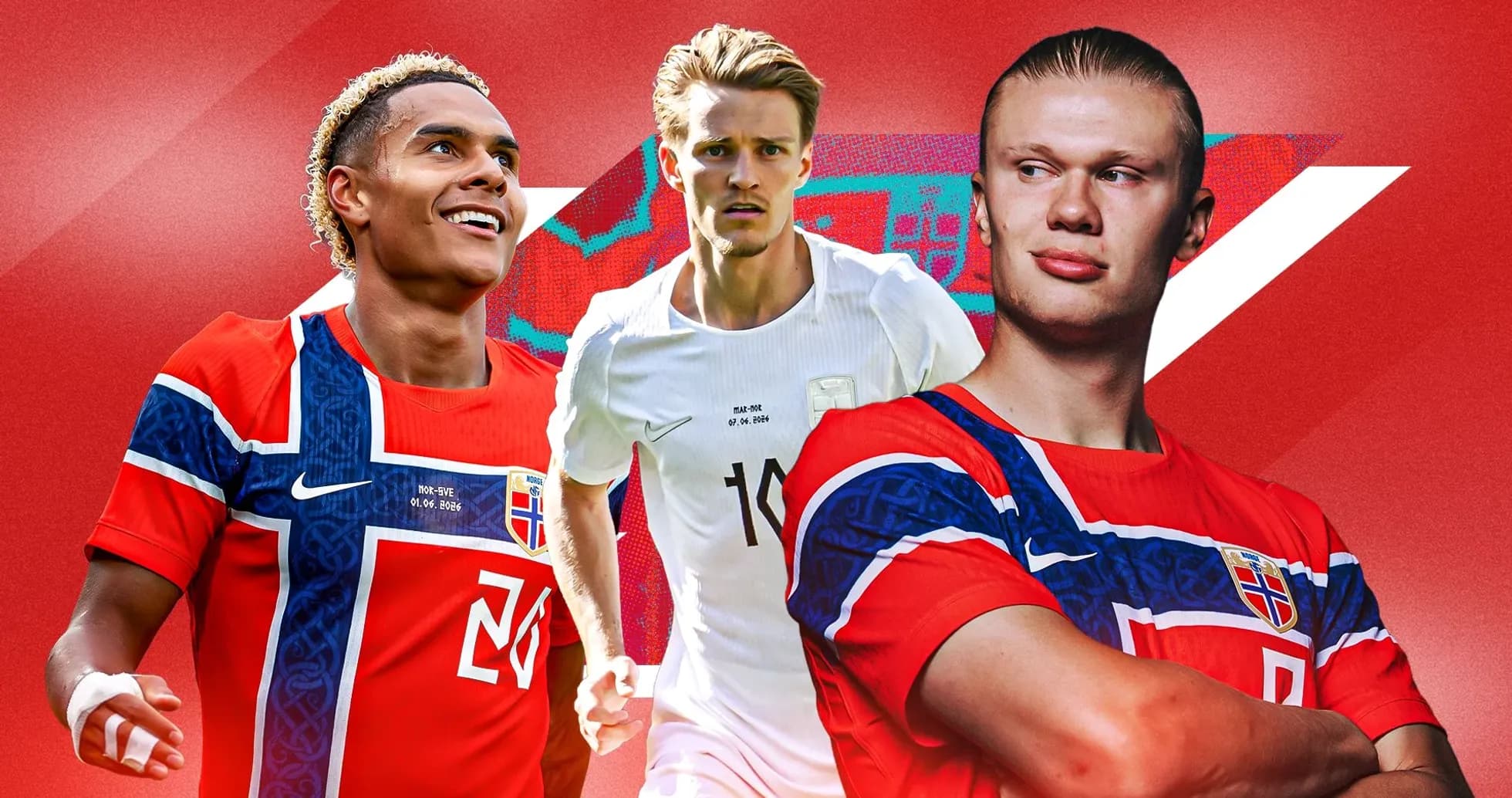
Erling Haaland will dominate the billboards, the broadcasts and the pre-match debates. That much is inevitable. But Norway are heading to North America with far more than a one-man show – and with a tactical blueprint that quietly leans on some very different stars.
Wings built for Haaland – and for chaos
The plan is simple on paper: feed Haaland. The execution is anything but orthodox.
On the left, Antonio Nusa looks set to carry the weight of expectation. The RB Leipzig winger is only 21, but plays with the swagger of someone who knows exactly how good he is. He drifts past markers, rides tackles, and rarely seems rushed in the final third. Six goal contributions in six qualifying games underline the point, with a goal and assist in a 3-0 dismantling of Italy and more damage in the 4-1 hammering in the return fixture. When Norway turned a heavyweight into a punchbag, Nusa was at the heart of it.
Behind him lurks Andreas Schjelderup, another young left-sider whose stock has rocketed. The 22-year-old arrives off a storming second half of the season under Jose Mourinho at Benfica: 10 combined goals and assists in just 14 league matches, plus a Champions League brace against Real Madrid in January. He is not a guaranteed starter yet, but inside the Norwegian camp there is little doubt – this is a future star, and a very real option if Solbakken wants to tilt games from the bench.
The right flank tells a different story altogether. Alexander Sorloth, all 6'5" of him, is nominally stationed out wide. In reality, he is a second centre-forward in waiting. When Norway have the ball, he drifts infield to stand shoulder-to-shoulder with Haaland, turning the penalty area into a land of giants. Eight goal contributions in eight qualifying matches show he is no decoy.
If Solbakken needs a different profile, Fulham’s Oscar Bobb offers guile and tight control, though his early days at Craven Cottage have been more about adaptation than explosion. Jens Petter Hauge has forced his way back into the picture as well. The former AC Milan attacker did not feature in qualifying but played his way in with sharp, inventive performances for Bodo/Glimt, including in their eye-catching Champions League wins over Man City and Inter.
Norway’s wide players are not there just to hug the touchline. They are there to drag defences around until the gaps appear for Haaland, Sorloth and the late runners from midfield. And that is where the real conductor steps in.
Odegaard, the quiet star who runs the show
The midfield is where Norway start to look like a serious tournament side.
Martin Odegaard wears the armband and carries the creative burden. At Arsenal, he can frustrate as much as he dazzles, drifting in and out of games. In national colours, the equation changes. He is the reference point, the man everyone looks for when the ball turns over and space opens up.
Despite missing three of eight qualifiers in an injury-hit club season, Odegaard still finished with seven assists – the most of any player in Europe. Three of those came in one game against Israel. When Norway needed someone to stitch attacks together, he delivered.
Alongside him, the platform is strong. Sander Berge brings Premier League steel and positional discipline in front of the back four. Fredrik Aursnes, a refined No.8 from Benfica, links play and breaks lines with the timing of a seasoned pro. Both are used to the pace and pressure of top-level football.
Aursnes’ story adds an extra layer. Two years ago, at 28, he walked away from international duty to “have more time and freedom to prioritise other things in my life besides football”. In February, he changed his mind. Now, at 30 and without a single minute in qualifying, he looks set to walk straight into the XI at the World Cup. That kind of U-turn only happens when a coach knows exactly what he is getting – and cannot afford to leave it behind.
Depth, for once, is not a Norwegian problem. Patrick Berg, the elegant Bodo/Glimt captain, offers composure and control. Serie A-based Kristian Thorstvedt and Morten Thorsby add legs, aggression and tactical flexibility. Solbakken can rotate without tearing the spine out of his team.
Still, everything flows through Odegaard. He will be the one threading passes between the lines, spinning balls into the channels for Nusa and Nusa’s understudy Schjelderup, and searching for Haaland’s runs through the middle. If Haaland is the finisher, Odegaard is the scriptwriter.
Norway need both in perfect rhythm.
Life after Haaland? Norway have a plan
Solbakken will not want to imagine a World Cup without Haaland. He probably will not have to. The Manchester City striker is expected to start every game and play every minute, barring disaster.
But if the unthinkable happens, Norway are not walking into a void.
Sorloth would step up as the central striker. His international scoring record is solid, and he arrives from an Atletico Madrid season that yielded 20 goals despite not always being first choice. Solbakken summed him up in an interview with FIFA: a physically imposing, loyal forward who can operate across the front line, threaten goal and assist in equal measure, and – crucially – work himself into the ground for the team, even from a role he might not prefer.
Behind him, Jorgen Strand Larsen offers another compelling option. The Crystal Palace forward has turned heads in the Premier League since his 2024 arrival, coupling honest graft with penalty-box instincts. He warmed up for the tournament with a brace in a friendly against Sweden and scored against Italy in qualifying. If minutes open up, he will not be a token substitute. He will be a genuine alternative.
Norway have spent years being defined by the strikers they do not have. This time, they arrive with three who can all hurt you in different ways.
The secret weapon: a right-back who thinks like a winger
For all the talk of Haaland, Odegaard and the glittering wide talent, Norway’s most unusual attacking threat comes from a right-back.
Julian Ryerson is the reason Sorloth starts wide. When Norway have possession, Sorloth moves into the box to join Haaland, freeing the Borussia Dortmund full-back to surge forward. Once he crosses halfway, he stops looking like a defender.
Eighteen Bundesliga assists in 2025-26 tell their own story. Ryerson whips in crosses early, hits cut-backs with precision and rarely wastes a dead ball. Many of those assists came from corners and free-kicks, where his delivery has become a weapon in its own right.
The trick is simple but brutal. With Haaland and Sorloth both inside, Ryerson has two towering targets to hit, plus Odegaard and the midfield runners lurking for second balls. Norway turn the right flank into an artillery line. Opponents know what is coming; stopping it is another matter entirely.
In a tournament where set-pieces and small margins often decide everything, Ryerson could be the man who tips tight games.
A nation finally back on the big stage
This is Norway’s first World Cup in 28 years. For a generation, the tournament has been something the country watched, not something it lived.
Solbakken has felt that gap more than most. He played at France 98. Since then, every four years has brought the same story: Norway at home, watching others under the brightest lights. That is why the scenes after qualification mattered. Fifty thousand fans, minus four degrees, a Monday night – and the streets still packed. A country that had waited nearly three decades finally had a team to follow again.
The reward is brutal: a place in the so-called Group of Death with France, Senegal and Iraq. Solbakken is not selling fairy tales. He does not see Norway as dark horses to win the whole thing. What he does believe, and has said plainly, is that on their day they can beat stronger opponents. That is the ambition: not to shock the world over a month, but to shock someone, somewhere, when it matters most.
He wants this World Cup to show a new Norway. More attacking. More expressive. A team of good individuals, yes, but even more a team that runs and fights for each other.
Haaland’s goals will headline. Odegaard’s passes will trend. Nusa’s dribbles, Sorloth’s movement, Ryerson’s crosses and Aursnes’ late return from international exile will all shape the story.
The question now is simple: in the hardest group of all, can this long-absent nation turn talent and belief into something that lasts longer than a glorious cameo?