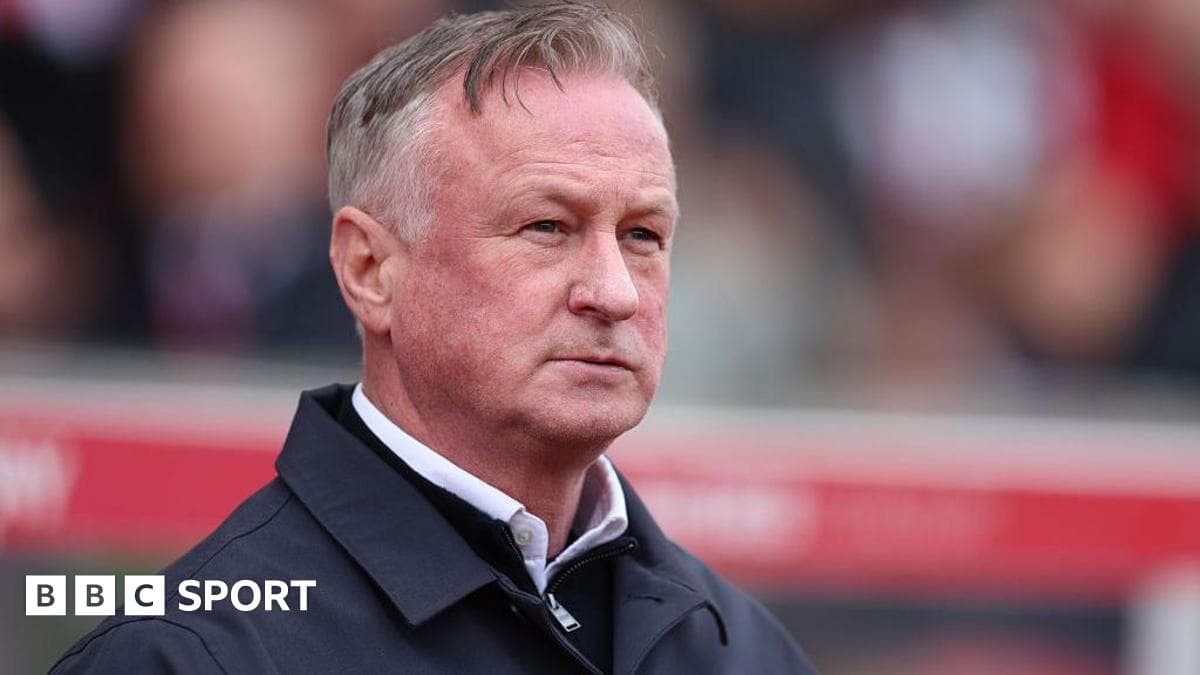
Michael O’Neill Commits to Northern Ireland Over Blackburn Rovers
Michael O’Neill has chosen his path. It leads back to Belfast, not Blackburn.
The 56-year-old will not take the Blackburn Rovers job on a permanent basis and instead doubles down on his role as Northern Ireland manager, ending weeks of uncertainty over his future.
Blackburn chapter closes, country comes first
O’Neill arrived at Ewood Park in February on an interim deal, tasked with steadying a listing ship while still serving as Northern Ireland head coach. It was an unusual arrangement, scheduled to run until the end of the 2025-26 campaign, and he never pretended it could last forever.
Fifteen games later, his work in Lancashire is done. Five wins, five draws, five defeats: a perfectly balanced record that delivered the one outcome that truly mattered for Rovers – survival. Blackburn finished 20th in the Championship and stayed clear of the trapdoor.
During that spell, O’Neill made no secret of the strain of juggling both posts. He repeatedly said a permanent dual role was unrealistic. One job would have to give.
After talks with the club, the answer arrived.
“Following discussions with the club, Michael has decided to continue his long-term commitment to his role as Northern Ireland head coach, with a focus on leading the national team towards qualification for the Uefa European Championships in 2028,” Blackburn confirmed.
O’Neill’s own words carried the tone of a man who enjoyed the ride but knows where his responsibility lies.
“Blackburn Rovers is a historic football club with a proud tradition and passionate supporters. I have thoroughly enjoyed my time working with the players, staff and everyone around the club,” he said, before drawing a clear line. “After careful consideration, I have decided that my long-term focus must remain with Northern Ireland and the journey towards the European Championship campaign ahead.”
Blackburn now head back into the market. The club says the process of identifying and appointing a new permanent head coach begins immediately, with updates to follow.
A second Northern Ireland project gathers pace
For Northern Ireland, the decision lands like a boost of pure adrenaline.
The Irish FA quickly welcomed the clarity. In a statement, it said it was “delighted” O’Neill had chosen to stay, praising the “exciting squad” he has assembled and pointing directly at the twin targets ahead: this autumn’s Uefa Nations League and the Euro 2028 qualifiers, with O’Neill “at the helm”.
The numbers behind his international reigns underline his standing. Across his two spells, he has taken charge of 104 games, winning 38, drawing 23 and losing 43. The high point remains Euro 2016, when he guided Northern Ireland to their first European Championship finals.
That is the benchmark he now chases again.
This second stint has followed a familiar pattern. Just as in his first spell, O’Neill inherited a struggling side, this time from Ian Baraclough. Results have not yet delivered another major tournament – Northern Ireland missed out on Euro 2024 and the most recent World Cup – but the team’s shape and style have sharpened. They look more competitive, more progressive, more ambitious on the ball.
The age profile tells its own story. In March, during a World Cup play-off defeat to Italy, O’Neill’s starting XI had an average age of just 22.5 years, the second-youngest Northern Ireland team on record since World War Two. And that was without three key figures: Conor Bradley, Dan Ballard and Ali McCann. Even with them included, the core remains strikingly youthful.
This is a squad built with a long runway. A group with a ceiling still some distance away.
Eyes on June, then the long road to 2028
The decision to stay allows O’Neill to move quickly from boardroom talks back to the training pitch.
Northern Ireland face Guinea in Cadiz and France in Lyon in June friendlies, fixtures that now serve as staging posts rather than distractions. In September, the Nations League begins, with O’Neill’s side drawn in Group B2 against Hungary, Georgia and Ukraine.
Those games will reveal more about how far this young group has travelled, and how much further it can go under a coach who has already taken his country to one Euros and believes there is another in reach.
For supporters, the relief is obvious. When O’Neill hinted in March that he would “return to the status quo” for the June fixtures, it sounded like a man leaning towards staying. By April, he admitted a decision was still to be made, and the mood shifted. Alarm bells rang. The job he rebuilt had become attractive again; the Irish FA knew there would be no shortage of candidates if he walked away.
He has not. There will be no upheaval before the Nations League, no reset before the next qualifying cycle. Just continuity, and a manager who has nailed his colours firmly back to the international mast.
Blackburn Rovers will move on and find a new voice for their dressing room. Northern Ireland already have theirs – the same one that led them out in France eight years ago, now charged with turning a fearless, raw squad into a team ready to step back onto the European stage in 2028.