Mexico's Tactical Mastery in 2-0 Victory Over Ecuador
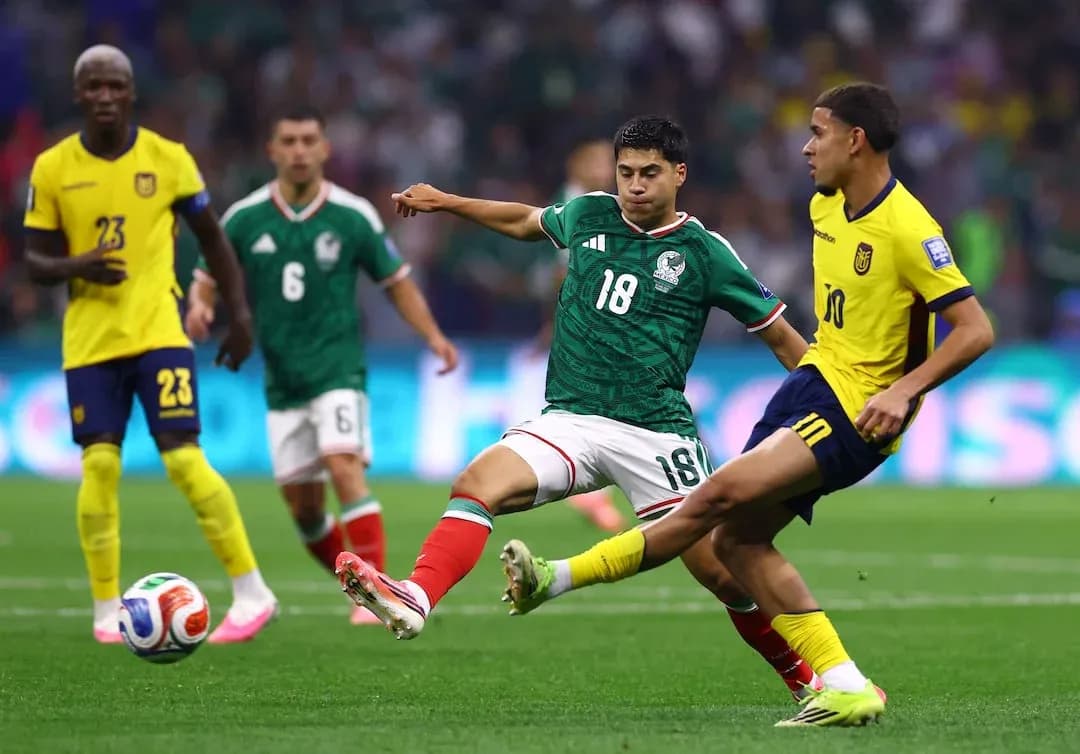
Mexico’s 2-0 win over Ecuador at Estadio Banorte was a clinic in game-state control rather than territorial dominance. Despite having just 43% possession and completing fewer passes (319 vs 407), Mexico used Javier Aguirre’s 4-3-3 to impose the key phases of the match, racing to a 2-0 lead by 31 minutes and then managing space, tempo and risk with notable maturity in this World Cup Round of 32 tie.
Ecuador, in Sebastian Beccacece’s 4-4-2, saw more of the ball and posted an 8-3 advantage in corners, but their possession was largely sterile. Their 0.73 xG from just 7 total shots (1 on goal) underlined how rarely they were able to access truly dangerous central zones. Mexico, by contrast, turned 15 shots and 1.02 xG into two first-half goals, then shifted into a compact, lower-risk block that protected the lead and forced Ecuador into frustrated, increasingly direct play.
I. Tactical structure and Mexico’s first-half punch
Mexico’s 4-3-3 was built on a clear vertical pattern: Raúl Jiménez as a central reference, Julián Quiñones attacking the left half-space, and Roberto Alvarado stretching the right. Behind them, the midfield trio of Gilberto Mora, Erik Lira and Luis Romo formed a narrow triangle that ceded some possession but controlled the central lanes where Ecuador’s 4-4-2 wanted to combine.
The opening goal at 22 minutes encapsulated the plan. Mexico drew Ecuador’s block to one side, then found Alvarado in an advanced right channel. His assist into Quiñones exploited the seam between full-back and centre-back, a classic half-space run from the left forward arriving inside the box. That pattern — wide overload, diagonal penetration — was the core of Mexico’s attacking identity.
The second goal on 31 minutes flipped the roles but kept the same idea. This time Quiñones became the provider, feeding Jiménez. The centre-forward’s movement between Ecuador’s centre-backs, combined with Quiñones’ timing, showed how Mexico’s front three were constantly rotating responsibilities while maintaining positional structure: one wide threat, one half-space runner, one central finisher.
Out of possession, Mexico’s front line pressed selectively rather than constantly. With Ecuador holding 57% of the ball, Mexico focused on blocking vertical passes into Moisés Caicedo and Pedro Vite. The 4-3-3 narrowed into almost a 4-1-4-1 at times, with Lira anchoring in front of César Montes and Johan Vásquez, and the wide forwards tracking Ecuador’s full-backs just enough to discourage overlaps.
II. Ecuador’s possession without penetration
Ecuador’s 4-4-2, with Enner Valencia and Gonzalo Plata up front, was designed to use width and quick switches. Nilson Angulo and John Yeboah started as wide midfielders, with Caicedo and Vite central. In theory, the 57% possession and 84% pass accuracy (407 passes, 340 accurate) should have allowed them to stretch Mexico and create cutbacks.
In practice, Mexico’s mid-block forced Ecuador wide and then defended crosses comfortably. With only 7 total shots and just 1 on target, Ecuador rarely converted their territorial advantage into genuine threat. The 5 shots inside the box were mostly under pressure or from poor angles, reflected in the modest 0.73 xG.
Beccacece’s triple substitution pattern around the hour — Yaimar Medina and Ángelo Preciado on at 46', Kevin Rodriguez for Enner Valencia at 59', then Jordy Caicedo and Kendry Páez at 79' — was an attempt to inject more verticality and crossing threat. However, the structural issue remained: Mexico’s centre-backs were rarely pulled out of position, and the double pivot was outnumbered and screened in central zones.
III. Game-state management, substitutions and discipline
Once 2-0 up, Aguirre’s changes were clearly about energy and control rather than chasing further goals. At 58', Brian Gutiérrez (IN) came on for Gilberto Mora (OUT), adding fresh legs in midfield. Obed Vargas (IN) replaced Luis Romo (OUT) at 73', and Santiago Giménez (IN) for Raúl Jiménez (OUT) at 74' kept the press honest while preserving the central reference. The double change at 80' — Orbelín Pineda (IN) for Julián Quiñones (OUT) and Israel Reyes (IN) for Roberto Alvarado (OUT) — effectively turned the 4-3-3 into a more conservative, hybrid 4-4-1-1, with extra stability on the flanks and in the half-spaces.
Ecuador’s discipline issues were a direct by-product of chasing the game. They committed more fouls (14 vs Mexico’s 10) and collected all four cards: three yellows and one red. The sequence matters tactically:
- 45+1' Alan Franco (Ecuador) — Tripping
- 90+3' Kendry Páez (Ecuador) — Tripping
- 90+5' Piero Hincapié (Ecuador) — Unsportsmanlike conduct (Red Card)
- 90+9' Moisés Caicedo (Ecuador) — Tripping
Franco’s booking just before half-time reflected Mexico’s success in provoking late, recovery tackles as they broke Ecuador’s lines. The late cards, especially Hincapié’s red for Unsportsmanlike conduct, came as Ecuador pushed higher, lost defensive balance and grew increasingly frustrated by Mexico’s game management and time control.
IV. Defensive performance and goalkeeper roles
Raúl Rangel (Mexico) had a relatively quiet but concentrated evening. Ecuador managed only 1 shot on goal, and Rangel made 1 save. Mexico’s defensive work was more about collective structure than last-ditch heroics: the back four of Jorge Sánchez, Montes, Vásquez and Jesús Gallardo were protected by a compact midfield screen, limiting the quality of looks Ecuador could generate.
Hernán Galíndez (Ecuador) also recorded 1 save despite facing 3 shots on goal. Mexico’s finishing efficiency — scoring twice from those three on-target efforts — is reflected in the expected goals and goals prevented metrics. Mexico’s xG of 1.02 suggests they converted close to the quality of chances created, while Ecuador’s 0.73 xG underlines how few truly dangerous moments they produced despite the territorial edge.
Both goalkeepers are credited with the same goals prevented figure (-0.57), indicating that, statistically, neither outperformed shot quality; instead, the story of the match was decided higher up the pitch, in how Mexico created and then controlled the game-state.
V. Statistical verdict and broader context
The raw numbers reinforce the tactical narrative. Ecuador’s 57% possession, higher pass volume and 8-3 corner advantage point to territorial dominance, but Mexico’s 15-7 shot edge, superior xG (1.02 vs 0.73) and cleaner disciplinary record (no cards vs Ecuador’s 3 yellows and 1 red) show a side that picked its moments and defended with control.
Mexico’s passing profile — 319 passes, 249 accurate at 78% — reflects a more vertical, risk-tolerant approach, using direct progression to exploit their front three. Ecuador’s 407 passes at 84% accuracy were tidier but too often in non-threatening zones, a hallmark of possession without penetration.
In sum, this Round of 32 tie was decided by Mexico’s superior structure in both boxes. The early, well-crafted goals from Quiñones and Jiménez gave Aguirre the platform to drop the block, manage energy through targeted substitutions, and force Ecuador into low-value possession and late frustration. From a tactical standpoint, Mexico advanced not by dominating the ball, but by dominating the spaces that mattered.