Liverpool and Chelsea Share Points in Tactical Clash
Anfield under grey Merseyside skies, Craig Pawson’s whistle, and two sides whose seasons have taken very different shapes. Following this result, Liverpool remain in the Champions League chase from 4th place on 59 points, their overall goal difference a tight +12 from 60 scored and 48 conceded. Chelsea, 9th with 49 points and a +6 overall goal difference (55 for, 49 against), leave with a point that steadies a listing ship after a brutal “DLLLL” run of form heading into this game.
The 1-1 draw fits the season-long profiles. At home, Liverpool have been potent and imperfect: 10 wins, 5 draws, 3 defeats at Anfield, with 33 goals for and 19 against. That home attacking average of 1.8 goals per game met a Chelsea side whose travels have quietly been their strength: 7 away wins, 5 draws, 6 losses, scoring 31 and conceding 25, an away attacking average of 1.7 and away defensive average of 1.4. This was always likely to be a contest of high tempo rather than high margin.
I. The Big Picture – Two Identities Collide
Arne Slot’s Liverpool are defined by intensity and verticality. The season’s most common structure, a 4-2-3-1 used in 32 league matches, was again the underlying reference, even if the official formation line was left blank. Giorgi Mamardashvili in goal, a back line of Curtis Jones, Ibrahima Konaté, Virgil van Dijk and Miloš Kerkez, and a midfield square of Ryan Gravenberch and Alexis Mac Allister behind Jeremie Frimpong, Dominik Szoboszlai and Rio Ngumoha, with Cody Gakpo leading the line, gave Liverpool a fluid, press-heavy shape.
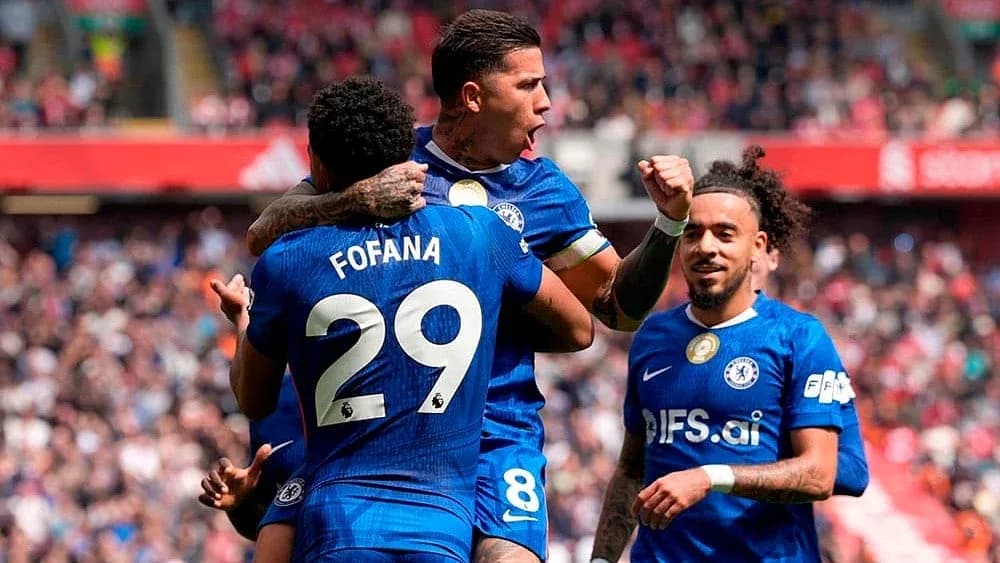
Calum McFarlane’s Chelsea also lean on a 4-2-3-1 – deployed 31 times this league season – but with a different rhythm: more control through Moisés Caicedo and Enzo Fernández, and sudden vertical jolts into João Pedro and Cole Palmer. At Anfield, Filip Jørgensen started in goal, shielded by Malo Gusto, Wesley Fofana, Levi Colwill and Jorrel Hato. Ahead of them, Caicedo and Andrey Santos formed the double pivot, with Palmer, Enzo and Marc Cucurella supporting João Pedro.
II. Tactical Voids – The Missing Stars
The absences shaped the story as much as those on the pitch. Liverpool were stripped of some of their primary end-product: Alisson, Wataru Endo, Hugo Ekitike, Mohamed Salah and Florian Wirtz all missed the fixture. That removed their top scorer Ekitike (11 league goals) and their leading creator Salah (6 assists), forcing Slot to lean heavily on Szoboszlai’s all-round engine and Gakpo’s dual role as scorer and facilitator.
For Chelsea, the picture was equally fractured. J. Derry, J. Gittens, A. Garnacho, P. Neto, Robert Sánchez and the suspended Mykhailo Mudryk were all unavailable. Mudryk’s absence removed one of their purest depth threats, while Sánchez’s concussion meant Jørgensen had to anchor the back line in a high-pressure environment. It narrowed McFarlane’s options for late-game chaos from the bench.
Disciplinary trends hung over the fixture like a storm cloud. Across the season, Liverpool’s yellow cards have spiked late, with 31.48% of their bookings coming between 76-90 minutes and a further 16.67% in 91-105. Chelsea show a similar late-game edge: 23.60% of their yellows arrive in 76-90, with 21.35% in 61-75. Both sides are combustible in the closing stretch, and Chelsea’s red-card record – spread across Moisés Caicedo, Marc Cucurella, Trevoh Chalobah and Robert Sánchez – added another layer of jeopardy.
III. Key Matchups – Hunter vs Shield, Engine Room vs Enforcer
The marquee duel was always going to be João Pedro against Liverpool’s defensive spine. Pedro arrived as one of the league’s most influential attackers: 15 goals and 5 assists overall, with 50 shots (28 on target) and 29 key passes. His movement between the lines and ability to carry the ball (71 dribbles attempted, 37 successful) asked constant questions of Van Dijk and Konaté.
Liverpool’s “shield” has been solid rather than watertight. Overall they concede 1.3 goals per game, with 1.1 at home; Chelsea’s away attack at 1.7 goals per game suggested Pedro would get his moments. The fact that Chelsea emerged with a goal and a draw is consistent with that statistical tension: Liverpool good at home, but not suffocating; Chelsea dangerous away, but rarely dominant.
In midfield, the engine-room battle was ferocious. Szoboszlai, Liverpool’s metronome, has been one of the league’s standout all-rounders: 6 goals, 5 assists, 2,090 completed passes at 87% accuracy, 68 key passes, and a defensive contribution of 52 tackles, 8 successful blocks and 29 interceptions. He is also Liverpool’s most combustible presence, with 8 yellows and 1 red this season and a missed penalty on his record – a reminder that his high-risk, high-reward style can tilt either way.
Opposite him, Caicedo and Enzo formed Chelsea’s double axis of control and bite. Caicedo’s numbers are imposing: 1,940 passes at 91% accuracy, 87 tackles, 14 successful blocks and 56 interceptions, plus 11 yellow cards and 1 red. He is both enforcer and metronome, and his duels with Szoboszlai framed the match’s rhythm. Enzo, with 9 goals, 3 assists and 65 key passes, added progressive threat; his 50 shots (30 on target) make him a genuine second-wave finisher rather than a pure distributor.
On the flanks and half-spaces, Gakpo’s role was pivotal. With 7 goals and 5 assists overall, 52 shots (21 on target) and 50 key passes, he is Liverpool’s de facto creative spearhead in Salah’s absence. His ability to drift wide, combine with Frimpong and Ngumoha, and attack the half-spaces between Fofana and Gusto or Colwill and Hato, repeatedly stretched Chelsea’s back four.
IV. Statistical Prognosis – xG Shape and Defensive Solidity
Even without explicit xG numbers, the season-long trends sketch the underlying expected-goals landscape. Liverpool at home average 1.8 goals scored and 1.1 conceded; Chelsea on their travels average 1.7 scored and 1.4 conceded. The equilibrium point hovers around a narrow margin, with both sides likely to generate multiple high-quality chances but neither overwhelmingly superior.
Liverpool’s 10 clean sheets overall (5 at Anfield) and Chelsea’s 9 (4 away) underline that both can lock games down in phases, but their late-card profiles and Chelsea’s red-card history hint at volatility rather than control in closing stages. Chelsea’s perfect penalty record this season – 7 taken, 7 scored – contrasts with Liverpool’s more fragile relationship from the spot, especially with Szoboszlai having missed one, adding a psychological wrinkle whenever contact in the box loomed.
Following this result, the 1-1 draw feels almost pre-written by the numbers: Liverpool’s strong but not ruthless home attack meeting Chelsea’s efficient away threat, two midfields stacked with creators and destroyers, and defensive units good enough to bend without fully breaking. In tactical terms, it was a night where the structures held, the stars flashed without deciding everything, and the table – 4th vs 9th, +12 vs +6 – remained an accurate reflection of the distance between them.