Lech Poznan Dominates FC Thun 7-0 in Tactical Masterclass
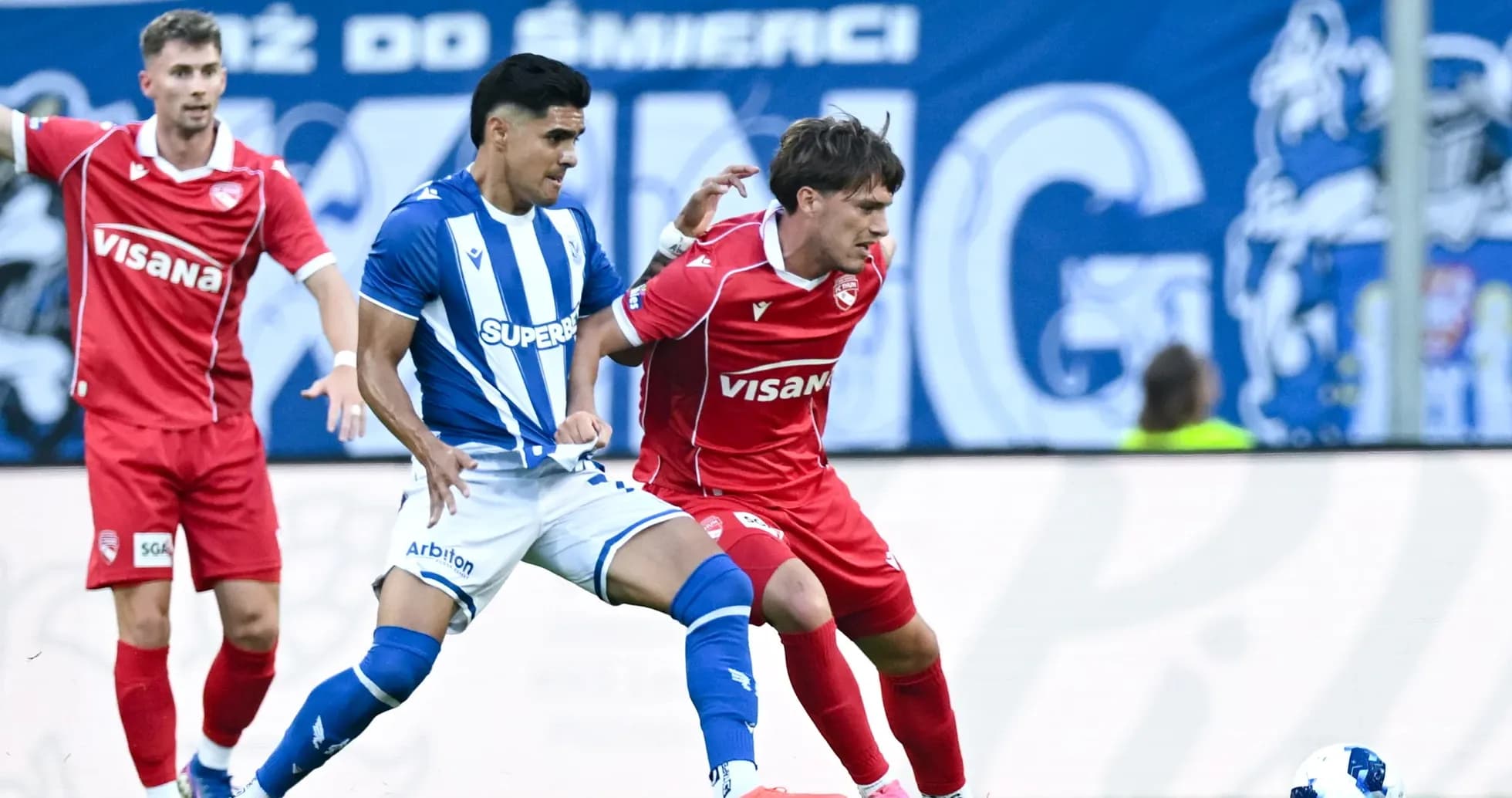
Lech Poznan’s 7-0 dismantling of FC Thun at Enea Poznań was a tactical domination built on structure rather than chaos. In a UEFA Europa League Play-offs tie that was effectively settled by half-time (5-0), Niels Frederiksen’s 4-2-3-1 imposed control through intelligent positioning and relentless occupation of the final third. FC Thun’s 4-4-2 under Luca Privitelli Gian never established compactness between the lines, leaving their double pivot exposed and their back four repeatedly dragged into wide, disadvantageous duels. The final shot profile (11 shots on goal for Lech against 4 for Thun, with Lech holding 56% possession) underlines how the hosts converted territorial control into constant penalty-box pressure.
Lech’s structure with the ball was the foundation. The nominal 4-2-3-1 often morphed into a 2-3-5 in possession: full-backs J. Pereira and M. Gurgul pushed high and wide, while the centre-backs W. Monka and M. Skrzypczak held a broad base. In front of them, the double pivot of A. Kozubal and R. Murawski staggered their positions – one dropping to help first phase, the other stepping into the right or left half-space. This gave clean progression lanes into the advanced trio of P. Walemark, P. Rodriguez and L. Palma behind A. Sayyadmanesh.
The early goals reflected that structure. With Thun’s 4-4-2 pressing line unable to screen both pivots and the central “10” space, Lech consistently found Rodriguez between the lines. Once he received on the half-turn, Walemark and Palma attacked the half-spaces, forcing Thun’s wide midfielders to run backwards rather than press. The result was sustained occupation of the final third, which explains Lech’s 11 shots on goal and 3 blocked shots: they were repeatedly able to shoot from central or half-space zones against a retreating back line.
Out of possession, Lech’s 4-2-3-1 block was aggressive but controlled. With only 8 fouls committed, they pressed primarily through cover shadows and positional traps rather than reckless challenges. Sayyadmanesh led the press onto Thun’s centre-backs, while the wingers curved runs to lock play to one side. Behind them, Murawski and Kozubal stepped forward on triggers – especially when a Thun midfielder received facing his own goal. This limited Thun to 4 shots on goal and 3 shots off goal despite having 44% of the ball; much of that possession was sterile, forced into wide or backward passes.
FC Thun’s 4-4-2 lacked vertical connections. The double pivot of N. Reichmuth and J. Roth was frequently pinned deep by Lech’s attacking midfielders, while wide men N. Zoukit and V. Matoshi were driven back to form a flat back six at times. The front pairing of M. Gutbub and B. Labeau became isolated, often receiving direct balls under pressure from Lech’s centre-backs. With Thun committing 16 fouls and collecting 2 yellow cards, their defensive response devolved into late interventions rather than coordinated pressing.
Thun’s in-game adjustments were reactive. The half-time and early second-half substitutions – F. Dursun for M. Gutbub at 45+1', M. Heule replaced by T. Strannegard and N. Zoukit by F. Saiz at 46' – aimed to add energy and more ball-playing capacity, but the structural issues remained. Even when Thun briefly threatened, the VAR intervention at 66' that disallowed a potential goal by Furkan Dursun underlined how rare and fragile their attacking moments were.
Frederiksen’s changes, by contrast, preserved the tactical framework while refreshing intensity. Walemark (IN) D. Hakans (OUT) at 37' was an early rotation to protect a key wide threat after his brace, but the role remained the same: aggressive attacking from the flank into the half-space. Later, Rodriguez (OUT) R. Gumny (IN) and Palma (OUT) G. Berggren (IN) at 64' shifted some emphasis towards control and defensive stability without sacrificing width, with Gumny comfortable stepping into midfield zones. Further changes – Kozubal (OUT) K. Delikat (IN) and Sayyadmanesh (OUT) W. Szymczak (IN) at 80' – allowed Lech to maintain their pressing structure and depth in the last phase.
The disciplinary profile also mirrored tactical dynamics. Lech’s single yellow card for Radosław Murawski at 87' came late, in a match already decided, and did not alter their capacity to control midfield. Thun’s two bookings – for Nils Reichmuth at 50' and Tom Strannegård at 70' – reflected a midfield under persistent stress, often arriving late into duels as Lech circulated the ball through their double pivot and advanced midfield line.
Statistically, the picture is clear. Lech’s 56% possession was not an overwhelming majority, but it was territorially dominant: they turned that share into 11 shots on goal, 6 shots off goal and 3 blocked shots, plus 5 corner kicks. Thun’s 44% possession yielded only 4 shots on goal, 3 shots off goal, 2 blocked shots and 3 corners, indicating that much of their ball use occurred in deeper zones without penetration. The foul count (16 for Thun, 8 for Lech) further underlines how often the Swiss side had to break play to survive transitions and overloads.
Without numerical data for passes or xG, the key tactical verdict rests on territorial control, shot quality and discipline. Lech Poznan imposed their 4-2-3-1 blueprint from the opening minutes, consistently finding free men between the lines and wide overloads, while maintaining a compact, proactive defensive block. FC Thun’s 4-4-2 never solved the spacing and pressing problems, and their reactive substitutions could not shift the game’s geometry. A 7-0 scoreline in a Play-offs tie is extreme, but the underlying tactical and statistical patterns fully support the scale of Lech’s superiority.