Lazio vs AC Milan: Tactical Analysis of a 2-2 Draw
Under the late-summer light of the Stadio Olimpico, Lazio and AC Milan delivered a match that said as much about their evolving identities as it did about the 2–2 scoreline. This was Round 4 of the Serie A regular season, a meeting between a Lazio side arriving in fourth place on 10 points and a Milan team sitting sixth on 8, both unbeaten, both testing how far their early-season form could stretch against a fellow contender.
Lazio came in with the statistical profile of a quietly ruthless side. Overall this campaign they had scored 6 goals and conceded 3 in 4 matches, a goal difference of +3, built on symmetry: 3 goals at home and 3 on their travels, with matching averages of 1.5 goals per game in both settings. Defensively, they had allowed 2 goals at home and 1 away, for an overall average of 0.8 goals conceded per match. AC Milan, by contrast, travelled to Rome with a slightly more expansive edge: 7 goals scored and 4 conceded overall, another +3 goal difference, with 5 of those goals coming away from home at an average of 1.7 per away game.
The tactical stage was set by the formations alone. Gennaro Gattuso’s Lazio lined up in a 4‑3‑3 that has become their default this season, used in all four league matches. C. Mandas in goal sat behind a back four of R. Floriani, J. Sutalo, O. Provstgaard and N. Tavares, a mix of youth and athleticism rather than star power. In midfield, D. Frattesi, R. Belahyane and K. Taylor formed a dynamic three, tasked with both protecting the back line and driving Lazio’s vertical surges. Up front, M. Cancellieri and M. Zaccagni flanked T. Noslin in a front line built on movement and pressing rather than a traditional reference point.
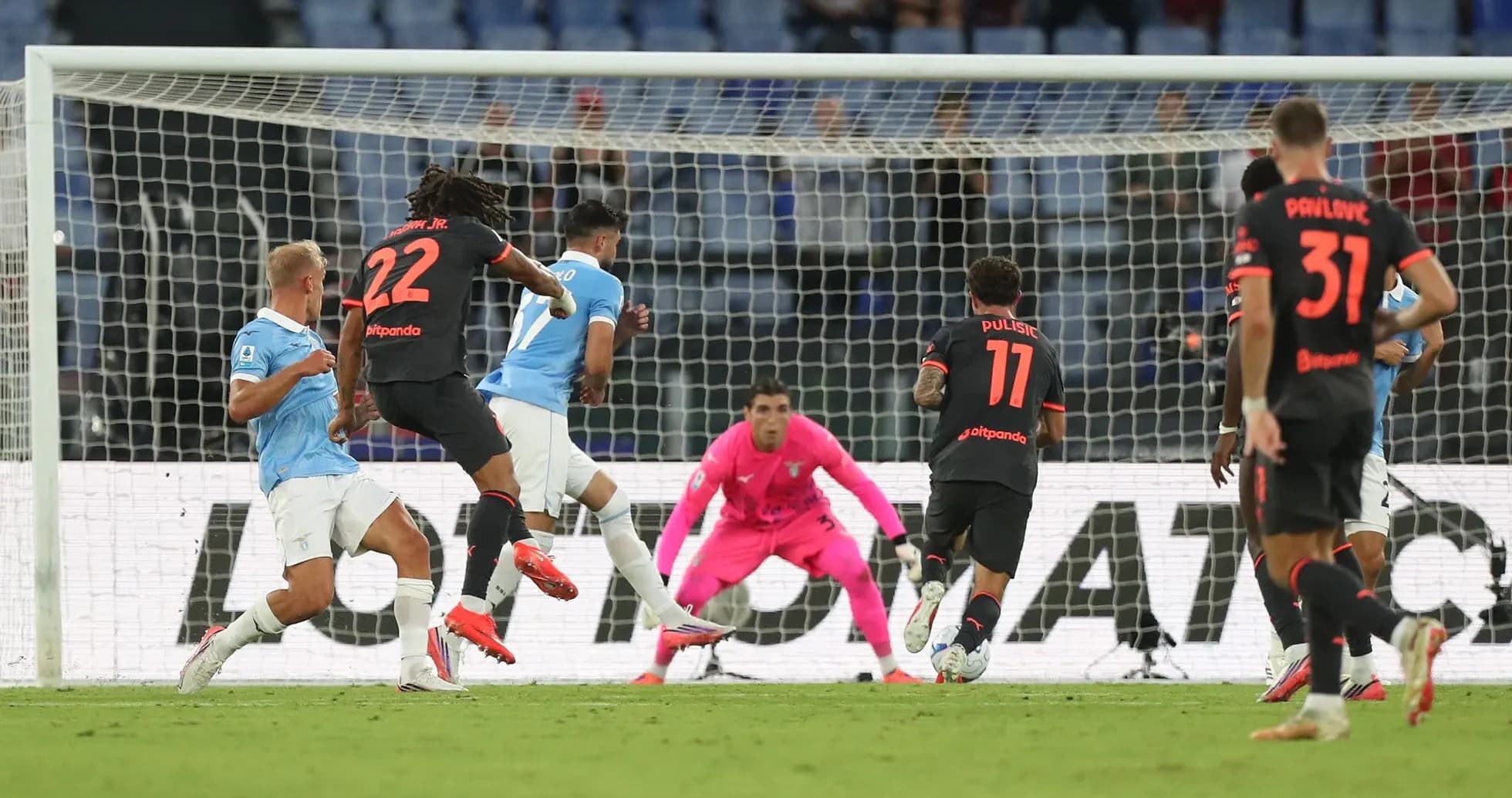
Ruben Amorim’s Milan answered with a 3‑4‑2‑1 that has already defined their season: M. Maignan behind a back three of M. Gila, K. De Winter and S. Pavlović, wing-backs P. Estupiñan and S. Chukwueze stretching the pitch, A. Rabiot and L. Modrić orchestrating in central zones, and an attacking trio of R. Loftus‑Cheek, A. Cissé and G. Ramos tasked with constantly shifting the angles of attack.
If Lazio’s seasonal DNA is control through balance, it is personified by Frattesi. Heading into this game he had 3 goals in 4 league appearances, from just 5 shots, and a strong 7.55 average rating. He is not just a late-arriving scorer but a complete midfielder: 78 passes completed with 82% accuracy, 6 tackles, 3 blocked shots and 4 interceptions. In this match, his role as the “engine” was to surge beyond Noslin into the spaces between Milan’s wide centre-backs, especially targeting the channels around De Winter.
Opposite him, Milan’s creative core ran through Rabiot and Chukwueze. Rabiot arrived with 1 goal and 2 assists in the league, plus 133 completed passes at 84% accuracy, while Chukwueze had already stacked 2 assists and 10 key passes in just four appearances. Together, they formed Milan’s “engine room”: Rabiot as the metronome and carrier, Chukwueze as the outlet capable of beating his man—9 dribble attempts with 6 successful—and then threading passes into Ramos and Cissé.
The absences on Lazio’s side shaped the defensive story. A cluster of defenders and defensive-minded players were missing: F. Dele‑Bashiru, D. Doekhi, A. Furlanetto, A. Marušić, Patric, L. Pellegrini and N. Rovella all sidelined, several through muscle, hand, knee or ankle injuries. That forced Gattuso to trust Sutalo and Provstgaard as the central pairing, with Floriani and Tavares as full-backs. It also meant less rotation in midfield, making Frattesi and Belahyane’s work rate non-negotiable.
Milan, by contrast, arrived with their core intact and it showed in their structural confidence. Pavlović, already one of the league’s standout defenders, came in with 12 tackles and 29 duels won from 40, plus 268 completed passes at 92% accuracy. He is both shield and playmaker from the back, and against Lazio his job was twofold: contain Noslin’s runs in behind and step out to disrupt Frattesi’s surges.
Discipline added another layer of tension. Lazio’s yellow card distribution this season has skewed towards the middle and late phases of halves: 25.00% of their yellows between 16–30 minutes, another 25.00% between 31–45, then 12.50% in each of the 61–75 and 76–90 windows, and a further 25.00% in added time from 91–105. That pattern hints at a side that grows more combative as halves wear on. AC Milan’s yellows are concentrated after the break: 25.00% in each of the 46–60, 61–75, 76–90 and 91–105 intervals, a clear sign that their intensity—and sometimes desperation—rises late. With M. Zaccagni already on 2 yellows for Lazio and Pavlović on 2 for Milan heading into the match, both the creative left-sided forward and the dominant centre-back were walking a disciplinary tightrope.
In the “Hunter vs Shield” duels, the narratives were rich. Frattesi’s scoring threat from midfield tested a Milan defence that had conceded 4 goals overall, including 4 on their travels. At the other end, A. Cissé—2 goals in 4 appearances, 31 duels contested—looked to exploit any hesitation between Sutalo and Provstgaard. Milan’s away scoring average of 1.7 suggested they would eventually find chances, even against a Lazio side that had kept 2 clean sheets overall and never failed to score this campaign.
The 2–2 full-time scoreline, after Lazio’s 2–0 half-time lead, felt like a statistical compromise between these identities. Lazio’s strong home attacking average, Milan’s resilience on their travels, and both teams’ unbeaten records converged into a contest where neither could fully impose their will. Following this result, the numbers will adjust, but the underlying truths remain: Lazio’s 4‑3‑3, driven by Frattesi and Zaccagni, is built to control and surge; Milan’s 3‑4‑2‑1, anchored by Pavlović and powered by Rabiot and Chukwueze, is designed to bend without breaking.
From a tactical prognosis perspective, the balance of xG-like indicators and defensive solidity still slightly favours Milan over a full season—they create more away, concede marginally more, but have the structural depth to chase games. Lazio, however, look every inch a Champions League contender: compact, efficient, and with enough individual quality in Frattesi and Zaccagni to tilt tight matches at the Olimpico in their favour.