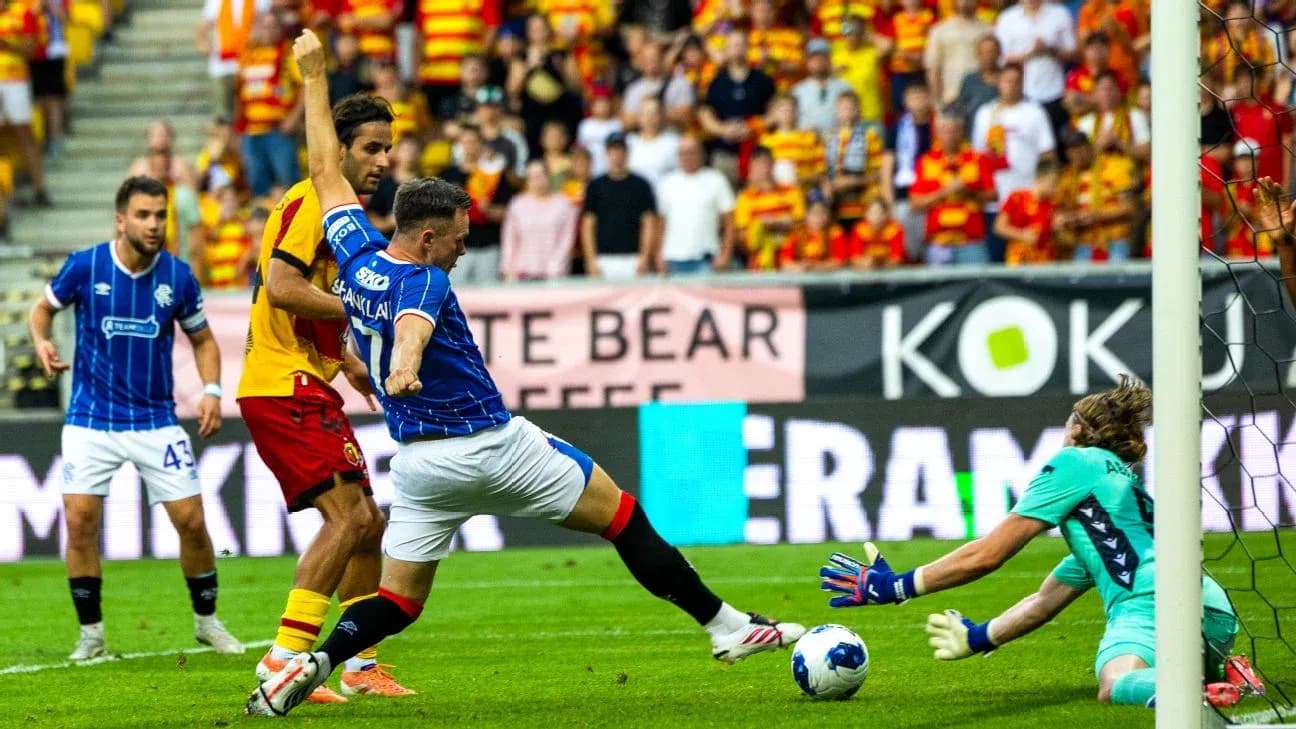
Jagiellonia's Tactical Discipline in 2-1 Win Over Rangers
Jagiellonia’s 2-1 win over Rangers at Chorten Arena was built on structural clarity and superior use of territory rather than overwhelming volume. Adrian Siemieniec’s 4-3-3 controlled the rhythm just enough, turning a chaotic opening full of defensive errors into a controlled mid-block that protected the lead. Rangers, in a 4-2-3-1 under Derek McInnes, generated more set-piece pressure and corners but never truly bent the game to their will, finishing with fewer shots on goal and chasing Jagiellonia’s compact lines for long stretches.
Out of possession, Jagiellonia’s 4-3-3 behaved more like a 4-1-4-1, with T. Romanczuk anchoring in front of the back four and S. Lozano initially stepping up to support the first line of pressure. The wide midfielders K. Szmyt and J. Imaz tucked in alongside Lozano to screen Rangers’ double pivot of T. Chukwuani and D. Neil. That narrowness forced Rangers to circulate into wide areas where full-backs D. Sterling and Tuur Rommens received under pressure rather than on the run. The 52% share of possession for Jagiellonia reflects that they were not simply a counter-attacking side; they were prepared to keep the ball, especially after going ahead.
With the ball, Jagiellonia’s structure was very deliberate. The back four of G. Montoia, Y. Kobayashi, A. Konstantopoulos and N. Wojtuszek stayed relatively conservative, giving a secure platform for rotations ahead. Romanczuk dropped between the centre-backs at times to help build, allowing full-backs to step a little higher while Lozano and R. Conceicao (before his substitution) formed a box with the wingers between Rangers’ lines. The attacking reference was N. Prelec as a central forward, tasked with pinning E. Fernandez and R. McCrorie and creating space for Szmyt and Imaz to attack the half-spaces. Seven shots on goal from Jagiellonia against only three from Rangers underline how effectively they converted their structured possession into clear looks, even with only one corner kick all match.
Rangers’ 4-2-3-1 was built around the double pivot of Chukwuani and Neil trying to progress through the first line, but Jagiellonia’s compact central block forced them to play around rather than through. The 48% possession and five corners for Rangers show they had phases of territorial pressure, especially via wide circulation and set plays, yet they lacked consistent central connections. The front four of D. Yokota, T. Aasgaard, M. Diomande and Chermiti were often isolated from the pivots, and when they did receive between the lines, Jagiellonia’s midfield line collapsed quickly to compress space.
McInnes’s triple change at 46' — C. Devlin (IN) for T. Chukwuani (OUT), N. Raskin (IN) for D. Neil (OUT), and F. Curtis (IN) for D. Yokota (OUT) — was a clear attempt to inject more energy and vertical passing from midfield while refreshing the right flank. Raskin’s later yellow at 90+2' symbolised Rangers’ late-game urgency and frustration more than control. Even with fresh legs, Rangers’ attacking pattern remained reliant on crossing and second balls, reflected in their one blocked shot and modest three shots on goal.
Siemieniec’s response with a double change on 65' — J. Agbonifo (IN) for R. Conceicao (OUT) and A. Klynge (IN) for S. Lozano (OUT) — subtly shifted Jagiellonia’s focus from progression to protection. Klynge’s introduction in midfield brought fresh legs for closing lanes, while Agbonifo added work rate in the wide zones to help the full-backs manage Rangers’ increasing wing play. The later substitutions at 80', with D. Drachal (IN) for J. Imaz (OUT) and Y. Sylla (IN) for N. Prelec (OUT), completed the tilt towards a more transition-oriented and defensively diligent shape, with Jagiellonia content to manage the game state and protect the 2-1 scoreline.
Discipline and duels tilted slightly towards Rangers’ aggression: they committed 15 fouls to Jagiellonia’s 11 and collected three yellow cards to the hosts’ one. Tuur Rommens’ early booking at 5' and Tochi Chukwuani’s caution at 34' indicated how often Rangers’ midfield and full-backs were late into challenges against Jagiellonia’s interior rotations. That pattern continued with Raskin’s late card. Jagiellonia’s single yellow for Yuki Kobayashi at 88' suggests a more controlled defensive performance, one that relied on structure rather than repeated tactical fouling.
Without explicit data on goalkeeper saves, the tactical picture must be inferred from shot volumes and locations. Jagiellonia’s seven shots on goal versus Rangers’ three strongly implies that the home side generated more consistent, on-target pressure, even if the match finished 2-1 and both teams benefitted from early own goals. Crucially, Jagiellonia’s ability to limit Rangers to just three efforts on target, despite conceding more corners and fouls, underlines the effectiveness of their compact block and the protection offered to S. Abramowicz in goal.
Overall, the statistical profile is of a finely balanced but subtly controlled home performance. Possession was almost even, but Jagiellonia produced more on-target shots with fewer set-piece platforms and fewer fouls. Rangers’ higher foul count and card load reflect a chasing team, using physicality to disrupt rather than a side dictating tempo. In a two-legged European context, this 2-1 home win in the 3rd Qualifying Round gives Jagiellonia a narrow but deserved edge, built more on structural discipline and chance quality than on sheer volume or dominance.