Iran's World Cup Opener: Tension and Protest Against Regime
In Los Angeles, where World Cup glitz usually drowns out everything else, Iran’s opening game against New Zealand is being dragged into a far darker orbit.
This is not just another group-stage fixture. It is a match wrapped in war, dissent and the threat of open revolt in the stands.
Taremi’s warning shot
Mehdi Taremi, Iran’s captain, did not bother to sugar-coat the mood around his team. From the moment they landed, he said, the tension has been suffocating.
“I have felt the tension from the first moment we arrived at this World Cup,” he admitted, laying bare a preparation shredded by geopolitics. Iran’s war with the United States has forced the squad to relocate their base to Mexico, while visa complications have hit members of the delegation and travelling supporters. Some fans have even seen their match tickets stripped away.
For Taremi, it strikes at the heart of what this tournament is supposed to represent.
“This kind of tension, it undermines that joy and it undermines the message of Fifa and our people, which is that football brings about peace,” he said. “I feel like this World Cup could have provided a better atmosphere than it has.”
Those are not the words of a man merely irritated by logistical hiccups. They are the words of a captain who senses that the football has become a sideshow.
“We’re going to make it hell”
Outside the Iranian camp, the anger is more direct, and it is pointed squarely at Tehran.
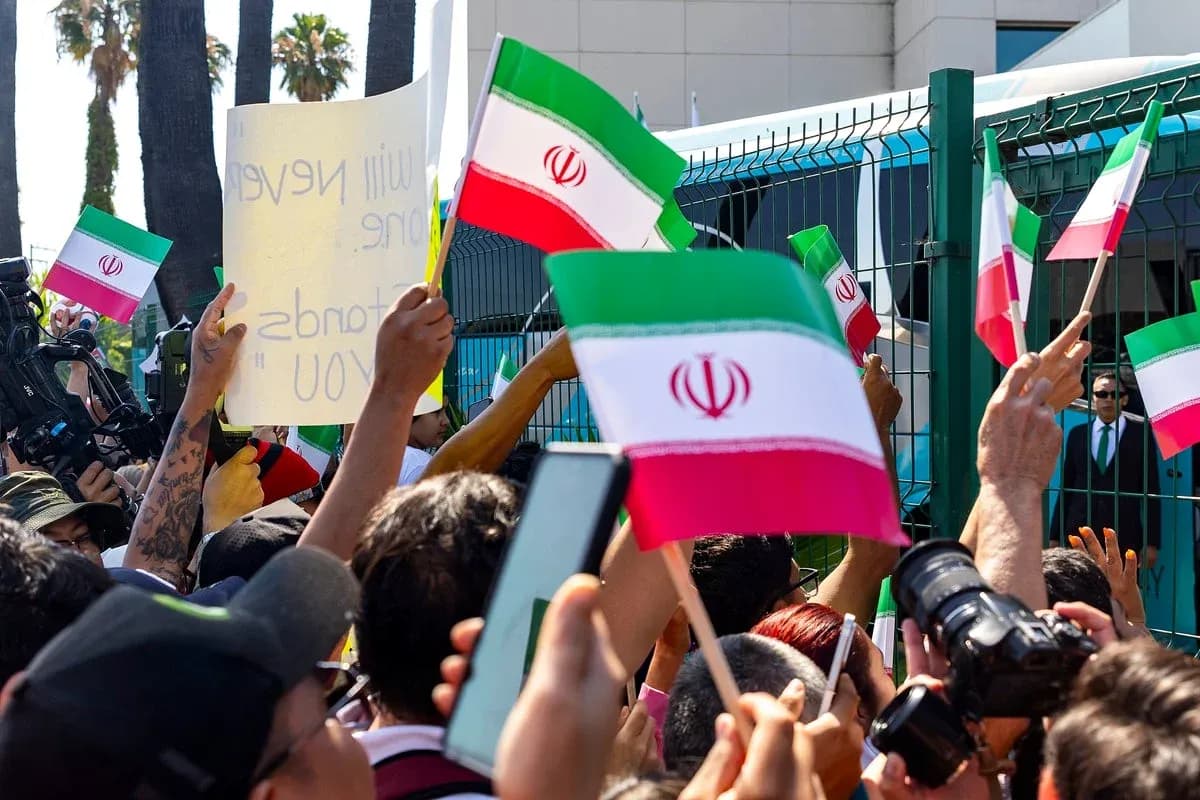
Iranian protesters, many of them exiles, are treating tonight’s game at SoFi Stadium as a stage. Their target is not New Zealand. It is the regime that sent the team here.
They plan to boo the anthem. They plan to turn their backs while it plays, revealing pre-revolutionary flags that Fifa has officially banned from stadiums. They plan to test how far those rules can really stretch.
“We’re going to make it hell,” one activist told the Daily Mail, explaining how buses have been organised from San Diego, Orange County and across Los Angeles to swell the numbers around the ground. “We’re going to boo the anthem that is going to play. We're going to turn our backs during the anthem so we will have our flags showing.
“I know Fifa banned it [the flag] but we will make a way to get it in. So we're going to see this flag, not the terrorist regime’s flag.”
For those protesters, this is not a World Cup opener. It is an opportunity, broadcast worldwide, to strip legitimacy from the government they oppose.
A coach under orders
Caught in the middle stands Amir Ghalenoei, the Iran head coach, who finds himself in one of the most extraordinary positions any manager has faced at a World Cup.
Ghalenoei has been given explicit instructions by the Iranian government: if pre-revolutionary flags are brandished, or if anti-regime chanting can be clearly heard, he is to stop the match.
The surreal possibility hangs over the game like a storm cloud. A coach, acting on orders from his government, potentially halting a World Cup fixture because of what is happening in the stands.
Yet, when he faced the media on Friday, Ghalenoei tried to steer the conversation back to football, or at least to something resembling it.
“We don’t pay attention to any of the hype and anything that goes on around us,” he insisted. “We are here to represent the respectful people of Iran, be it the Iranians inside Iran or the Iranian diaspora.
“We are not political people... football is separate from politics.”
The words are familiar. The context is anything but. For the first time in the tournament’s 96-year history, a host nation is at war with one of the participants. Iran’s campaign is being played out under that hard, unblinking truth.
A World Cup on edge
SoFi Stadium, usually a monument to American sporting excess, will tonight become something else entirely. Protesters will gather outside. Many will slip inside. The anthem will be the first flashpoint.
If the booing is loud enough, if the flags are visible enough, all eyes will turn not to the referee, but to Ghalenoei. Does he follow the instructions from Tehran and attempt to halt the game? Does he ignore them and let the match play on?
Fifa, already under scrutiny over its handling of political symbols and fan expression, will be watching closely. Its stadium regulations have tried to strip away overt political messaging, from banned flags to covered branding, yet this is a contest where politics does not lurk in the background. It walks through the front door.
On the pitch, Iran and New Zealand will try to play a football match. Off it, a fractured nation will try to make itself heard. The World Cup has always claimed to unite people under one game. Tonight in Los Angeles, it will find out what happens when that game collides head-on with a country at war with itself, and with its host.