Hydration Breaks and Their Impact on World Cup Matches
Curaçao’s roar had barely finished echoing around the stadium when the whistle cut straight through it.
In Houston, for a fleeting, electric moment, the smallest nation ever to reach a World Cup had Germany rattled. Livano Comenencia had just slammed his name into World Cup folklore, drawing Curaçao level at 1-1 against the four-time champions. Their fans exploded. The Germans stared around in disbelief.
Then came the hydration break.
The players trudged to the touchline, the noise dipped, and the spell broke. By halftime, Germany led 3-1. By full time, it was 7-1, another brutal scoreline in a World Cup history already littered with German thrashings.
“I actually felt sorry for them,” said former England striker Alan Shearer on The Rest is Football podcast. “They scored and then it was maybe 30 seconds after that it stopped. So it’s killed their momentum.”
That pause – mandated by FIFA’s new hydration-break protocol – has become one of the defining flashpoints of this World Cup. Brought in to protect players from the expected summer heat in the United States, Canada and Mexico, the breaks have instead ignited a fierce debate about rhythm, tactics and the creeping Americanisation of football’s most sacred institution.
Timeouts by another name
Every match now stops around the 22nd minute of each half. Three minutes. Drinks, shade, instructions. And, in some countries, commercials.
On paper, it is about player welfare. Some venues are nudging past 90°F (32°C). Medical experts have warned about heat stress, dehydration, and the toll of high-intensity football in such conditions.
On the pitch and on the airwaves, the conversation sounds very different.
“We’re in America, right? So, it’s like it is it’s like it’s a timeout,” Roy Keane said on The Overlap podcast with Gary Neville. “We love football because of the pace of the game ... what it’s doing is stopping the flow of the game, the momentum.”
The numbers from the early rounds back up that sense of disruption. In eight of the first 16 matches, a goal arrived within 10 minutes of a hydration break. Coaches are not just handing out bottles; they are huddling, rewiring games on the fly.
“You can use the break to tell the players what they need to improve or what is good or what they should do better,” Netherlands coach Ronald Koeman explained. “So you can use it in different ways to your advantage, and this is what we will be doing.”
The advantage has been clear. Canada, the US, Australia, Scotland, Sweden and Iran have all struck soon after play resumed. Momentum maps from analysts show sharp swings immediately following the stoppages, as if someone has grabbed the match by the collar and yanked it in a new direction.
Curaçao never found their footing again after their goal and the pause that followed. Morocco know that feeling too.
They had Brazil pinned back in New Jersey, buzzing with confidence and rewarded with a goal just before the first break. Then the whistle, the walk to the sidelines, the reset. Less than 10 minutes after the restart, Vinícius Júnior had levelled the match. The energy flipped.
Inside stadiums, fans are reacting in real time. In Foxborough, Massachusetts, boos rang out when the referee halted Iraq vs Norway for the first hydration break. The match hadn’t needed a pause in the eyes of the crowd; the game was flowing, the temperature tolerable, the tension building. Then – stop.
One rule, every game
FIFA, though, has made the policy universal. The breaks come regardless of weather, venue or conditions. Roof closed, air conditioning humming, like in Atlanta for Spain vs Cape Verde? It doesn’t matter. The clock hits 22, the whistle blows.
The governing body’s line is simple: “equal conditions for all teams, in all matches.”
Spain coach Luis de la Fuente is not against the idea in principle. He just questions the blanket application.
He said the breaks make sense in “extreme” heat, but added: “Tomorrow, when the temperature that we’ll have in this stadium is chill, maybe these breaks are not so needed, but we need to abide by the rules.”
Norway coach Staale Solbakken struck a similar note.
“I can understand it when it’s like it’s been in Greensboro (North Carolina), when it’s been 35 degrees (95 Fahrenheit) and a really hot climate and there’s a bit of vibration in the air – then I think it’s fine. But I don’t like it otherwise. I think it’s unnecessary," he said.
The game, they argue, already has its natural pauses: injuries, substitutions, half-time. This is something else entirely – a scheduled interruption that carves the half into two distinct phases.
France coach Didier Deschamps has already adjusted his thinking.
“It’s not two half times, it is four quarter times basically that we’ve got. This is what’s been decided and so the players and the coaches adapt to this new reality,” he said.
Coaches like Koeman and Deschamps are treating them as mini timeouts. Others see a line being crossed.
Football meets commercials
The sight that many traditionalists feared has already arrived on American screens. In the United States, Fox cuts straight to commercials during hydration breaks. The game stops; the ads roll. Telemundo, the Spanish-language broadcaster, has chosen not to follow suit.
For a sport that has long prided itself on 45-minute halves with no interruptions for advertisers, it feels like a watershed moment. Football has resisted the pattern of baseball, basketball and American football, where the broadcast is built around commercial windows. Until now.
“Every time going to a commercial is a bit ... not really (something) that I like,” Netherlands captain Virgil van Dijk admitted, having watched World Cup games on TV before his side’s opening 2-2 draw with Japan. “I think for the neutral watchers on TV it’s also not great.”
The risk is obvious. Once a space exists, the pressure to monetise it grows. If hydration breaks stay, the commercial model will only harden around them.
For now, at least, there is no guarantee they will survive beyond this tournament. It is not yet clear whether FIFA plans to make them a permanent fixture at future World Cups. The English Football Association has already indicated it is unlikely to adopt the format for Euro 2028, which will be hosted by the UK and Ireland.
The World Cup, though, often sets the trend. What begins as a response to a specific tournament can quickly become the new normal.
Ronaldo’s last dance – with the intensity of his first
While the sport wrestles with its changing shape, one constant looms large over this World Cup: Cristiano Ronaldo.
At 41, preparing for his sixth World Cup, the Portugal captain is still being treated by his national coach as the reference point for an entire generation.
“He is an example and a reference for football. For all those children on the street who begin to feel the love for sport, following the example of Cristiano Ronaldo is wonderful,” Roberto Martinez said before Portugal’s opener against DR Congo.
On the pitch, the debate is sharper. Ronaldo’s record – 143 international goals, five Ballons d’Or – is unmatched. His recent return in major tournaments is not. He has failed to score in his last nine matches at Euros and World Cups, and offers little when his team are out of possession.
Martinez, though, is unwavering. For him, Ronaldo remains the best option to lead the line.
“It is his sixth World Cup, but I can say that internally it seems to be his first World Cup in terms of intensity, in terms of emotional output, of how important it is for him to be prepared to lead the group,” the Portugal coach said.
“Within the team he is a vital player because he is the finisher, he is the player in the penalty area, he is the player who has those movements that can open spaces for other players. Within our attacking game, his numbers reflect the importance he has.”
Ronaldo’s influence stretches beyond goals. For teammates who grew up watching him, sharing a dressing room with him at a World Cup is still surreal.
Bruno Fernandes remembers his own awakening as a fan.
His first major-tournament memory came at Euro 2004, when a 19-year-old Ronaldo dazzled on home soil and helped Portugal reach the final.
“All of us in this national team we have grown up watching Cristiano Ronaldo play and for us it's such an honor to play next to him now in the same team,” said the Manchester United captain. “We're all here to support him and to support Portugal to go as far as possible.”
This time, Portugal travel with more than just their talisman. They arrive with a midfield that can stand alongside any in the tournament.
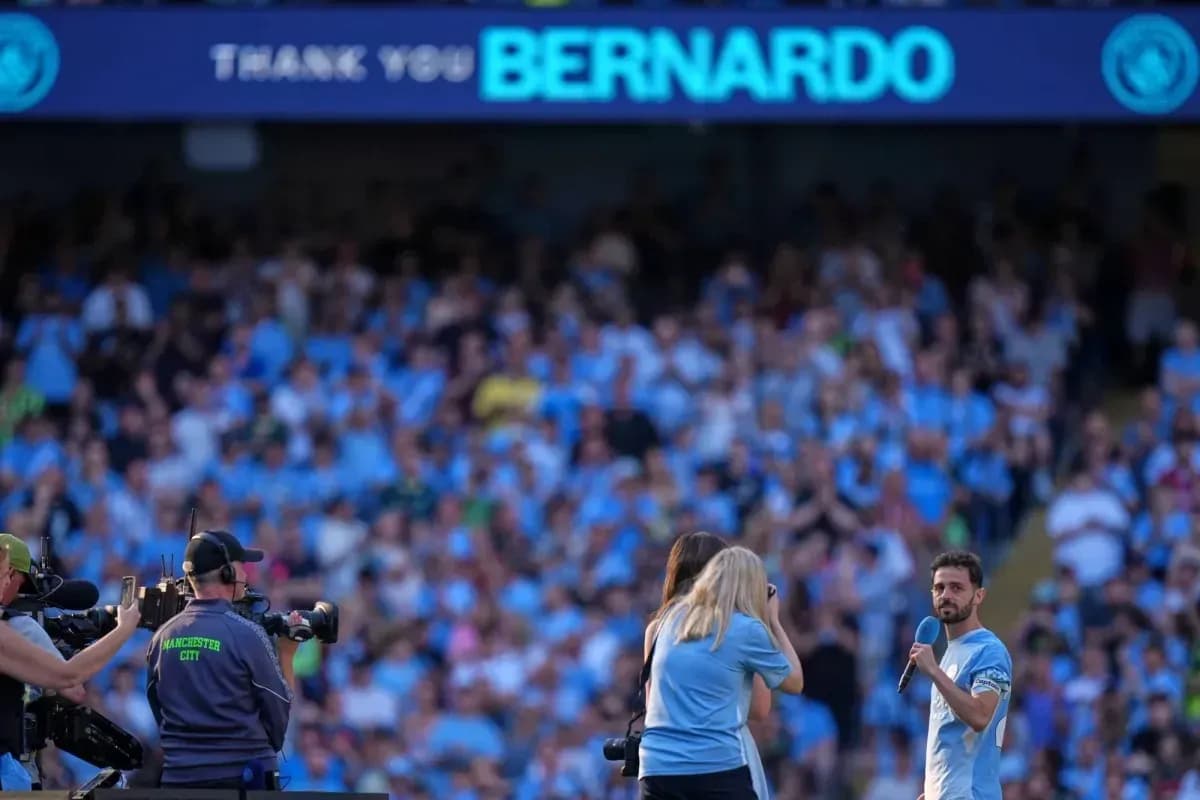
Fernandes himself is fresh from sweeping Premier League player of the year awards. Vitinha and Joao Neves have just lifted a second straight Champions League with Paris Saint-Germain. Bernardo Silva, after a glittering nine-year spell at Manchester City, is set to join Real Madrid.
“We have a very strong team, great individual quality, and beyond the individual quality and the strengths that we have as individual players, I think we are a very cohesive team, a very united team,” Fernandes said. “Obviously our dream is to be there (winning the World Cup) and I think that dreaming is not forbidden.”
No easy games, no long futures
Portugal’s group – DR Congo, Uzbekistan and Colombia in Group K – looks favourable on paper. That is precisely what worries Martinez.
He pointed to Spain’s goalless draw with Cape Verde as a warning about complacency.
“We’ve got very little to win tomorrow from the outside. If you win against Congo, it's expected. If you win by one, it's a big problem. If you draw, it's a catastrophe. If you lose, this is the end of the world,” he said.
“They come with no expectations, they are enjoying being here. We've seen incredible performances from teams like Qatar, Cape Verde, exemplary performances, that shows you that there are no easy games in a World Cup.”
Martinez also confirmed what many had suspected: this is his last dance with Portugal.
“My contract ends after the World Cup. This is not news, this is just a fact,” he said. “We're now focused on finishing the work that we've begun three-and-a-half years ago.
“When I came to Portugal the focus was to try to win everything, but most importantly to prepare for the World Cup.”
So the tournament unfolds with two parallel storylines.
On one side, a sport grappling with structural change – hydration breaks slicing into its rhythm, television networks eyeing new commercial windows, coaches treating halves like quarters. On the other, a 41-year-old forward chasing one final shot at the only trophy missing from his collection, backed by one of the deepest squads Portugal has ever assembled.
Somewhere between those forced pauses and those frantic bursts after the whistle, this World Cup will decide whether football’s new tempo and Ronaldo’s old hunger can coexist – or whether one of them has finally run out of time.