Hradec Králové vs Beşiktaş: Tactical Analysis of a Europa League Qualifier
Hradec Králové’s 3-4-2-1 and Beşiktaş’s 4-1-4-1 produced a tight, territorial Europa League qualifier in which structure and game-state management mattered more than volume of chances. At the Malsovicka arena, the visitors’ 1-0 win hinged on how efficiently they used a slight possession edge (52% to 48%), their block of six out of the ball, and their ability to transition even after going down to ten men.
Hradec Králové’s shape was clearly designed to control central zones and release wing-backs from the midfield line of four. With three centre-backs and two narrow forwards (T. Sloncik initially alongside M. van Buren and O. Mihalik), they aimed to crowd the half-spaces and then break quickly. The home side generated more “clean” efforts on target (9 shots on goal to Beşiktaş’s 5), which reflects a coherent attacking structure: the front three could pin Beşiktaş’s back line while V. Darida and S. Dancak connected play from deeper midfield slots.
However, the absence of blocked shots (0) is revealing. Hradec Králové were often shooting at the end of clearer sequences rather than from heavily congested zones; yet, despite this, they lacked the final detail to beat the Beşiktaş goalkeeper A. Nubel (Beşiktaş), whose save count is not provided but whose defensive unit in front of him absorbed pressure with six blocked efforts. That contrast—home side with more shots on goal, away side with more blocks—illustrates how Beşiktaş’s 4-1-4-1 compacted the box and forced Hradec Králové to finish from less favourable angles or under late pressure.
Discipline and Tactical Adjustments
Discipline shaped the rhythm early. A second-minute yellow for Mick van Buren and a 29th-minute caution for Jakub Uhrinčať nudged Hradec Králové’s back line and central reference forward into more cautious duels, limiting how aggressively they could step into Beşiktaş’s midfield. Beşiktaş’s first booking, for Václav Černý at 37', underlined the visitors’ willingness to break up transitions when Hradec Králové tried to run through the inside channels.
David Horejs adjusted before the break and just after it. At 42', D. Ludvicek (IN) came on for J. Kucera (OUT), refreshing the right side of the 3-4-2-1, likely to maintain intensity in wide pressing. On 59', M. Valenta (IN) replaced S. Dancak (OUT), and A. Umar (IN) came on for M. van Buren (OUT), giving Hradec Králové a new reference in attack and extra legs in midfield. These changes coincided with a period of sustained home pressure, visible in the corner count (8 for Hradec Králové versus 5 for Beşiktaş) and the growing shot tally. The hosts consistently forced Beşiktaş to defend deep, but they could not translate that territorial advantage into a breakthrough.
Beşiktaş’s Tactical Setup
Vincenzo Italiano’s 4-1-4-1 for Beşiktaş was built on S. Ozcan as the single pivot, screening the centre-backs T. Djalo and E. Topcu, with full-backs M. Murillo and Kassoum Ouattara providing width. In possession, the shape often resembled a 2-3-4-1, with Ozcan dropping between or alongside the centre-backs and the advanced line of V. Cerny, J. Olaitan, O. Kokcu and I. Fakili supporting Oh Hyeon-Gyu. The visitors produced fewer shots on goal (5) but a higher volume of attempts that were blocked (6), suggesting they were more willing to shoot through traffic and from the edge of the box, trusting second balls and deflections.
The turning point came with Kassoum Ouattara’s disciplinary collapse. Booked at 65' and again at 71', he immediately saw red at the same 71' mark, leaving Beşiktaş with ten men and forcing a structural rethink. The left side had to be rebalanced, and Italiano responded with a triple substitution at 76': W. Ndidi (IN) for O. Kokcu (OUT), R. Yilmaz (IN) for I. Fakili (OUT), and S. Kilicsoy (IN) for V. Cerny (OUT). Ndidi’s entry added defensive ballast in midfield, R. Yilmaz provided a more conservative profile in the back line, and Kilicsoy offered fresh running up front.
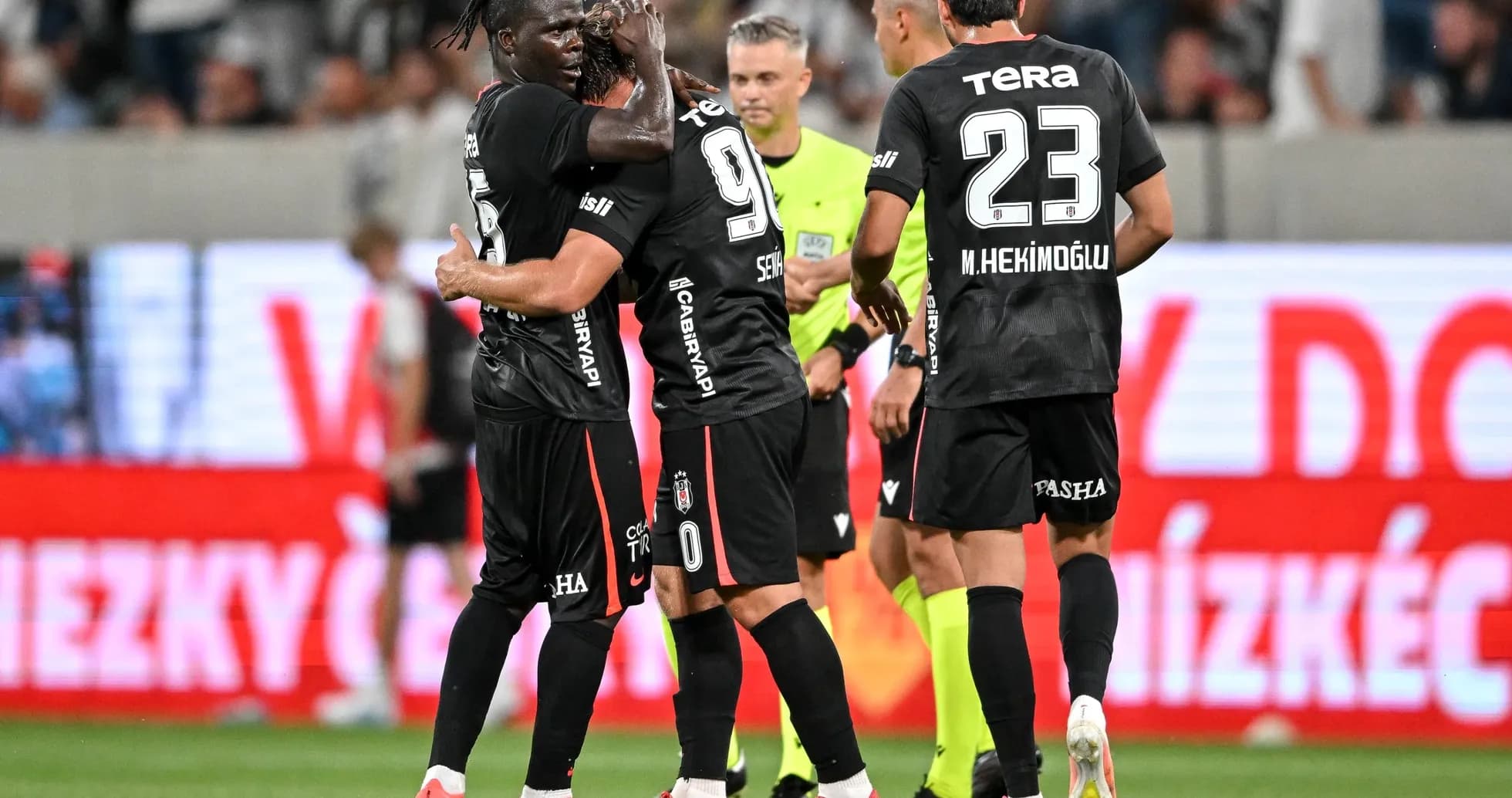
Remarkably, Beşiktaş’s winner arrived just four minutes later. At 80', S. Kilicsoy struck the decisive goal for the visitors, capitalising on a moment when Hradec Králové were still adjusting to the new dynamics of facing a ten-man opponent that had just reorganised. Tactically, the home side’s instinct was to push higher and exploit the numerical superiority, but that created transition lanes that Beşiktaş, now more direct, could attack. Kilicsoy’s goal encapsulated that shift: fewer structured possessions, more emphasis on verticality and exploiting space behind the advanced Hradec Králové line.
Final Phases and Statistical Insights
Horejs tried to re-energise his attack immediately, with D. Trubac (IN) replacing T. Sloncik (OUT) at 81', adding a fresh creator between the lines. Yet the late phases showed a pattern: Hradec Králové pinned Beşiktaş back, accumulated corners and shots on goal, but the visitors’ low block, anchored by Ozcan until his own late substitution at 88' (E. Agbadou IN, S. Ozcan OUT), remained intact. Italiano’s final changes—M. Hekimoglu (IN) for Oh Hyeon-Gyu (OUT) at 88'—were about fresh legs to chase long clearances and relieve pressure.
Statistically, the game underlines contrasting defensive methods. Hradec Králové committed more fouls (10 to 6), reflecting their need to counter-press aggressively whenever Beşiktaş broke the first line. Beşiktaş, by contrast, relied more on positional discipline and compactness than on repeated tactical fouling. The card count—two yellows for Hradec Králové, three yellows and one red for Beşiktaş—mirrors this: the visitors’ defensive intensity on the flanks, especially through Ouattara and Oh Hyeon-Gyu (booked at 83'), occasionally spilled over into late challenges.
With no xG or passing figures available, the clearest statistical picture is territorial and defensive. Beşiktaş edged possession (52%), absorbed more pressure in their own box (six blocked shots, five corners conceded), and yet conceded more shots on goal (9). That they still emerged with a 1-0 away win speaks to the effectiveness of their block and their capacity to strike in the key transition moment through Kilicsoy. For Hradec Králové, the tactical framework was sound enough to control large stretches of the match, but the lack of cutting edge in the final third and vulnerability to a single counterpunch ultimately defined the tie.