HNK Hajduk Split's Tactical Masterclass in UEFA Europa League
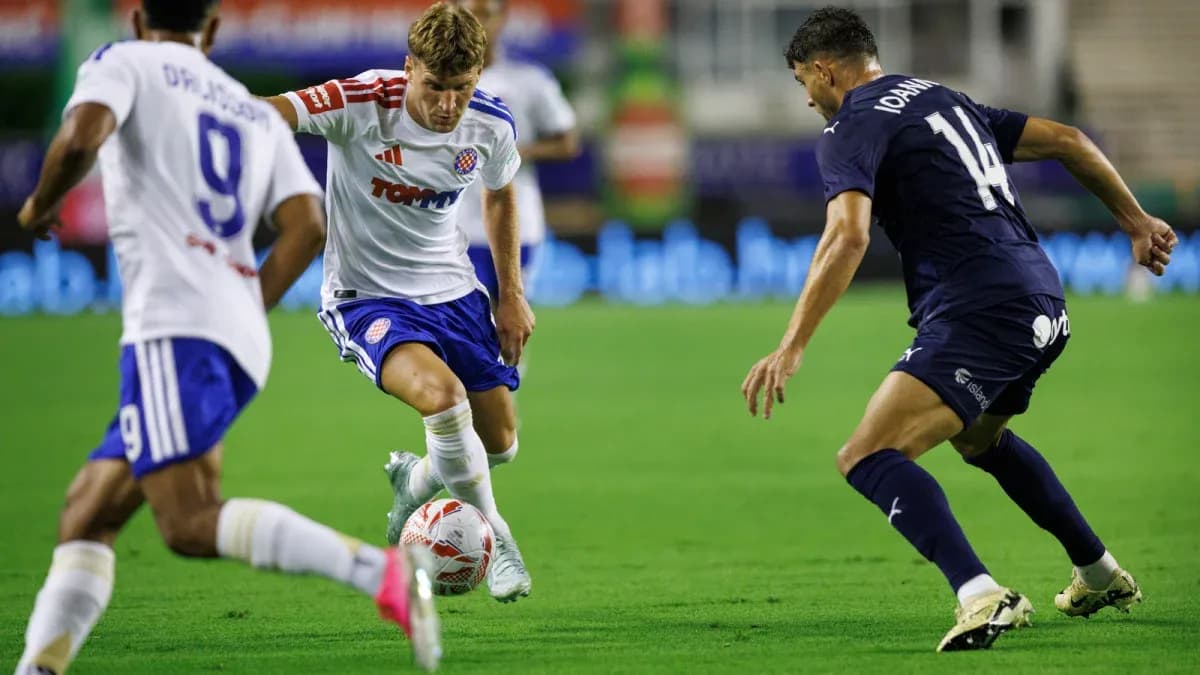
HNK Hajduk Split’s 2-0 win over Pafos at Stadion Poljud in the UEFA Europa League 2nd Qualifying Round was a clinic in compact defending, transitional punch, and intelligent game-state management. Despite trailing the ball possession 45% to 55% and being out-shot 8–14 overall, Hajduk controlled the zones that mattered, striking twice in an 8-minute second-half spell and then closing the game with discipline and structural clarity.
In contrast, Pafos’ 3-4-3 had more of the ball, more total attempts, and more efforts off target (11 shots off goal to Hajduk’s 6), but struggled to convert territorial control into truly destabilising moments. Their attacking shape was too often in front of Hajduk’s block, and once they fell behind, the Cypriot side’s adjustments came without the vertical incision needed to break a well-drilled 4-2-3-1.
Hajduk’s structure was built from a classic 4-2-3-1 base. The back four of S. Hrgovic, A. Van Hoorenbeeck, D. Maresic and M. Acapandie played relatively narrow and conservative, allowing the double pivot of R. Pukstas and Adrion Pajaziti to step out and contest Pafos’ midfield box. With Pafos operating a 3-4-3 featuring wing-backs Jaja and Nikolas Ioannou, the risk for Hajduk was being overloaded in wide areas. Instead, they used intelligent staggering: the full-back on the ball side would engage the wing-back, while the near-side pivot slid across to screen inside lanes, leaving the far-side full-back tucked in to protect the box.
This approach is reflected in the shooting profile. Pafos generated more total shots (14 to 8) and more shots on goal (3 to 2), but Hajduk effectively funnelled many of those efforts into lower-quality zones and rushed attempts, as suggested by Pafos’ high count of shots off goal (11). Hajduk, by contrast, were selective: only 8 total shots, but 2 on target — both converted — indicating a focus on high-value situations rather than volume.
Key Tactical Breakpoints
The first key tactical breakpoint arrived just before the hour. At 55', Nikolas Ioannou (Pafos) collected a yellow card for “Foul”, underlining how often Hajduk’s forwards and attacking midfielders were able to draw contact once they turned Pafos’ defensive line. A minute later, at 56', M. Sego struck the opener for Hajduk. It was the archetypal payoff for their game plan: absorb, spring quickly, and attack the space behind Pafos’ wide defenders. The goal changed the entire dynamic — Pafos, already the side with more possession, now had to chase against a block that could sit even deeper and more compact.
Pafos attempted to respond structurally rather than purely emotionally. At 63', they made a double substitution: Bruno (IN) came on for D. Goldar (OUT), and A. Brito (IN) came on for Pepe (OUT). This hinted at a desire for more progressive passing and perhaps a different distribution of width and depth from the back and midfield. But the reshuffle was immediately punished. At 64', A. Brito himself was booked for “Professional foul”, and in the same minute D. Melnjak doubled Hajduk’s lead, assisted by M. Acapandie. Again, the pattern was clear: Pafos, stretched in transition and adjusting their defensive reference points after changes, were vulnerable to direct, well-timed forward movements from Hajduk’s wide and overlapping players.
From that point, the match became about game management for Hajduk and chase-mode for Pafos. The away side continued to shoot (ending with 14 attempts and 3 on goal), but the hosts’ defensive organisation in their 4-2-3-1 — often morphing into a 4-4-1-1 without the ball — kept most of those efforts at arm’s length. The fact that Hajduk registered 0 blocked shots while Pafos also recorded 0 blocked shots suggests that both sides were generally able to release efforts without last-ditch interventions; instead, the defensive work was done earlier in the phase, through positioning and pressure that forced inaccuracies (notably Pafos’ 11 shots off target).
Substitutions from Hajduk were clearly aimed at preserving structure and physical freshness. At 77', a triple change rebalanced the side: M. Livaja (IN) came on for M. Sego (OUT), A. del Moral (IN) came on for D. de Almeida (OUT), and M. Skelin (IN) came on for D. Maresic (OUT). This allowed Gonzalo Garcia to maintain intensity in the first line of pressure and refresh legs in central areas, crucial as Pafos pushed more men forward. At 83', A. Guram (IN) replaced D. Melnjak (OUT), a like-for-like swap that kept the left flank secure, and at 90+2', R. Raci (IN) came on for S. Hrgovic (OUT), ensuring defensive stability until the final whistle.
Discipline became a subtle but important tactical layer. Hajduk accumulated three yellow cards: Adrion Pajaziti at 4' for “Foul”, Adam Huram at 87' for “Foul”, and Alberto del Moral at 88' for “Professional foul”. These bookings, spread across the match and different zones, reflect a willingness to break up Pafos’ rhythm and prevent transitions, especially late on when the visitors were chasing. Pafos, meanwhile, saw two yellows: Ioannou’s early second-half “Foul” at 55' and A. Brito’s “Professional foul” at 64'. The card balance — HNK Hajduk Split: 3, Pafos: 2, Total: 5 — underlines that both sides engaged in tactical fouling, but Hajduk did so more frequently as they protected their lead.
Statistically, the verdict is clear: Pafos held more of the ball (55% possession), took more shots, and earned 7 corner kicks to Hajduk’s 8, but lacked the precision in the final third. Hajduk’s 2 shots on goal from 8 total attempts being both converted highlights a ruthless edge and a clear emphasis on chance quality over quantity. The absence of free-kick counts (both teams listed at 0) limits deeper set-piece analysis, but the corner numbers and shot patterns suggest that while Pafos reached advanced zones, Hajduk were more incisive once there.
In the context of a two-legged European qualifier, this 2-0 home win — built on a compact 4-2-3-1, sharp transitions, and disciplined late-game management — gives HNK Hajduk Split both a scoreboard cushion and a clear tactical template. Pafos, for all their possession and volume of attempts, will need to find more verticality and penalty-box clarity in the return leg if they are to overturn a deficit created as much by structure and timing as by finishing.