Hannibal Mejbri: Tunisia's Hope at the 2026 FIFA World Cup
The boy named for a general who crossed the Alps now carries a nation’s hopes across football’s biggest mountain.
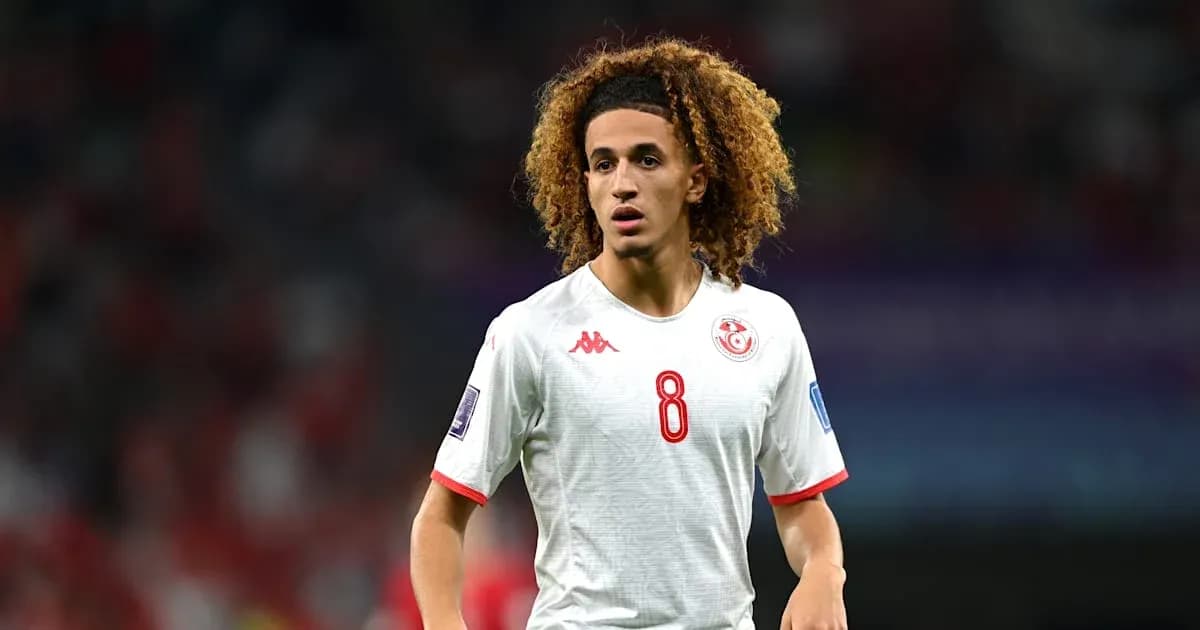
Hannibal Mejbri, 23 years old and already the heartbeat of Tunisia’s midfield, leads the Eagles of Carthage into the 2026 FIFA World Cup with a nickname steeped in history and a story rooted far from ancient battlefields. His Hannibal is not on horseback, but in boots; not staring at Rome’s walls, but at the barrier Tunisia have never broken – the group stage.
The echoes of Carthage travel a long way. They end, improbably, in a curved block of flats in Paris.
From La Banane to the world
Mejbri was born in the French capital to Tunisian parents and raised in the 20th arrondissement, a dense, working-class pocket of Paris where the streets thrum with North and West African life. Tunisians, Algerians, Moroccans. Senegalese, Malians. A patchwork of identities stitched together by one common language: football.
In that neighbourhood stands La Banane, the Banana, a long, arcing block of flats that bends around a courtyard like a concrete touchline. It was here, in the shadows of that curve, that a kid with big, blond hair stayed out until darkness swallowed the day.
“Instead of going straight up to my house, I used to stay out and play football until night fell,” Mejbri recalls in World at Their Feet, the short-form series from Olympics.com tracking emerging talent on the road to the 2026 World Cup. No master plan. No carefully plotted route to the elite. Just a boy, his friends, and a ball.
Childhood friend Hubert Mbuyi remembers how hard it was to miss him. Not just because of the talent.
“He had a unique style, with big hair, big blonde hair. So everyone knew him and had a lot of expectations for him,” Mbuyi says. The formula was simple: “Where you could find a pitch and a ball, you will find Hannibal.”
That restless energy would not stay in La Banane for long.
Paris, Monaco, Manchester: the fast lane
At six, Mejbri joined the academy at Paris FC. Seven formative years followed, the kind that harden touch and sharpen instincts, before a brief stint at Boulogne-Billancourt. Then came the first major leap.
In 2018, Monaco – a club with a well-earned reputation for spotting and polishing young talent – paid €1 million to bring the 15-year-old into their youth system. For a boy from the 20th arrondissement, the contrast was jarring.
“I could feel the richness of Monaco,” he says. “So yeah, it was a little bit of a shift, a little dream, and I learned a lot there.”
The experience on the pitch did not always match the postcard off it. He did not have the smoothest of times in the principality, yet his raw ability and obvious potential were impossible to ignore. Bayern Munich watched. Paris Saint-Germain watched. Barcelona watched.
When the moment of choice arrived in August 2019, he turned elsewhere. The teenager chose Manchester United, three-time Champions League winners and a club that still sells the idea of a pathway from academy to global stage.
His climb through the Old Trafford ranks was quick. By 2021, Mejbri had made his Premier League debut. Two years later, in September 2023, he scored his first top-flight goal for United in a 3–1 home defeat to Brighton. A consolation on the scoreboard, but not in his mind.
“I still get chills,” he admits. “I don’t know why I started to celebrate when we were losing 3–0, and you can see in my celebration that I had a certain rage in me and that I let go of everything when I scored.”
The moment captured him perfectly: emotion spilling over, pride unshaken by the scoreline, a player who fights the game as much as he plays it.
A choice of flag, a question of heart
On the international stage, Mejbri’s decision was just as charged. He represented France at under-16 and under-17 level, a natural step for a Paris-born prospect. The blue shirt fit easily. It did not, in the end, fit best.
In 2021, when Tunisia called, he followed the pull he had always felt.
“I joined Tunisia because I chose with my heart,” he says. “Even though I lived in France, it doesn’t take away the love I have for France. But I find that the love I have for Tunisia is greater.”
That choice has defined his career. He is already 44 caps into his journey with the Eagles of Carthage and has twice been named African Revelation of the Year at the Africa d’Or awards. Each appearance is more than a game. It is a thread back to La Banane.
“When I represent my country, I also represent my neighbourhood,” he says. “Because I know that I will represent them, and so all of that, it’s a bit related to pride.”
In the flats and streets where he first chased the ball until the light disappeared, they feel that connection every time he steps onto the pitch.
“All Tunisians are proud of him,” Mbuyi says. “Because in the end, he’s a kid from the neighbourhood. When he plays matches, everyone focuses on the match. We’re all watching Hannibal’s hair on the pitch. We try to spot him every time.”
The hair remains a beacon. So does the shirt.
Giving back to La Banane
Success has not cut the cord to home. Every summer, Mejbri returns to La Banane and turns the courtyard into a stage, organising a football tournament for the community that raised him. He hands out shirts, too – around 100 last year alone.
“You can just walk around here and find two or three people wearing his shirt,” Mbuyi says. For the kids, it is not just fabric and a name. It is proof.
“Hannibal is a great example of what the people look for in this area. Because of him, the young kids can dream.”
Now the boy who once played until nightfall under the dim lights of a Paris estate leads Tunisia into a World Cup that demands the same stubborn refusal to go home when the sun goes down. The ancient Hannibal rode to the edge of Rome and stalled there, close enough to see the city but not to take it.
This Hannibal, draped in red and white, has his own frontier in sight: dragging the Eagles of Carthage over their own mountain and out of the group stage at last.