Hammarby FF vs Anderlecht: Tactical Analysis of 1-1 Draw in UEFA Europa League
Hammarby FF’s 1-1 draw with Anderlecht at 3Arena in the UEFA Europa League 2nd Qualifying Round was a classic clash of territorial control versus structural compactness. Hammarby dictated much of the ball and volume of shots, but Anderlecht’s early punch and later game-management – even down to ten men – shaped the tactical story.
From the outset, the formations framed the duel: Hammarby in a 4-3-3 that was in reality a very fluid 4-1-4-1/4-3-3 hybrid, against Anderlecht’s more traditional 4-4-2 that often dropped into a 4-4-1-1 without the ball. Hammarby’s back four of H. Skoglund, V. Eriksson, F. Winther and N. Persson were supported by a midfield triangle of M. Karlsson, T. Tekie and V. Lind, with M. Madjed and N. Besara operating between the lines behind central forward P. Abraham. This structure was built to dominate possession and create overloads in the half-spaces.
Anderlecht’s back line of A. Maamar, L. Petrot, G. Biancone and L. Augustinsson sat relatively narrow, with E. Llansana and M. Kana shielding central zones and wide midfielders N. Saliba and K. Nga tasked with shuttling laterally to close Hammarby’s wide rotations. Up front, D. Sikan and J. Onia Seke (later replaced) provided the first line of pressure but were primarily focused on being vertical outlets in transition rather than pressing high.
The early goal at 6' from D. Sikan was a direct product of Anderlecht’s transition emphasis. With Hammarby still settling into their passing rhythm, Anderlecht exploited space behind the midfield three, using a quick vertical sequence that bypassed Hammarby’s first line and isolated the centre-backs. The 4-4-2 allowed Anderlecht to have two high reference points; Sikan’s movement between Eriksson and Winther dragged the line out of shape and punished Hammarby before their rest-defence structure had been properly established.
After that blow, the statistical pattern reflects Hammarby’s tactical response. With 56% possession and 12 total shots (6 on goal), they increasingly pinned Anderlecht back. The full-backs, especially Skoglund and Persson, advanced to create wide superiority, effectively turning the shape into a 2-3-5 in sustained attacks: the two centre-backs holding the halfway line, Tekie sitting as a single pivot, and the advanced five formed by the two full-backs, Karlsson, Madjed and Abraham. Besara’s starting role as a nominal midfielder added another creative presence between Anderlecht’s lines, forcing their double pivot to constantly choose between stepping out or protecting the back four.
Anderlecht, by contrast, accepted a more reactive posture. Their 44% possession and only 6 total shots (4 on goal) underline a game plan built around compactness and selective counters rather than sustained control. The wide midfielders dropped deep, often forming a flat midfield four ahead of the back four. This left Sikan and Onia Seke relatively isolated but kept the central corridor congested, aiming to funnel Hammarby’s attacks into wide areas and then defend crosses with Petrot and Biancone’s aerial presence.
The card profile offers further insight into the defensive strain and aggression balance. Anderlecht collected three yellow cards and one red card, all within a structure under pressure. Nathan-Dylan Saliba’s bookings at 24' and 78', followed immediately by his red card at 78', were emblematic: as Hammarby’s midfield rotations increased and the tempo rose, Anderlecht’s wide and central midfielders were repeatedly forced into late or desperate interventions to break rhythm. Ludwig Augustinsson’s yellow at 27' similarly reflected the difficulty of managing Hammarby’s wide overloads and overlapping full-backs.
Hammarby’s two yellow cards, for Frederik Winther at 35' and Victor Eriksson at 46', point to the vulnerability that came with their high line and aggressive rest-defence. With both centre-backs cautioned, their ability to defend Sikan’s and later substitutes’ runs into depth was compromised, which in turn forced Hammarby to be slightly more cautious with their counter-press, especially in the second half.
Substitutions were used tactically rather than merely for freshness. Anderlecht’s first change at 55' – M. N’Diaye (IN) came on for L. Augustinsson (OUT) – suggested an adjustment on the left side, likely to maintain defensive intensity against Hammarby’s right-flank combinations. The double change at 64', with M. Cvetkovic (IN) for K. Nga (OUT) and L. Ambros (IN) for M. Kana (OUT), indicated a desire to refresh both the wide and central midfield zones to cope with Hammarby’s growing territorial dominance.
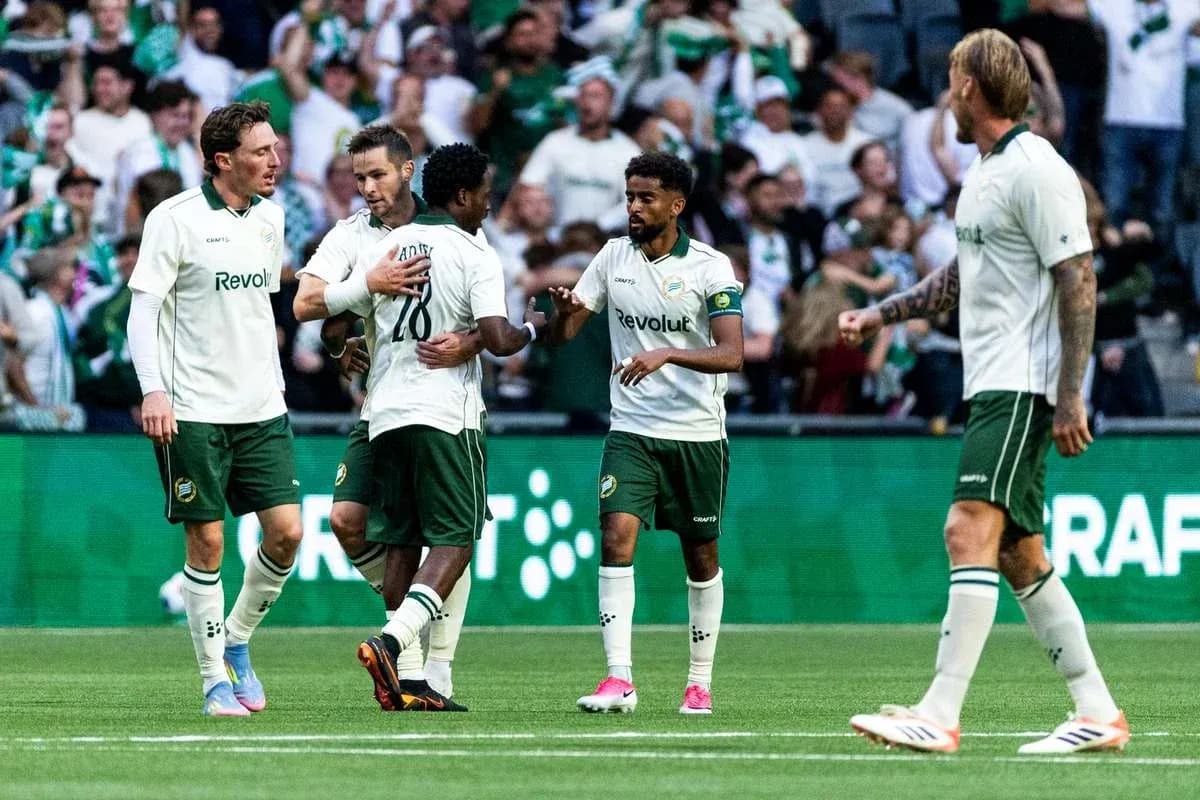
Hammarby’s key offensive shift came at 75', when O. Johansson (IN) came on for N. Besara (OUT). This change injected fresh legs and slightly more verticality into the attacking midfield line, with Johansson’s energy helping to sustain pressure against an Anderlecht side that was now defending deeper and, after Saliba’s dismissal at 78', with ten men. Later, at 86', F. Adjei (IN) came on for V. Lind (OUT), a substitution that directly impacted the scoreboard: Adjei’s late goal at 89', assisted by P. Abraham, rewarded Hammarby’s insistence on keeping numbers high in the box and continuing to attack the channels against a tiring, numerically reduced block.
From a territorial and chance-creation perspective, Hammarby’s 5 corner kicks to Anderlecht’s 2 underline their sustained pressure, particularly in the second half. The lack of recorded blocked shots for either side (0-0) suggests that when Hammarby did create shooting opportunities, they were often able to get efforts through to goal rather than being shut down at source – a function of their ability to shift Anderlecht’s block laterally and find shooting lanes at the edge or just inside the box.
Anderlecht’s resilience, however, should not be understated. Despite the numerical disadvantage and lower shot volume, they still produced 4 shots on goal from just 6 attempts, indicating a relatively high shot quality when they did break forward. Their compact 4-4-1 after the red card, combined with disciplined central protection, limited Hammarby to a single breakthrough despite the possession and territorial edge.
In tactical terms, the 1-1 scoreline reflects a contest where Hammarby’s structured, possession-heavy 4-3-3 largely imposed its will territorially, but Anderlecht’s early transition goal and later deep-block resilience – even after Saliba’s dismissal – allowed them to escape 3Arena with a draw. For the return leg, Hammarby will feel their positional play and shot volume give them a platform to build on, while Anderlecht will be encouraged by how their 4-4-2/4-4-1 defensive framework and transition threat remained effective under sustained pressure.