The Guardiola Effect: How Pep Reshaped the Premier League
Ask a Premier League manager who shaped the way they see the game and one name keeps coming back: Pep Guardiola.
When he finally walks away from Manchester City, his legacy will not be a single team or a stack of medals. It will be a league that now thinks, trains and plays in his image – even when it tries to rebel against him.
The goalkeeper revolution – and the full circle
Guardiola’s first big act at City set the tone. He arrived, took one look at Joe Hart – a title-winning, fan-favourite England No 1 – and moved him out. In came Claudio Bravo. Then Ederson.
He didn’t just want a goalkeeper. He wanted a playmaker in gloves, a man who could split a press with a 40-yard pass. In England, that was close to heresy. Pundits lined up to question him. Supporters wondered if he understood the league he had walked into.
Ten years on, it is almost unthinkable for a top-flight club to go without a keeper who can play. The old-school shot-stopper became an endangered species. Manchester United shifted from David de Gea to Andre Onana. Arsenal moved Aaron Ramsdale aside for David Raya. Chelsea cycled from Edouard Mendy to Kepa Arrizabalaga to Robert Sanchez. Across the division, the template was clear: if you can’t pass, you don’t last.
Then the game tilted again.
High, aggressive, man-to-man pressing from goal-kicks changed the risk-reward equation. Playing out from the back became a tightrope. Space for attacking teams moved higher up the pitch. Mistakes in the first phase were punished brutally.
And at City, the symbol of Guardiola’s revolution, Ederson – the archetype of the modern, passing goalkeeper – gave way to Gianluigi Donnarumma, a keeper whose reputation rests far more on one-against-one dominance than on his distribution.
Donnarumma’s ability to win duels had underpinned Paris St-Germain’s Champions League triumph. Guardiola decided that in a world of suffocating presses and razor-thin margins, that skill was worth reshaping his own idea of a No 1.
City still take risks. Against the most aggressive pressers, they sometimes go short anyway, asking Bernardo Silva or Rodri to drop onto the penalty spot to receive. It can look like a five-a-side game played inside their own box. But it’s calculated chaos, designed to draw opponents in and then slice through them.
The priority, though, has shifted. In tight games, City now place a premium on the keeper who wins the big duel, not just the one who splits the lines. United have followed, replacing Onana with Senne Lammens, a more traditional profile. A decade on from Hart’s exile, the league has almost looped back on itself – only this time with Guardiola still at the centre of the change.
From makeshift full-backs to a tactical blueprint
The 2017-18 season, when City hit 100 points, is remembered for the records. It should also be remembered for an injury crisis that forced Guardiola into one of his most influential ideas.
Early that campaign, City ran out of natural full-backs on the left. No obvious solution. No specialist to plug in. So Guardiola scanned his squad for left-footers with the technique to play inside. He landed on Oleksandr Zinchenko and Fabian Delph.
Instead of hugging the touchline, his left-back stepped into midfield alongside the holding player. The role inverted. That tweak did several things at once: it thickened City’s presence in the middle, improved their build-up, protected them in transition and freed the winger to stay wide and stretch the pitch.
Opponents could not get to grips with it. The jigsaw snapped into place, and City surged away from the pack.
The idea spread. When Mikel Arteta took Zinchenko to Arsenal, he built some of his most fluent football around that same principle, full-backs drifting infield to overload midfield. Ange Postecoglou, another Guardiola disciple, used Pedro Porro and Destiny Udogie in similar fashion at Tottenham, stepping inside next to the pivot to control games from the centre.
Guardiola, though, never left the concept alone. When Zinchenko was injured in 2018-19, Aymeric Laporte – a left-footed centre-back – filled in at left-back. In the Treble season of 2022-23, Manuel Akanji and Nathan Ake started wide of Ruben Dias and John Stones, nominally as full-backs but functionally as part of a four-man central defensive unit. Stones would then stride into midfield, turning a back four into a three, and a midfield two into a three.
That shift opened the door to a new breed of “full-back”: centre-backs stationed on the flank, building a back three in possession, then defending the width out of it. Newcastle’s Dan Burn, at 6ft 7in, has become the poster boy for that trend, tucking in as a third centre-half on the ball while defending like a conventional left-back when out of possession.
At the other end of the spectrum, Guardiola has also leaned into hyper-attacking full-backs. Joao Cancelo, and now Nico O’Reilly, have been used as roaming playmakers from wide starting positions, drifting centrally and high, arriving in the box to create and score. It is full-back as No 10, with chalk on their boots only in the opening phase.
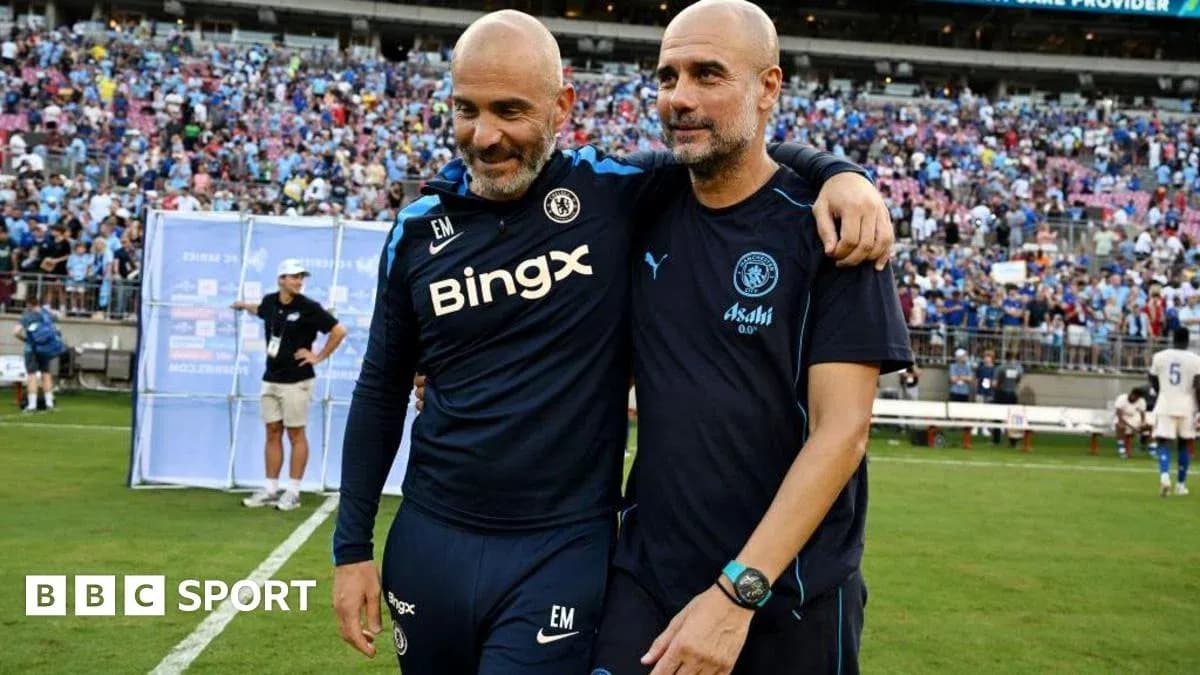
Arteta has followed with Jurrien Timber and Riccardo Calafiori at Arsenal. At Chelsea, Malo Gusto and Marc Cucurella have been asked to step in and up, operating more like midfielders under Enzo Maresca, another coach steeped in Guardiola’s school of thought.
What began as an emergency fix has become one of the defining tactical threads of the modern Premier League.
Owning the ball, owning the league
Guardiola has always been obsessed with possession. Not as a statistic, but as a form of control.
In his Barcelona days, after a Champions League tie against Inter Milan in which he started Zlatan Ibrahimovic and played more directly, he confided that he felt he had betrayed himself. Less of the ball, quicker attacks, more chaos. It gnawed at him. He resolved that if he failed, he would do so on his own terms, with his team dictating the rhythm.
At City, that vow has held. The method has evolved – inverted full-backs, centre-backs stepping into midfield, wingers wide or narrow depending on the opponent – but the core principle remains: dominate the ball, dominate the game.
In 2017-18, City averaged 71.9% possession across the league season. Since then, they have never dropped below 60%. Six titles in seven seasons turned that approach from an outlier into the benchmark.
The league has bent towards it. Liverpool under Arne Slot, champions in his first season, played with more control and structure than under Jurgen Klopp, closer to Guardiola’s positional game than to Klopp’s relentless, transitional storm. Arteta’s Arsenal have combined a ferocious defensive record with a clear desire to keep the ball and suffocate opponents.
At Brighton, a club built on a sustainable model, the board have repeatedly hired coaches who want to impose themselves through possession. Roberto De Zerbi and Fabian Hürzeler both followed that line, using the ball as their main defensive weapon.
Others have tried to live in that world and been found out. Scott Parker, Vincent Kompany and Russell Martin all clung to a possession-first philosophy in the Premier League, only to discover that without the right level of player, and without Guardiola’s capacity to adapt, the idea alone is not enough. Their struggles underline how deeply his influence runs – and how hard it is to replicate.
Before Guardiola, English football prided itself on intensity, verticality and speed. Sir Alex Ferguson’s Manchester United sides defined that era: fast attacks, wide play, ruthless counter-punching. Under Michael Carrick, United have leaned back into those roots, thriving on transition moments.
Yet Guardiola walked into a league stamped with Ferguson’s tactical DNA and rewrote much of its playbook. The Premier League is still quick, still physical, still unforgiving. But its best teams now spend long stretches of games constructing attacks patiently, rotating positions, baiting presses, searching for the spare man. That shift has his fingerprints all over it.
The myth of a fixed ideology
One of the great misconceptions about Guardiola is that he simply imposes a rigid style, forcing a league to bend to him. The reality is more nuanced – and more impressive.
He does have non-negotiables: he wants technical players, he wants his team to control space and the ball, he wants structure. Inside that framework, though, he is relentlessly pragmatic. He builds around the players he has, the injuries he suffers, the weaknesses he spots in the competition.
He has won with false nines and with classic centre-forwards. With wingers hugging the touchline and with wide men drifting into the half-spaces. With full-backs inverted, with full-backs overlapping, with full-backs who are barely full-backs at all.
Each time the league starts to copy what has just brought him success, he moves again. By the time rivals install their ball-playing goalkeeper, he is prioritising one-on-one specialists. When they finally bed in their inverted full-backs, he is fielding a back line of centre-halves. When they mimic his possession structure, he tweaks the pressing triggers or the height of his defensive line.
That, more than any single tactical innovation, is the Guardiola effect on the Premier League: a constant raising of the bar, a moving target that others can see but never quite catch.
The managers who grew up watching him are now on the touchline opposite him, trying to beat him with ideas he helped plant. The question for the league is simple: when he does eventually leave Manchester, will English football keep chasing his shadow, or is someone finally ready to set the next agenda?