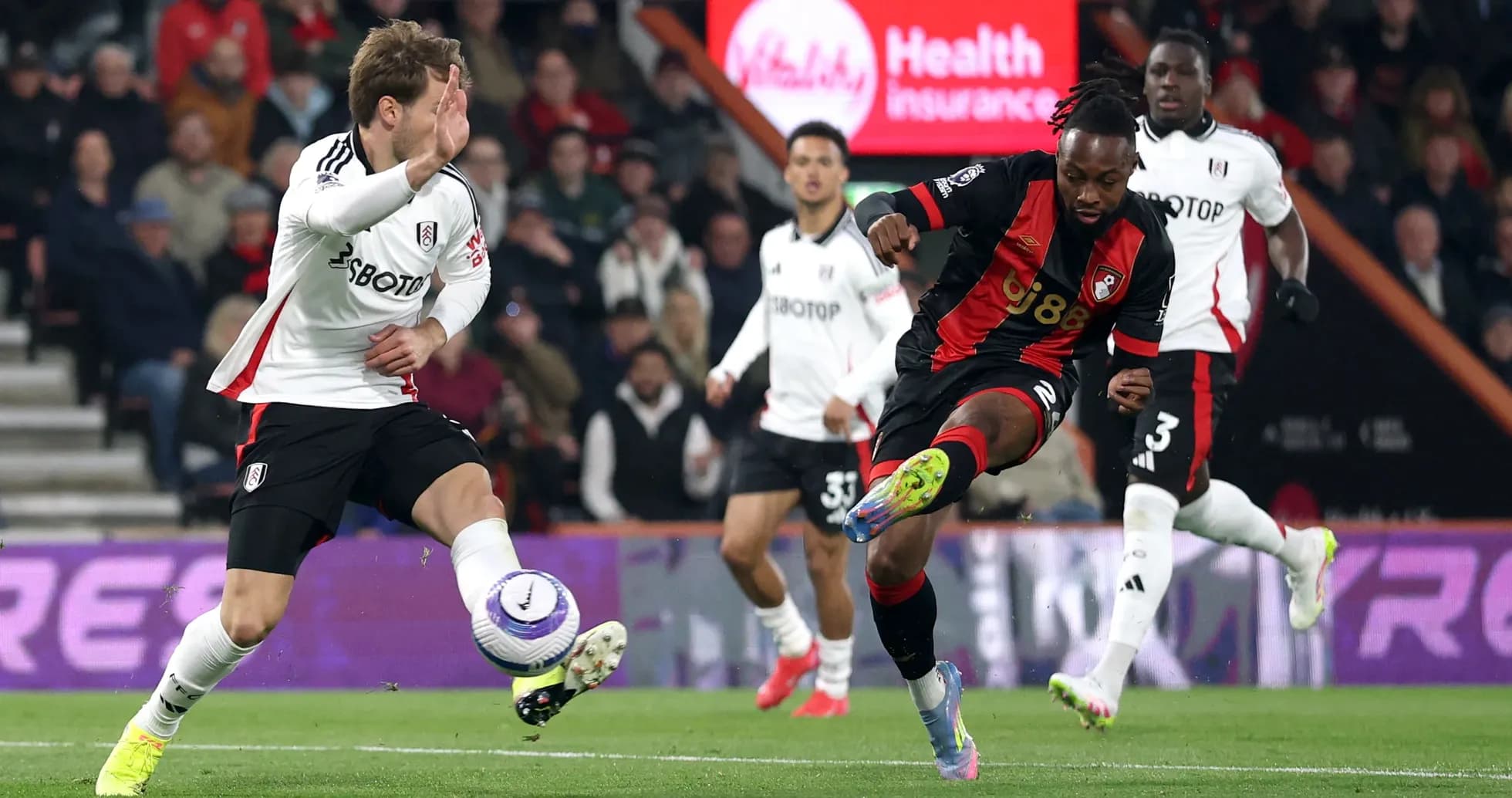
Fulham vs Bournemouth: Tactical Analysis of a Tight Contest
Craven Cottage felt tight and tense as the final whistle confirmed a 0–1 defeat for Fulham, a result that underlined the contrasting trajectories of these two sides heading into the closing stretch of the 2025–26 Premier League season. Following this result, Fulham remain 11th on 48 points with a goal difference of -6, while Bournemouth consolidate 6th on 55 points with a goal difference of 4, still firmly in the Europa League conversation.
I. The Big Picture – Styles colliding on the Thames
This was a meeting of two distinct seasonal identities. At home, Fulham have been defined by efficiency and edge: 10 wins from 18 at Craven Cottage, with 28 goals for and only 20 against. Their home attacking average of 1.6 goals per game has been the bedrock of mid-table stability, even as their overall record (14 wins, 6 draws, 16 losses) and total goals against of 50 have exposed defensive frailties on their travels.
Bournemouth arrived as one of the league’s most resilient and awkward assignments. Overall they have drawn 16 of 36 matches, losing only 7, with 56 goals scored and 52 conceded. On their travels they have been balanced and dangerous: 6 away wins, 7 draws, 5 defeats, scoring 28 and conceding 33, with an away attacking average of 1.6 goals per game. Their form line of WWDWW coming into this fixture hinted at a side that knows how to manage tight games and squeeze value from marginal moments.
The 0–1 scoreline fit that pattern. Fulham, who overall average 1.2 goals for and 1.4 against per match, were held below their usual home output by a Bournemouth side comfortable in a compact, counter-punching role.
II. Tactical Voids – Absences and discipline
Both managers had to navigate notable absences that subtly reshaped the tactical landscape.
Marco Silva was without A. Iwobi (injury) and R. Sessegnon (hamstring injury), removing two flexible, line-breaking options from his rotation. Without Iwobi’s ability to drift inside and link, Fulham leaned more heavily on Harry Wilson and Emile Smith Rowe to provide creativity between the lines, and on Samuel Chukwueze to carry the ball in wide channels.
For Andoni Iraola, the absences were arguably more structurally significant. L. Cook (hamstring injury) and J. Soler (hamstring injury) were unavailable, stripping Bournemouth of a controlling presence in midfield and an extra technical profile in advanced zones. More disruptive still was the suspension of Álex Jiménez, Bournemouth’s most card-prone defender with 10 yellow cards and a reputation for aggressive duels. His absence forced a reshuffle in the back line and removed a defender who had contributed 11 successful blocks over the campaign.
Disciplinary trends also framed the risk management on both sides. Fulham’s season card profile shows a pronounced spike in yellow cards from 46–60 minutes (21.92%) and a sustained late-game aggression, with 20.55% of yellows between 76–90 and a further 23.29% in added time (91–105). Bournemouth are even more combustible late on, with 27.71% of their yellows between 76–90 and 20.48% between 91–105. Both teams, then, are used to walking a disciplinary tightrope as matches stretch and spaces open.
That history inevitably influenced how Fulham’s back line – particularly Joachim Andersen, who has already seen red once this season – approached Bournemouth’s transitions, and how Ryan Christie, who carries one red card of his own, balanced his pressing intensity with restraint in midfield.
III. Key Matchups – Hunter vs Shield, and the engine room
The headline duel was always going to involve Bournemouth’s cutting edge. Eli Junior Kroupi, one of the league’s standout young attackers, came into this fixture with 12 league goals and 2 penalties scored from 2 attempts. His 29 total shots with 20 on target underline his efficiency, and his 21 key passes show that he is more than just a finisher.
Against a Fulham defence that, overall, concedes 1.4 goals per game and 50 in total, Kroupi’s movement between the lines and in the half-spaces was a constant threat. The “shield” for Fulham was anchored by Andersen and Calvin Bassey, with Antonee Robinson providing recovery pace on the flank. Andersen’s profile – 45 tackles, 19 successful blocks and 36 interceptions across the season – set the tone. He is an anticipatory defender who steps out to break play early, and Bournemouth looked to exploit the space behind him whenever he was drawn forward.
In the engine room, the battle was more nuanced. Saša Lukić, Fulham’s combative midfielder with 44 tackles, 9 blocks and 16 interceptions, is also one of the league’s more frequent foulers, with 50 fouls committed and 9 yellow cards. His role was to disrupt Bournemouth’s rhythm, especially around Alex Scott and Ryan Christie. Bournemouth’s central pair needed to withstand Lukić’s pressure while still progressing the ball into the feet of Kroupi, Marcus Tavernier and Evanilson.
Harry Wilson was Fulham’s creative axis. With 10 goals, 6 assists and 38 key passes, he has been their premier chance creator, and his duel with Bournemouth’s midfield screen was decisive. Bournemouth’s structure aimed to deny Wilson the pockets where he can turn and thread passes, forcing him wider and deeper, and trusting Adam Smith and Marcos Senesi to handle the subsequent crosses.
IV. Statistical Prognosis – Margins and xG logic
On the balance of seasonal data, a narrow Bournemouth edge in xG expectation was always plausible. Their overall attacking average of 1.6 goals per game, matched home and away, suggests they generate consistent shot quality, while their 11 clean sheets (5 away) point to a defensive unit capable of absorbing pressure and still limiting high-quality chances.
Fulham, by contrast, are a split personality: robust at home with 1.6 goals scored and only 1.1 conceded on average, but less secure when stretched. Even at Craven Cottage, their 6 home defeats and 3 home failures to score hinted at vulnerability against well-organised, transition-savvy opponents.
Following this result, the numbers and the narrative align. Bournemouth’s maturity in game management, their capacity to turn half-chances into decisive moments through players like Kroupi, and their late-game discipline – despite a history of yellow-card surges – combined to edge a tight contest. Fulham’s structure, anchored by Andersen and powered creatively by Wilson, remains solid, but against opponents of Bournemouth’s defensive solidity and attacking efficiency, their margin for error is wafer-thin. Here, that margin was the single goal that separated mid-table comfort from European ambition.