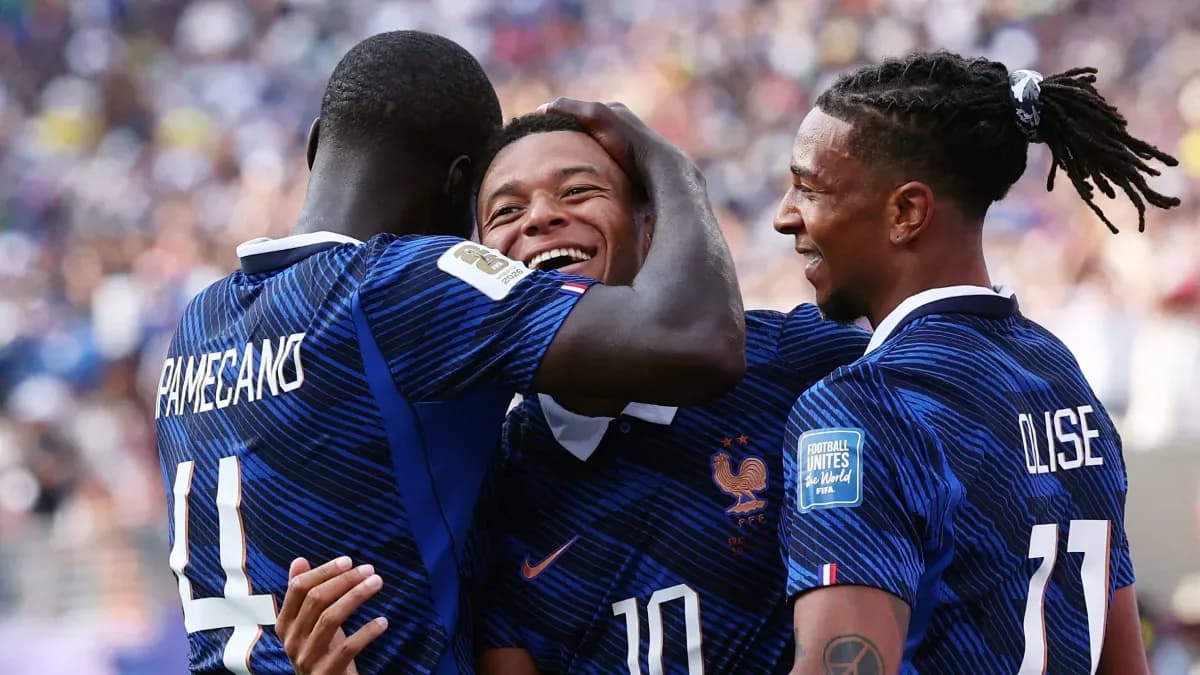
Exploring France's Multicultural 2026 World Cup Squad Led by Kylian Mbappe
In international soccer, questions about players' national eligibility often stir debate. For France, criticism has emerged suggesting their squad is packed with players born outside French borders. Yet, according to The Athletic, 23 out of the 26 players on Les Bleus’ 2026 World Cup roster were actually born in France.
National team eligibility isn’t determined solely by birthplace. FIFA rules allow players to represent a country if they meet any of four criteria: being born there, having a parent or grandparent born there, or residing there for a certain period.
Foreign-born Players in France's Squad
The team includes just three members born outside France:
- Michael Olise, born in London, England, to a French-Algerian mother, has been impressive throughout the tournament. Despite not scoring yet, he leads with five assists. Olise chose France over England, Algeria, and Nigeria because he grew up admiring French stars like Zidane and Henry and felt a natural connection to the country.
- Marcus Thuram, born in Parma, Italy, has dual citizenship from Guadeloupe and France. His father, Lilian Thuram, also a former French international, likely influenced his decision to play for France. Marcus has scored three goals in 35 appearances for Les Bleus.
- Brice Samba, the backup goalkeeper, was born in Linzolo, Republic of the Congo. He moved to France early and later became a citizen, choosing to represent France internationally.
France Tops Birthplace Rankings Among World Cup Teams
Despite some claims, France leads all nations in the number of players born in their country participating in the 2026 World Cup. The Athletic reports 99 players across 13 different countries were born in France. Here’s a breakdown of countries with the most native-born players at the tournament:
2026 France World Cup Roster Overview
Guided by coach Didier Deschamps, the squad blends talent from domestic and international clubs. Some key players include:
- Goalkeepers: Mike Maignan (AC Milan), Robin Risser (Lens), Brice Samba (Rennes)
- Defenders: Lucas Digne (Aston Villa), Malo Gusto (Chelsea), Lucas Hernandez (Paris Saint-Germain), Theo Hernandez (Al-Hilal), Ibrahima Konate (Liverpool), Jules Kounde (Barcelona), Maxence Lacroix (Crystal Palace), Dayot Upamecano (Bayern Munich), William Saliba (Arsenal)
- Midfielders: N'Golo Kante (Fenerbahce), Manu Kone (AS Roma), Adrien Rabiot (AC Milan), Aurelien Tchouameni (Real Madrid), Warren Zaire-Emery (Paris Saint-Germain)
- Forwards: Maghnes Akliouche (Monaco), Bradley Barcola (Paris Saint-Germain), Rayan Cherki (Manchester City), Ousmane Dembele (Paris Saint-Germain), Desire Doue (Paris Saint-Germain), Jean-Philippe Mateta (Crystal Palace), Kylian Mbappe (Real Madrid), Michael Olise (Bayern Munich), Marcus Thuram (Inter Milan)
Understanding Player Eligibility Rules
A player can represent a nation if they were born there, have a parent or grandparent born there, or have lived there for a defined duration. This explains why players like Olise, Thuram, and Samba, born abroad, wear the French jersey. Meanwhile, other nations show similar patterns; Morocco’s team, for instance, features six players born in France but eligible through Moroccan heritage.