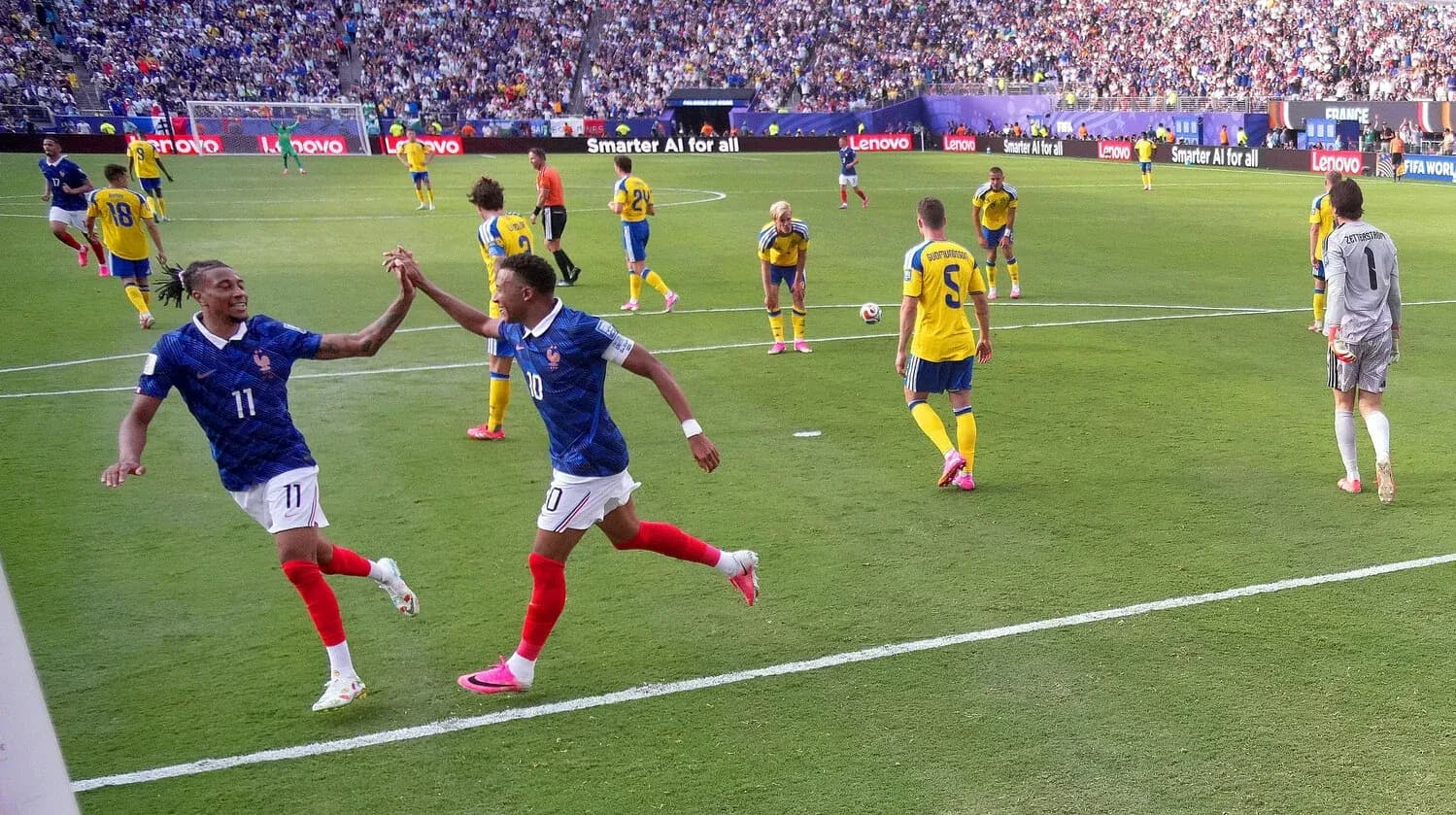
France vs Sweden: World Cup Round of 32 Clash
MetLife Stadium in New-York stages a World Cup Round of 32 clash that feels more like a collision of footballing ideologies than a simple knockout tie: France, perfect through the group phase and statistically the tournament’s most ruthless side, against a volatile but dangerous Sweden whose ceiling is high, but whose defensive floor is alarmingly low.
Heading into this game, France arrive as the form team of the World Cup. They topped Group I with 9 points from 3 matches, scoring 10 and conceding 2; that gives them an overall goal difference of 8, exactly matching the standings. Across the entire tournament so far, they have played 4 fixtures, winning all 4. At home venues they have played 3 times, winning all 3, while on their travels they have 1 win from 1. Their attacking output is relentless: overall they have scored 13 goals, with 9 at home and 4 away. That translates to an overall average of 3.3 goals per game, with 3.0 at home and an even more explosive 4.0 away. Defensively, they have conceded just 2 in total, 1 at home and 1 away, for an overall average of 0.5 goals against per match (0.3 at home, 1.0 away). Two clean sheets in total underline a side that is not only dominant but balanced.
Sweden’s route has been far more turbulent. Their group record shows 1 win, 1 draw and 1 defeat, with 7 goals scored and 7 conceded overall – a goal difference of 0 that accurately captures their instability. In the broader tournament sample of 4 fixtures, Sweden have played once at a home venue and 3 times away. At home they have 1 win from 1, scoring 5 and conceding 1, an extraordinary home average of 5.0 goals for and 1.0 against. But on their travels they have struggled: 0 wins, 1 draw and 2 defeats, with only 2 goals scored and 9 conceded, giving an away average of 0.7 goals for and 3.0 against, and a total of 10 goals conceded overall (1 at home, 9 away). There is no clean sheet yet, and they have failed to score once away. Sweden are capable of devastating bursts, as that 5-1 home win shows, but their away profile is exactly what a side like France is built to punish.
France’s Tactical Setup
Didier Deschamps doubles down on France’s identity with a 4-2-3-1 that has become their tactical signature in this tournament, used in all 4 matches so far. Mike Maignan anchors the side in goal, shielded by a back four of Jules Kounde, Dayot Upamecano, William Saliba and Lucas Digne. In front of them, Aurelien Tchouameni and Adrien Rabiot form a double pivot designed to suffocate transitions and recycle possession quickly into the attacking three of Ousmane Dembele, Michael Olise and Bradley Barcola, all servicing the tournament’s most lethal finisher, Kylian Mbappe.
Mbappe is not just France’s spearhead; he is the World Cup’s defining figure so far. Across 4 appearances and 351 minutes, he has 6 goals and 2 assists, with 19 shots and 13 on target, and a rating of 8.65. His 10 key passes and 18 dribble attempts, 7 successful, show a player who is as much creator as finisher. Beside him, Dembele has 4 goals and 2 assists from 288 minutes, with 7 shots (5 on target), 9 key passes and 8 dribble attempts, 4 successful. Between them they have produced 10 goals and 4 assists overall, a two-pronged storm aimed squarely at Sweden’s most fragile zone: their away defence.
Behind those stars, Olise quietly dictates. He leads the assist charts with 5 overall, from 4 appearances and 308 minutes. His 211 passes at 87% accuracy, 9 key passes and 8 successful dribbles from 11 attempts show a playmaker comfortable both between the lines and wide, able to draw defenders out and slip runners through. His duel numbers – 34 contested, 19 won – underline a willingness to compete physically, crucial against Sweden’s robust back line.
Sweden’s Tactical Setup
Graham Potter’s Sweden line up in a 4-4-2 for this tie, a departure from the three-at-the-back systems they have often used (3-1-4-2 twice and 3-4-3 once). Johan Widell Zetterstrom starts in goal, protected by a back four of Daniel Svensson, Gustaf Lagerbielke, Victor Lindelof and Gabriel Gudmundsson. The midfield four of Anthony Elanga, Lucas Bergvall, Yasin Ayari and Ethan Stroud must both screen that back line and connect to the front pair of Viktor Gyokeres and Alexander Isak.
Up front, Sweden have weapons. Isak, one of the tournament’s leading creators, has 1 goal and 3 assists overall, from 4 appearances and 358 minutes. His 7 shots (6 on target), 7 key passes and 77% passing accuracy make him the conduit between midfield and attack. Gyokeres adds power and persistence: 1 goal and 2 assists overall, 9 shots with 6 on target, and 40 duels contested, 16 won. He has also drawn 7 fouls, a sign of how often he occupies and irritates centre-backs. Together, they form Sweden’s “Hunter” axis, tasked with prying open a French defence that has conceded just 2 goals in 4 matches overall.
Key Matchups
The “Engine Room” duel is equally intriguing. On one side, Tchouameni and Rabiot, whose positional discipline will be vital in preventing Sweden’s forwards from receiving between the lines. On the other, Ayari and Bergvall. Bergvall, who has 1 assist and 84 passes at 88% accuracy overall, also carries a disciplinary edge: he has 1 yellow card and has committed 7 fouls. Sweden’s card profile is telling: overall their yellows are spread across the match, but 40.00% come between 76-90 minutes, a clear late-game surge of desperation or fatigue. France, by contrast, have only 1 yellow card overall, and it arrived between 61-75 minutes, suggesting a side that rarely loses control.
That disciplinary contrast feeds directly into the tactical prognosis. France’s attack tends to build pressure relentlessly; even without minute-by-minute goal data, their overall scoring average of 3.3 per game, combined with Sweden’s overall concession rate of 2.5 and away concession rate of 3.0, points towards a match where the French front four generate sustained waves of chances. Sweden’s late-game yellow-card spike between 76-90 minutes intersects ominously with the period where France’s depth can introduce fresh legs like Marcus Thuram, Rayan Cherki or Warren Zaire-Emery from the bench, driving at tiring defenders already on bookings.
Defensively, France’s overall average of 0.5 goals conceded per match, and 2 clean sheets, suggest that even if Isak and Gyokeres fashion moments in transition, those will likely be isolated rather than sustained. Sweden’s inability to keep a clean sheet overall, combined with 10 goals conceded in 4 matches, makes a shutout against Mbappe, Dembele and Olise statistically improbable.
In narrative terms, this Round of 32 tie feels like a test of whether Sweden’s attacking duo can punch hard enough to destabilise a structurally superior opponent. But the numbers lean heavily towards France: perfect form, a huge positive goal difference, and an attack that has already produced 13 goals overall against a defence that leaks 2.5 per game. The tactical story points to Deschamps’ side controlling territory and tempo, Sweden relying on counters and set pieces, and the late stages at MetLife Stadium likely belonging to France’s bench-fuelled onslaught against a Swedish back line walking a disciplinary tightrope.