Ferencvarosi TC vs Twente: Tactical Insights from a 2-2 Draw
Ferencvarosi TC and Twente produced a tactically volatile 2-2 draw at Groupama Aréna in the UEFA Europa League 2nd Qualifying Round, a match defined less by volume statistics and more by structural shifts and game-state management. Ferencvaros led 1-0 at half-time and extended that advantage to 2-0 despite going down to ten men before the break, only for Twente’s bench-driven response to tilt the dynamics and force parity late on. With virtually all core metrics (possession, shots, passing) unavailable, the tactical story is written through formations, substitutions, disciplinary swings and the evolving risk profiles of both coaches.
Opening Phase
The opening phase saw Ferencvarosi TC’s 4-3-3 interpreted in a notably front-foot way. Balazs Borbely deployed D. Dibusz in goal behind a back line anchored by M. Gomez and T. Raemaekers, with Cadu nominally wide on the left of the defensive band but listed as a midfielder, hinting at an asymmetric full-back role. In midfield, P. Rommens, G. Kanichowsky and M. Corbu offered a compact central trio, while the advanced line of K. Zachariassen, L. Joseph and C. O’Dowda was designed to attack Twente’s back four through flexible movement rather than a fixed centre-forward reference.
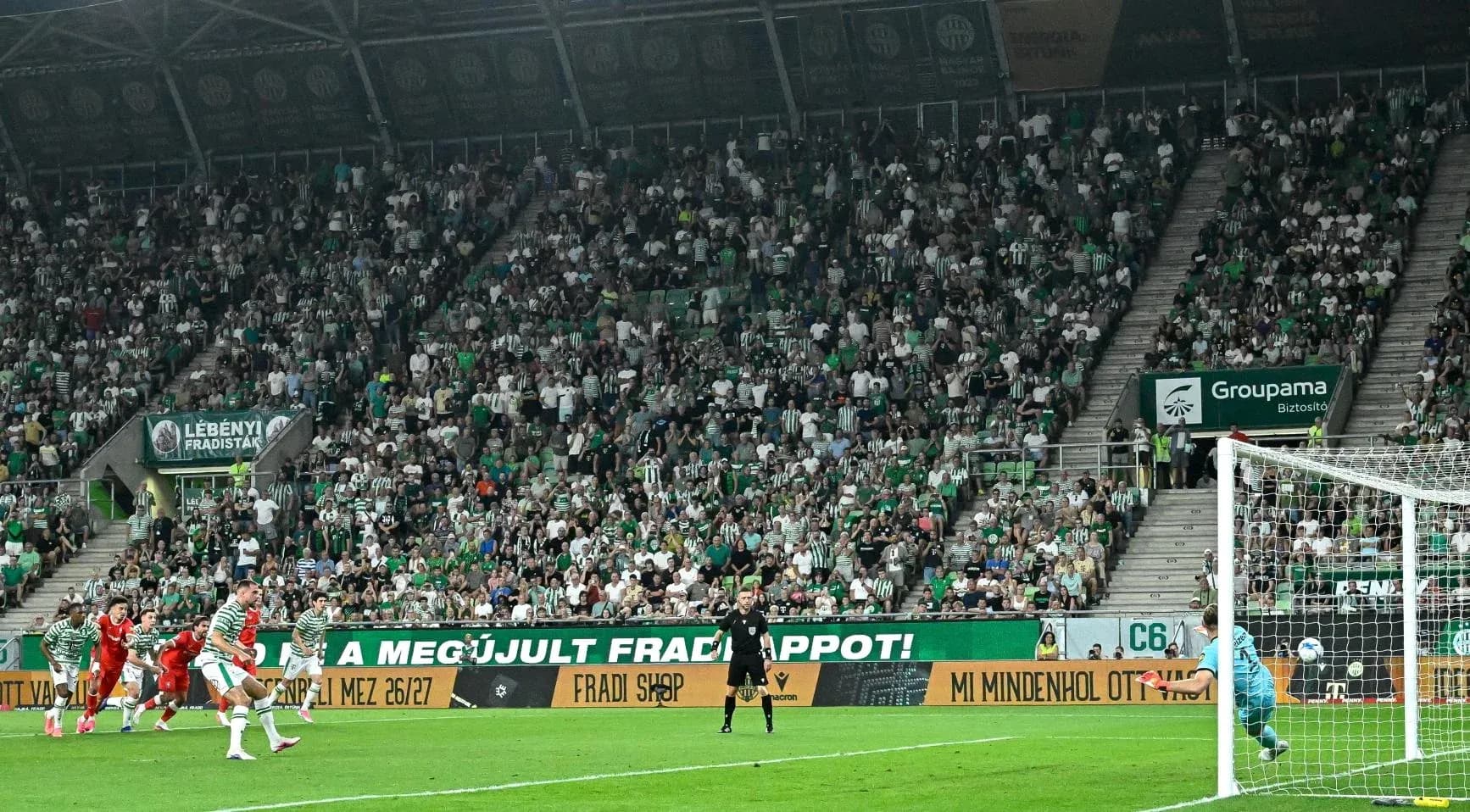
Twente mirrored the 4-3-3 on paper under John van den Brom, with L. Unnerstall in goal, a back four of B. van Rooij, S. Lemkin, R. Nijstad and A. Adelgaard, and a midfield of R. Zerrouki, K. Hlynsson and T. van den Belt supporting a front three of D. Rots, W. Weghorst and S. Orjasaeter. Structurally, that shape should have allowed Twente to match Ferencvaros man-for-man across the pitch, but the early key moment went against them: at 22’, T. Raemaekers converted a penalty for Ferencvaros, immediately rewarding the hosts’ more assertive use of their 4-3-3 and giving them scoreboard leverage to defend from a compact mid-block.
Red Card Impact
The red card to P. Rommens at 36’ for “Serious foul” fundamentally changed Ferencvaros’ tactical brief. Reduced to ten men, Borbely’s side could no longer press in a high 4-3-3 with the same intensity. Instead, the shape likely morphed into a 4-4-1 out of possession, with one of the wide players dropping into midfield and L. Joseph or K. Zachariassen operating as a lone advanced outlet. The fact that Ferencvaros still reached half-time 1-0 up speaks to disciplined horizontal shifting and a willingness to concede territory to Twente while protecting the central lane in front of D. Dibusz.
Second Half Adjustments
The start of the second half crystallised both coaches’ readings of the situation. Van den Brom reacted immediately at 46’, making a double substitution: S. Lammers (IN) came on for K. Hlynsson (OUT), and D. Weidmann (IN) came on for A. Adelgaard (OUT). Those changes signalled a clear intent to add more direct attacking presence (Lammers) and fresh energy in the build-up from deeper zones (Weidmann), even at the cost of some original defensive balance on the left. Twente’s 4-3-3 thus tilted towards a more aggressive, perhaps 4-2-3-1-like orientation in possession, with extra focus on occupying the half-spaces and feeding Weghorst.
Yet it was ten-man Ferencvaros who struck next. At 50’, L. Joseph made it 2-0, a goal that underlined how Borbely’s side leaned into fast transitions and individual duels rather than sustained possession. With a numerical deficit, Ferencvaros’ best route to goal was always going to be early balls into space and vertical runs from the front line; Joseph’s goal confirmed that this plan was executable even under pressure.
Disciplinary Sequence
The disciplinary sequence around 56’ and 61’ further framed the game’s tactical tone. Cadu received a yellow card for “Unsportsmanlike conduct” at 56’, matched by T. van den Belt (Twente) with the same reason in the same minute, and S. Lemkin followed with a yellow at 61’ for “Unsportsmanlike conduct”. Those bookings suggest a contest that had become increasingly fractious in midfield and along the defensive line, as Twente pushed bodies forward and Ferencvaros defended their lead with growing intensity.
Twente's Substitutions
Twente’s next wave of substitutions at 63’ and 72’ completed the shift from control to outright chase mode. At 63’, Y. Taha (IN) came on for T. van den Belt (OUT), injecting fresh legs and presumably more vertical running into midfield. At 72’, M. Pjaca (IN) replaced D. Rots (OUT), while L. Vennegoor of Hesselink (IN) came on for S. Orjasaeter (OUT). Those moves gave Twente multiple attacking reference points around Weghorst, effectively transforming the front line into a multi-striker configuration, with wide forwards capable of attacking the box and half-spaces simultaneously.
Borbely’s response was necessarily conservative. At 73’, Dele (IN) came on for C. O’Dowda (OUT), likely to add fresh energy in the wide channel for defensive work and transitional outlets. At 78’, N. Zohore (IN) replaced L. Joseph (OUT), swapping a scorer for a fresh runner who could press, hold the ball and contest aerials as Ferencvaros sank deeper. Finally, at 88’, J. Levi (IN) came on for Cadu (OUT), a late adjustment that removed a booked player and shored up the defensive block for the closing minutes.
Late Goals
The late goals for Twente were the logical consequence of that tactical storyline. At 82’, W. Weghorst reduced the deficit to 2-1, capitalising on the cumulative pressure and the increased volume of service into the box created by Lammers, Pjaca and the advanced full-backs. At 86’, L. Vennegoor of Hesselink equalised for 2-2, a strike emblematic of Twente’s decision to overload the penalty area with multiple targets. With Ferencvaros locked into a deep, narrow low block and a man down, second balls and crosses became increasingly difficult to defend cleanly.
Final Minutes
Discipline remained a subplot to the end. Y. Taha’s yellow card at 88’ for “Foul” reflected Twente’s continued aggression in duels as they sought either a winner or to prevent Ferencvaros from countering late. The final substitution by Ferencvaros at the same minute underlined Borbely’s priority: risk management, card control and survival at 2-2.
From a statistical verdict standpoint, the absence of concrete data on shots, possession, passing and xG means the analysis rests on structural evidence and game-state logic rather than numerical confirmation. What is clear is that Ferencvaros’ red card and subsequent 2-0 lead forced them into a reactive, low-possession model built on compactness and counter-attacks, while Twente’s bench depth allowed them to progressively increase attacking density and finally convert territorial dominance into goals. Card totals — Ferencvarosi TC: 1 yellow, 1 red; Twente: 3 yellows; Total: 5 cards — reinforce the image of a high-intensity, emotionally charged tie where tactical discipline and substitution timing were as decisive as any unseen metric.