England's World Cup Build-Up: Pressure Mounts Before Croatia Clash
England’s World Cup build-up has lurched from concern to farce, and they haven’t even kicked a ball yet.
Thomas Tuchel’s side open against Croatia under a cloud of fitness doubts, selection drama and a level of outside noise that feels tailor‑made for a major tournament eve. The demand is blunt: “make the semi-finals at least or he has failed.” The reality around the camp is anything but straightforward.
Tuchel, Maguire and a brutal call
Harry Maguire’s World Cup disappointment arrived in the most modern of ways. As The Sun reported, Tuchel told the defender he wouldn’t be going to the tournament over FaceTime.
No meeting at St George’s Park. No quiet office chat. A video call.
Maguire later tried to unpack the manager’s reasoning. He explained that Tuchel had “gone with the four lads that he got through the qualifying in the autumn camps where he felt like they did well during those six games,” before immediately adding: “But he did say that he can’t really give me an excuse.”
That contradiction hangs in the air. The explanation and the absence of one, delivered in the same breath. For a player who has lived every high and low with England in recent years, it underlined the ruthless edge of this new era.
Pressure dialled up before a ball is kicked
If there was any doubt about the stakes, the headline on Martin Lipton’s column on The Sun’s website removed it:
“Thomas Tuchel can have no excuses as England get World Cup underway – make the semi-finals at least or he has failed.”
No caveats. No allowance for the chaos that tends to define tournament football. On the morning after Spain – European champions and one of the pre‑tournament favourites – were checked by Cape Verde, it felt particularly stark. Spain’s stumble was a reminder that this stage rarely bends to expectation. The demand on Tuchel, though, remains uncompromising.
Saka’s gamble and Arsenal’s ‘concerns’
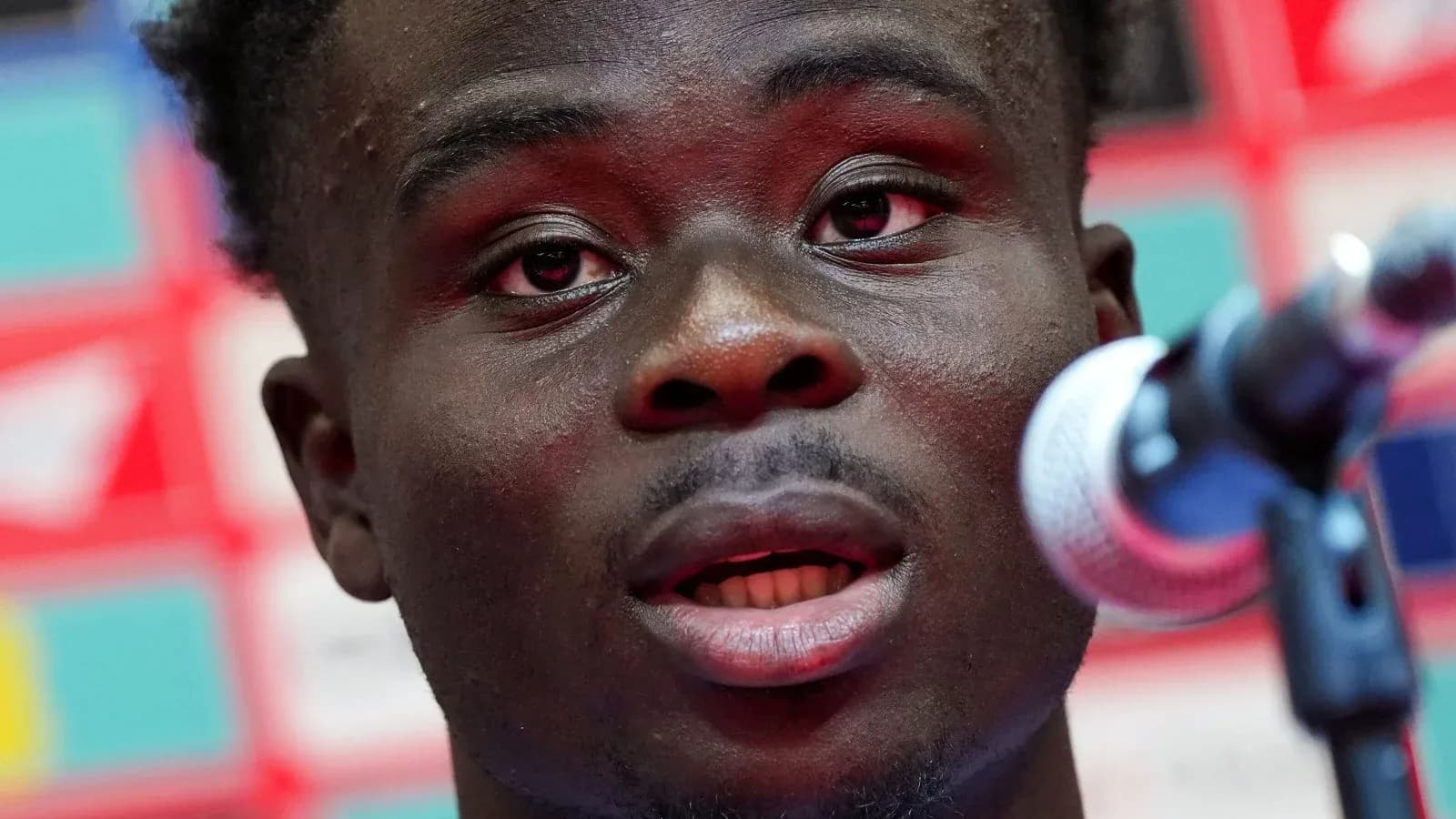
Bukayo Saka, as so often, sits at the heart of England’s hopes and fears.
On Monday he spoke openly about his condition, with Tuchel already having warned that “it is very unlikely he starts and finishes all the matches” at this World Cup. Anyone tracking his minutes knew why. Saka has started and finished just one match for club or country since mid‑March. He began only two of Arsenal’s final seven Premier League games in the title run‑in, played under an hour in their Champions League semi‑final second leg and featured for less than 30 minutes across England’s warm‑up games after missing the March squad through injury.
Even so, his words were bullish. He declared himself “ready to go” and “happy to take the gamble” on his fitness for England.
From there, the noise spiralled. The Daily Mirror ran John Cross’s piece under a measured headline: “Bukayo Saka ready to take World Cup ‘gamble’ in huge boost to England’s chances.” Their sister site, the Daily Express website, reframed it as: “Bukayo Saka sparks Arsenal concerns with alarming England comments at World Cup.”
The contrast was striking. The underlying facts were not. Saka himself credited Mikel Arteta and “the Arsenal medical team” for working closely with England and having “managed me amazingly since March.” Tuchel echoed that, saying last week of the winger’s ongoing Achilles problem: “They took very good care of him and were very aware of it at Arsenal.”
Everyone inside the two camps knows he is not at 100%. Everyone has known for months. The “alarming” element, it seems, is a player saying he wants to play and feels ready to do so. Arsenal’s medical staff will hardly be shocked by that.
Storms, SWAT and the search for jeopardy
Around the team, the off‑pitch narrative has veered into the absurd.
Reports that England were “shaken” by a tornado near their base came with the detail that it forced them to change… nothing at all. They stayed inside on a quiet evening, as planned.
The Sun’s foreign editor Nick Parker then produced another instalment in the saga of supposed peril. The headline screamed: “SWAT team rushes to armed standoff just mile from England World Cup stadium as suspect arrested.” The opening line set the scene: “A SWAT team and a host of armed police yesterday responded to an incident a mile from where England’s first match will be played.”
Seven paragraphs later came the crucial line: “There is no indication the incident was connected to the World Cup or posed any threat to the tournament or its venues.”
The drama dissolved in a sentence. Still, the impression of a squad living on the edge of some great unseen danger lingers in the coverage. At this rate, fireworks five miles away will be billed as a direct threat to the camp’s tranquillity.
Spain slip, panic spreads
Spain’s draw with Cape Verde triggered its own round of tournament forecasting. The Sun’s website framed it as a warning: “Why England and all other World Cup rivals should be worried after Spain are humbled by Cape Verde.”
The conclusion? Spain “still cannot be ruled out of contention for the trophy” despite dropping points in their opener with two group games left. In other words, a heavyweight failed to win once and remains a contender. Hardly a revelation, yet it feeds into the wider sense of volatility around this World Cup.
Between freak weather, local crime stories with no bearing on the tournament, and Saka’s entirely predictable willingness to risk his fitness, the picture painted is of a competition creaking at the seams. The reality is more mundane. But perception shapes pressure, and England are carrying plenty of that already.
Mixed messages and muddled logic
Away from the national team, the commentary around other World Cup performers has thrown up its own curiosities.
Jeremy Cross, writing in the Daily Mirror, argued that Liverpool will be quietly encouraged by the early form of Florian Wirtz and Alexander Isak. Both have impressed, albeit against modest opposition in Curacao and Tunisia. So far, so reasonable.
Then came the strange twist: “Iraola will want this to continue. He would never admit it, but the Spaniard will hope Isak uses the biggest stage of all to find himself again, before taking that feeling back to Anfield.”
Why, exactly, would Andoni Iraola “never admit” he wants his star striker and expensive asset to find form on the biggest stage? Why would any manager shy away from saying he wants his centre‑forward brimming with confidence? The logic frays the longer you stare at it.
It is a small example, but it fits a broader theme: narratives being stretched to breaking point to inject intrigue where the football itself already provides enough.
Croatia looming through the noise
Strip all that away and one truth remains. England face Croatia with key players short of full fitness, a manager under explicit orders to deliver at least a semi‑final, and a media environment that has already gone into tournament overdrive.
The tornado has passed. The SWAT team has gone home. Spain have stumbled but remain dangerous. Saka is ready to gamble. Maguire is watching from afar, his World Cup hopes ended by a video call.
The question now is simple, and it will be answered on the pitch: in a storm of hype, fear and expectation, how many of Tuchel’s players are truly ready to face Croatia?