Declan Rice's Heavy Workload: England's Iron Man at Risk
Aaron Cresswell calls Declan Rice “a freak of nature”. It has never sounded more like a warning than it does now.
Since the start of the 2020-21 season, Rice has played 360 games for club and country. West Ham’s European runs, England’s tournament cycles, Arsenal’s tilt at the Premier League and Champions League – whenever the stakes have risen, Rice has been in the thick of it, shoulders squared, lungs burning, never asking out.
Until Wednesday night in Los Angeles.
England’s iron man starts to creak
England’s 4-2 win over Croatia in their World Cup opener was wild, disjointed and, for long stretches, deeply uncomfortable. At the centre of it all, Rice looked like a man finally feeling the weight of those miles in his legs.
This was appearance No 63 of his season. It showed. The 27-year-old, usually the anchor around which England’s structure rests, found himself dragged into places he did not want to be. The space between him and Elliot Anderson yawned open in the first half. Croatia poured through it.
Rice dropped too deep, then was lured out by Luka Modric’s movement. England’s midfield became a patch of loose threads, and Croatia tugged at every one of them.
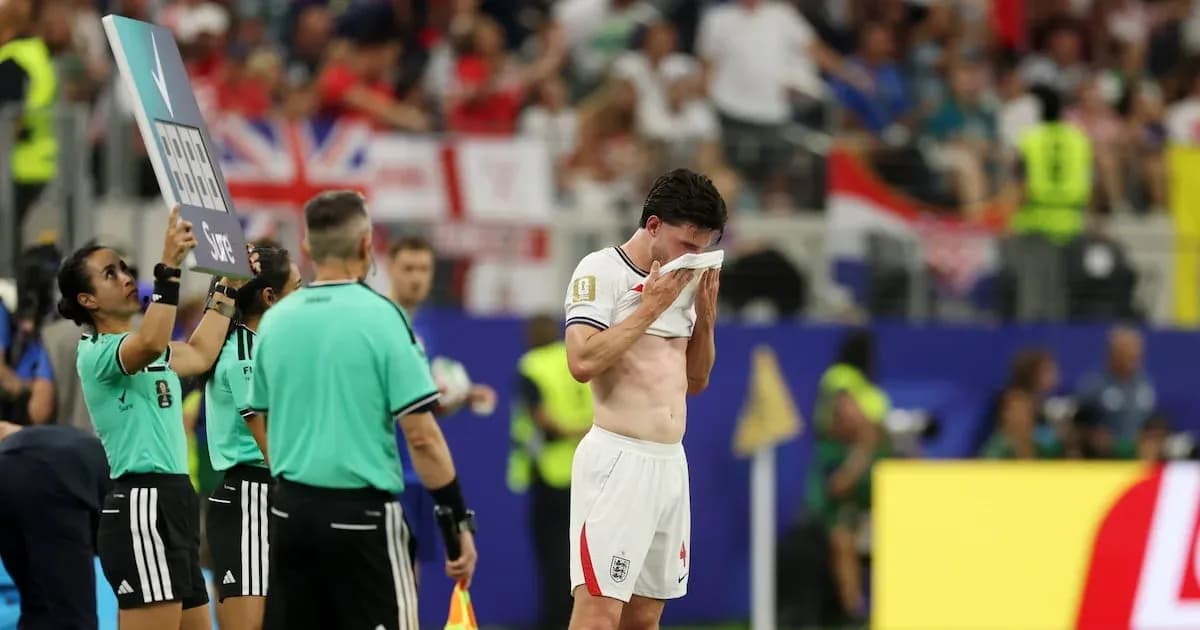
Thomas Tuchel can tidy up the shape. That is his job. What he cannot easily fix is the sight that truly jarred: Rice trudging off in the 72nd minute, England clinging to a 3-2 lead, his body telling him it had had enough.
Rice almost never leaves the pitch when England are under siege. He is the one who usually stays on to do the grim, necessary work. This time he signalled he could not continue.
Tuchel later explained that Rice had felt discomfort in his lower back and upper hamstring. The substitution, he insisted, was precautionary. Rice himself moved quickly to declare he would be ready for Ghana on Tuesday.
England may have to resist his instincts.
A team built around one man
Tuchel’s verdict on Rice’s display was pointed in its understatement. “Declan had some unusual ball losses,” he said. For a player whose security in possession is one of his calling cards, that line said enough.
The problem for England is simple: they do not function without him. Across six years, whenever Rice has been missing, the team has rarely looked convincing. This squad carries no like-for-like replacement.
Kobbie Mainoo glides on the ball and sees passes others do not, but he does not yet have Rice’s frame, his aerial presence, his set‑piece threat. Jordan Henderson brings experience and a voice, but at 36 he was overlooked when England needed to keep the tempo high against Croatia. If Tuchel did not turn to him in that chaos, when will he?
The answers are not obvious. The options are imperfect. So the temptation is always the same: ask Rice to go again. And again. And again.
A glimpse of life without Rice
Tuchel’s first instinct when Rice departed was to drag Jude Bellingham deeper. For eight anxious minutes, England flirted with disaster. Croatia surged, England’s control vanished, and an equaliser felt inevitable.
It was only when Djed Spence came on for Bellingham that a different picture emerged. Reece James stepped away from right back and into midfield, into a role he has come to know well at Chelsea.
That switch changed the feel of England’s build-up. James, used by Enzo Maresca as a central midfielder for much of the last 18 months at Stamford Bridge, knows the angles. He has the physicality to duel, the timing to tackle, the range to punch passes through the lines.
This was not a random experiment. James played in midfield during his loan at Wigan in 2018-19. Under Maresca, he was redeployed again, initially to scepticism, then to widespread approval. The shift paid off spectacularly when Chelsea beat Paris Saint-Germain in last year’s Club World Cup final, James patrolling the middle with authority.
Tuchel, who once saw James strictly as a right back, has come around. He watched James excel alongside Moisés Caicedo in Chelsea’s 3-0 win over Barcelona last November, then dominate Rice when Arsenal visited Stamford Bridge five days later. The evidence kept stacking up.
“Reece James can play in the 6 because he does on a high level for Chelsea,” Tuchel said when unveiling his World Cup squad, using that argument to justify leaving out Adam Wharton and Alex Scott.
Against Croatia, that theory started to look like England’s emergency plan made flesh.
Versatility – and a gamble
Tuchel built this squad with flexibility in mind. If James steps into midfield, others can shuffle into the back line. Spence, Ezri Konsa and Jarell Quansah all offer solutions at right back.
One possible configuration would see Konsa tucking in as an auxiliary third centre back alongside John Stones and Marc Guéhi, with Nico O’Reilly released to surge from left back. England could morph into a back three in possession, with James anchoring midfield and the full backs becoming auxiliary playmakers.
On the tactics board, it looks neat. On the pitch, there is one major caveat: James’s body.
The Chelsea captain’s hamstrings have betrayed him too often. The latest setback came in March and cost him almost two months. Chelsea have had to ration his minutes, to treat every sprint as a calculation.
England are already without Tino Livramento, whose calf injury forced Tuchel to draft in Trevoh Chalobah. James is first choice at right back, but he cannot start every game. He certainly cannot be expected to solve England’s midfield problem on his own if Rice’s workload becomes unsustainable.
Relying on Rice’s resilience and James’s fragile fitness as twin pillars is not a strategy. It is a risk.
The bill for endless minutes
Tuchel arrived at this World Cup with fitness concerns gnawing away at him. The decision to fly early to Florida for a camp in the sun was rooted in conditioning, in trying to give players a buffer before the intensity of tournament football.
Rice joined up late, straight from Arsenal’s Champions League final. Another high-pressure game, another 90 minutes, another demand on a body that has barely paused for breath in four years.
He keeps pushing himself to the limit. He always has. That is why coaches trust him and team-mates lean on him. It is also why the numbers are now so stark.
If England go all the way to the final and Rice is not given a rest, he will finish the season on 70 appearances for club and country. Seventy. For a central midfielder asked to cover ground, to tackle, to compete in every duel, that figure borders on brutal.
England need him. They know it. He knows it. The question is whether they can keep asking for more without something giving way.
Tuchel must find a way to protect his vice‑captain without ripping out the spine of his team. The World Cup has only just begun, and already England’s most reliable constant looks worryingly human.