Crystal Palace vs Everton: Tactical Analysis of 2-2 Draw
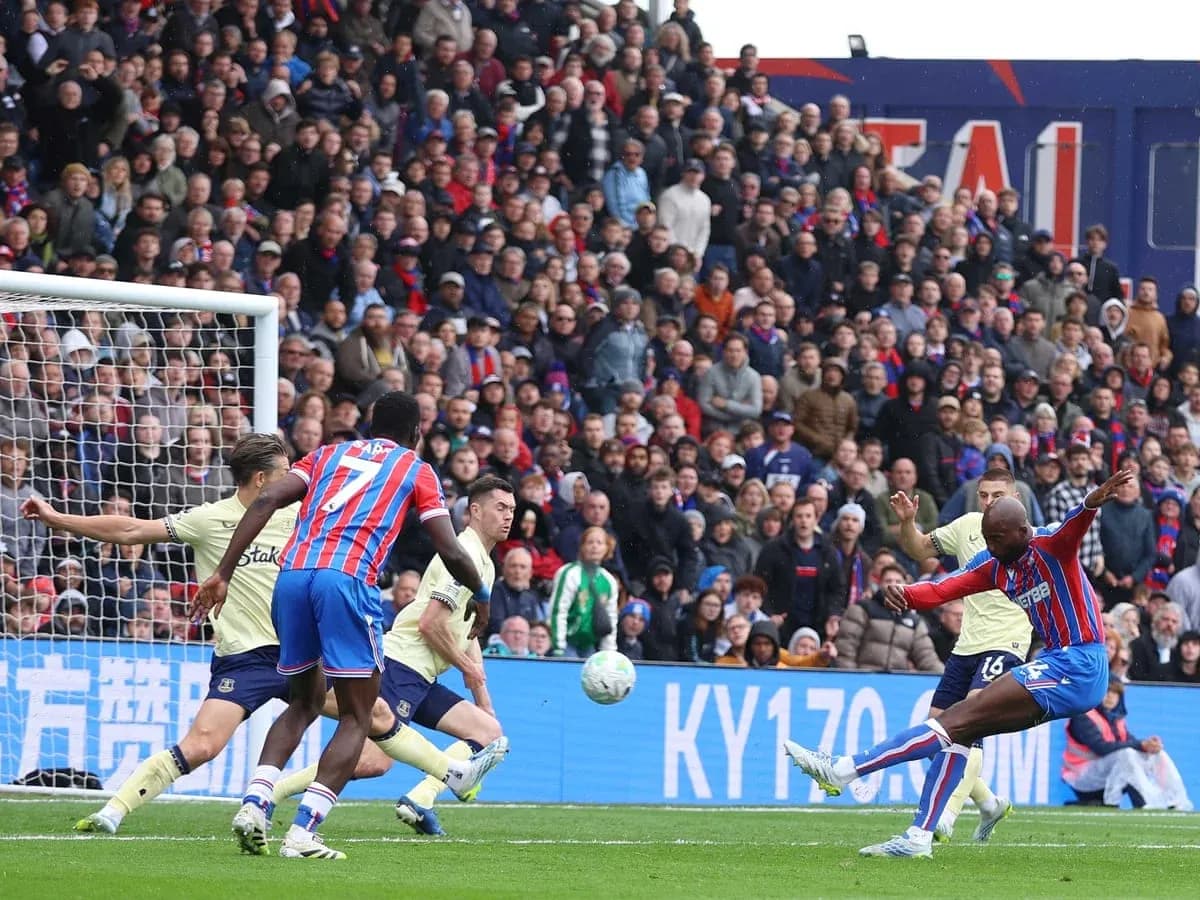
Crystal Palace and Everton shared a 2-2 draw at Selhurst Park in Premier League Regular Season - 36, a match defined by contrasting structures and momentum swings. Palace’s 3-4-2-1 under Oliver Glasner generated territorial dominance and a clear xG edge (2.66 to Everton’s 1.44), yet Everton’s 4-2-3-1 was ruthless in key transition moments and set-piece phases. The halftime score of 1-1 reflected Palace’s growing control after an early Everton breakthrough, and the final 2-2 mirrored a tactical arm-wrestle: Palace as the proactive, possession-heavy side, Everton as the compact, vertically dangerous unit that maximised fewer attacks.
First Half
Everton struck first on 6', with James Tarkowski scoring a normal goal from a set-piece situation, immediately validating their aerial threat and direct approach. Discipline then began to shape the rhythm. At 30', James Garner (Everton) received a yellow card — Foul — a first sign of the strain Everton’s midfield double pivot was under against Palace’s central overloads. Palace equalised on 34' through Ismaïla Sarr, a normal goal that came as the hosts began to turn possession into box entries. On 45', Vitaliy Mykolenko (Everton) was also booked — Foul — as Palace’s wing pressure forced more aggressive defensive interventions on the flanks. The half closed at 1-1, with Palace on top territorially but level on the scoreboard.
Second Half
Immediately after the restart, Everton reasserted themselves. On 47', Beto finished a normal goal, assisted by Tarkowski, underlining Everton’s plan: defend deep, then exploit set pieces and early-second-half transitions before Palace could re-establish their structure. Glasner’s first structural shift came on 65', when Jørgen Strand Larsen (OUT) made way for Jean Philippe Mateta (IN): Jean Philippe Mateta (IN) came on for Jørgen Strand Larsen (OUT). This change reoriented Palace’s attack toward a more penalty-box-focused target. Everton responded on 70' with their own centre-forward rotation: Beto (OUT) was replaced by Thierno Barry (IN): Thierno Barry (IN) came on for Beto (OUT), a move aimed at refreshing their outlet option while maintaining the 4-2-3-1 shape. Palace’s adjustment paid off on 77', when Jean Philippe Mateta scored a normal goal to bring the match back to 2-2, a just reward for sustained pressure.
Final Substitutions
The final substitutions were about energy and midfield control. On 80', Brennan Johnson (OUT) was replaced by Jefferson Lerma (IN): Jefferson Lerma (IN) came on for Brennan Johnson (OUT), signalling Glasner’s desire to stabilise central spaces and guard against Everton counters while still sustaining attacks through Sarr and the wing-backs. Simultaneously, Everton altered their attacking midfield line: Merlin Röhl (OUT) went off for Tyrique George (IN): Tyrique George (IN) came on for Merlin Röhl (OUT), injecting fresh legs between the lines. Deep into stoppage time at 90+4', Everton made a final tweak: Kiernan Dewsbury-Hall (OUT) was replaced by Carlos Alcaraz (IN): Carlos Alcaraz (IN) came on for Kiernan Dewsbury-Hall (OUT), a late attempt to add ball-carrying and pressing energy in midfield. Across the 90 minutes, card discipline was one-sided: Crystal Palace received 0 cards, Everton 2 (James Garner and Vitaliy Mykolenko, both for “Foul”), for a total of 2.
Team Structures
Structurally, Palace’s 3-4-2-1 sought to dominate central corridors and half-spaces. Chris Richards, Maxence Lacroix, and Jaydee Canvot formed a back three that allowed both Daniel Muñoz and Tyrick Mitchell to push high as wing-backs. In possession, Adam Wharton and Daichi Kamada acted as a double pivot, with Kamada often stepping into advanced pockets to support Ismaïla Sarr and Brennan Johnson behind the striker. This structure underpinned Palace’s 59% ball possession and 21 total shots (15 inside the box), illustrating a clear plan: sustained pressure, wide overloads, and repeated entries into the penalty area.
Everton’s 4-2-3-1, by contrast, was built around compactness and verticality. Jordan Pickford anchored a back four of Jake O'Brien, Tarkowski, Michael Keane, and Mykolenko, with Tim Iroegbunam and James Garner screening in front. The attacking trio of Merlin Röhl, Kiernan Dewsbury-Hall, and Iliman Ndiaye supported Beto, seeking to break quickly once possession was won. Their 13 total shots (10 inside the box) with only 41% possession highlight a game plan focused on fewer but higher-impact attacks, often triggered by turnovers and set pieces rather than prolonged build-up.
Goalkeeper Performances
Goalkeeper performance framed the risk-reward profiles of both sides. Dean Henderson made 5 saves for Crystal Palace, aligning with Everton’s 6 shots on goal and 1.44 xG, and his 1.2 goals prevented figure suggests he was critical in preventing the visitors from converting their efficient chances into a third goal. At the other end, Jordan Pickford registered 6 saves against Palace’s 8 shots on goal and 2.66 xG, with the same 1.2 goals prevented metric, indicating that both keepers performed at a similarly high shot-stopping level despite Palace’s greater volume of attempts. Henderson operated largely behind a high line and aggressive wing-backs, while Pickford was repeatedly called upon to bail out a defence under sustained pressure.
Statistical Overview
Statistically, Palace’s 459 total passes, 382 accurate (83%), underline their role as the dominant possession side, circulating the ball to move Everton’s block and create crossing and cutback situations. Everton, with 313 total passes, 232 accurate (74%), accepted a more direct, lower-possession profile, consistent with a team prioritising territory and quick progression over control. Palace’s 5 fouls to Everton’s 13 further reflect the game state: Palace defending higher and with more control, Everton forced into more last-ditch and disruptive actions, which also produced their two yellow cards.
The xG split (Crystal Palace 2.66, Everton 1.44) supports the impression that Glasner’s side created the clearer and more numerous chances. Yet Everton’s efficiency, through early goals from Tarkowski and Beto and strong set-piece execution, ensured the match ended 2-2. Overall form-wise, Palace looked like a side comfortable imposing their structure at home, while Everton’s defensive resilience and opportunism kept them competitive despite being second-best in most metrics. Defensively, both teams’ goals prevented figures (1.2 each) highlight that, on the day, the goalkeepers were key in preserving a point apiece in a tactically rich draw.