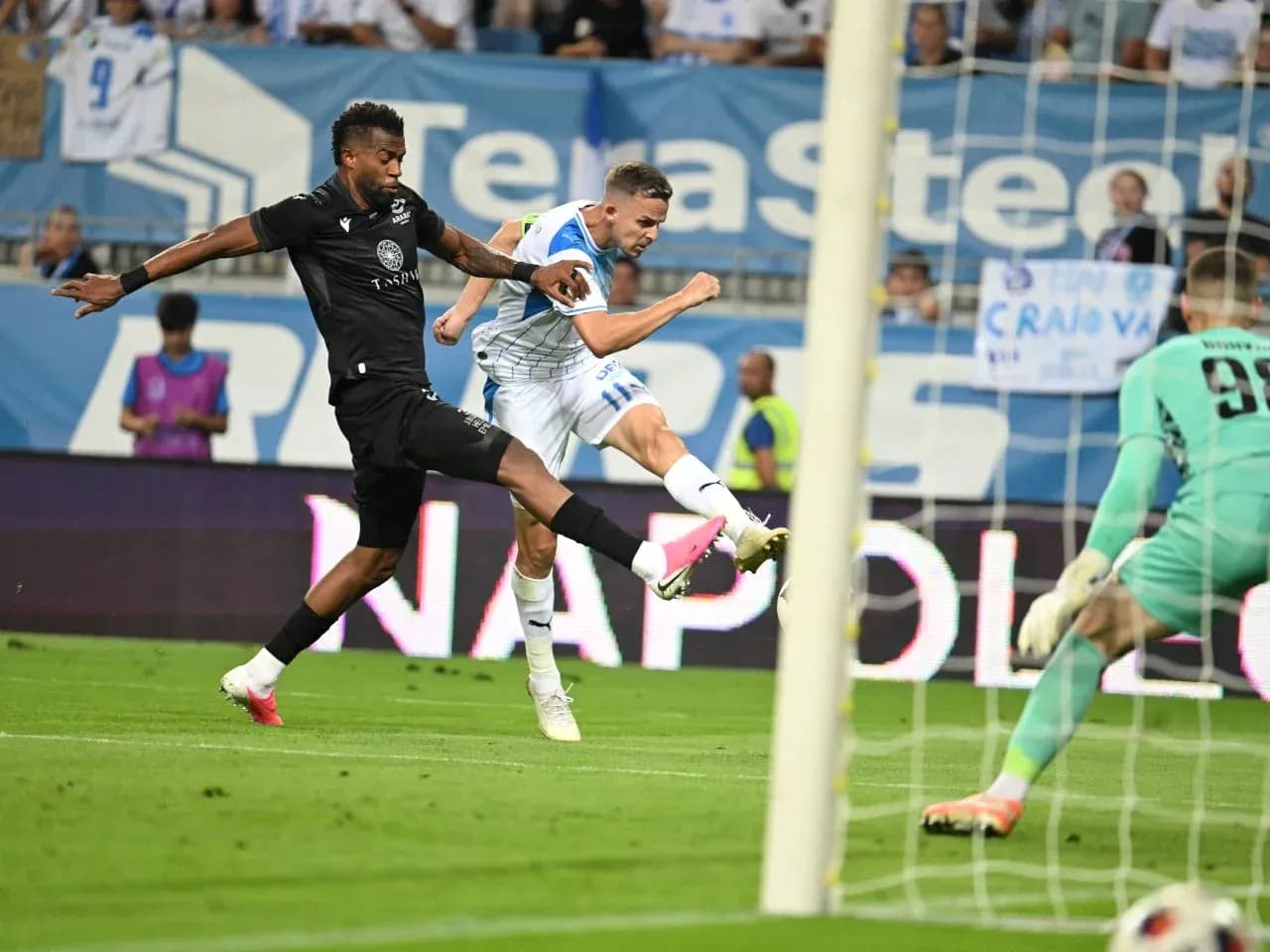
Craiova vs Ararat-Armenia: Tactical Analysis of a 1-1 Draw
Universitatea Craiova’s 3-4-3 against Ararat-Armenia’s 4-3-3 produced a territorially dominant but ultimately frustrated home performance at Stadionul Ion Oblemenco, ending 1-1 in the UEFA Europa League Play-offs.
Craiova’s structure was clear from the opening minutes. With a back three of V. Screciu, A. Rus and O. Romanchuk, they built from a broad base, using the wing-oriented midfield line of N. Bancu and C. Mora outside, plus A. Cicaldau and A. Mekvabishvili inside, to create width and passing angles. The front trio of S. Baiaram, A. Al Hamlawi and the advanced midfielder D. Matei often formed a narrow line of three, looking to overload central zones and then release Bancu or Mora into space.
Despite that platform, Ararat-Armenia struck first. From their 4-3-3, they were compact and conservative without the ball, with full-backs E. Grigoryan and H. Oliveira staying narrow alongside centre-backs B. R. Wilson Valdez and A. Malis. The opener at 20 minutes, finished by Malis from an Oliveira assist, typified their threat: a set or second-phase situation where a defender could step into an advanced pocket, exploiting Craiova’s high line and the space around their outside centre-backs.
Craiova’s response was to push their wing-backs even higher, effectively turning the shape into a 3-2-5 in possession. Bancu became the key attacking outlet from the left, arriving from deep into the half-space rather than hugging the touchline. The equaliser at 33 minutes reflected that pattern: Bancu finished after combination play involving Cicaldau, who operated as the main link between the double pivot and the front line. Once level, Craiova continued to dominate territory, but Ararat’s compact 4-3-3 block forced them into a lot of circulation around the box rather than clear-cut chances.
The disciplinary profile underlined Craiova’s aggressive counter-pressing and high defensive line. They committed 15 fouls to Ararat’s 5 and collected four yellow cards, all for home players: David Matei at 39 minutes, Oleksandr Romanchuk at 47, Adrian Rus at 69 and Monday Etim at 78. Even without explicit reasons listed, the clustering of cards around defensive players and central midfielders matches a game where the home side repeatedly had to stop transitions after losing the ball high. Ararat, by contrast, managed the game with far fewer interventions, staying on their feet and relying on compact distances rather than tactical fouling.
In terms of chance creation, the numbers support Craiova’s territorial control. They registered 7 shots on goal and 7 shots off goal, plus 1 blocked shot, against Ararat’s 2 shots on goal, 4 off goal and 2 blocked. That volume, especially the on-target count, indicates that Craiova were able to work the ball into finishing positions with reasonable regularity, even if the quality of those chances cannot be quantified here. Ararat’s lower shot volume but early goal fits a strategy based on selective, high-impact forays rather than sustained pressure.
Set-pieces were another clear battleground. Craiova earned 8 corner kicks to Ararat’s 4, consistent with the home side pinning their opponents back and forcing clearances under pressure. Yet Ararat’s centre-back pairing, supported by a deep midfield three of Benny, K. Muradyan and A. Serobyan at various stages, managed those deliveries effectively enough to limit second-ball chaos. The 3-4-3’s usual strength on attacking set-plays – three centre-backs plus tall forwards and wing-backs – did not translate into a decisive edge on the scoreboard.
The offside figures (3 for each team) point to both sides trying to exploit depth. Craiova’s forwards, especially Al Hamlawi and Baiaram, looked to run beyond the last line against a relatively high Ararat defence that stepped out aggressively. On the other side, Sandro Lima and Z. Banjaqui, supported by A. Serobyan from midfield, sought to counter quickly into the spaces left by Craiova’s advanced wing-backs. The equal offside count reflects a game where both defensive lines were well-drilled in stepping up, and both attacks were willing to risk runs in behind.
The substitution pattern from Filipe Coelho was a clear attempt to refresh the front line and sustain pressure. At 62 minutes, S. Nsimba (IN) came on for A. Al Hamlawi (OUT), adding more direct running in the channels, while M. Etim (IN) replaced D. Matei (OUT), giving extra verticality and 1v1 threat from midfield. Later, at 69 minutes, Cicaldau (OUT) made way for Teles (IN), a like-for-like adjustment to maintain energy in the interior. At 85 minutes, T. Baluta (IN) replaced Mekvabishvili (OUT), and L. Basceanu (IN) came on for S. Baiaram (OUT), effectively reconfiguring the attacking midfield line to chase a late winner. These changes kept the 3-4-3 structure intact but rotated profiles: more runners, more dribblers, and fresh legs to attack a tiring Ararat block.
Tulipa’s substitutions for Ararat-Armenia were more about game management and preserving the draw. At 69 minutes, Franca Carlos (IN) replaced Benny (OUT), shoring up midfield legs. At 75 minutes, J. A. Balanta (IN) came on for H. Oliveira (OUT), slightly rebalancing the right side with more defensive stability. A triple change at 80 minutes – Z. Shaghoyan (IN) for Z. Banjaqui (OUT), M. Carlier (IN) for K. Muradyan (OUT), and A. Tera (IN) for A. Serobyan (OUT) – refreshed all three midfield and wide roles, reinforcing the compact 4-3-3 shell and ensuring they could continue to compress central spaces and defend crosses.
Possession is officially listed at 0% for both teams, which is clearly a data anomaly and cannot be used analytically. Without passing figures or xG, the best indicators of control are shots, corners and fouls. On those measures, Craiova were the proactive, front-foot side: more shots on goal (7 vs 2), more corners (8 vs 4), more fouls (15 vs 5) and all of the cautions. That profile is typical of a home team imposing the tempo, taking risks with numbers forward and being forced into recovery fouls when counters broke.
Ararat-Armenia’s defensive index, inferred from their ability to restrict Craiova to a single goal despite the volume of attempts, was strong. Their back four and rotating midfield three maintained compactness between the lines, forcing a lot of Craiova’s efforts to be either from less optimal zones or under pressure. Meanwhile, their overall form in this tie will be judged positively: they scored first away, managed the game with minimal disciplinary damage and left with a 1-1 result that reflects a disciplined, low-error approach against a structurally ambitious but wasteful Craiova side.