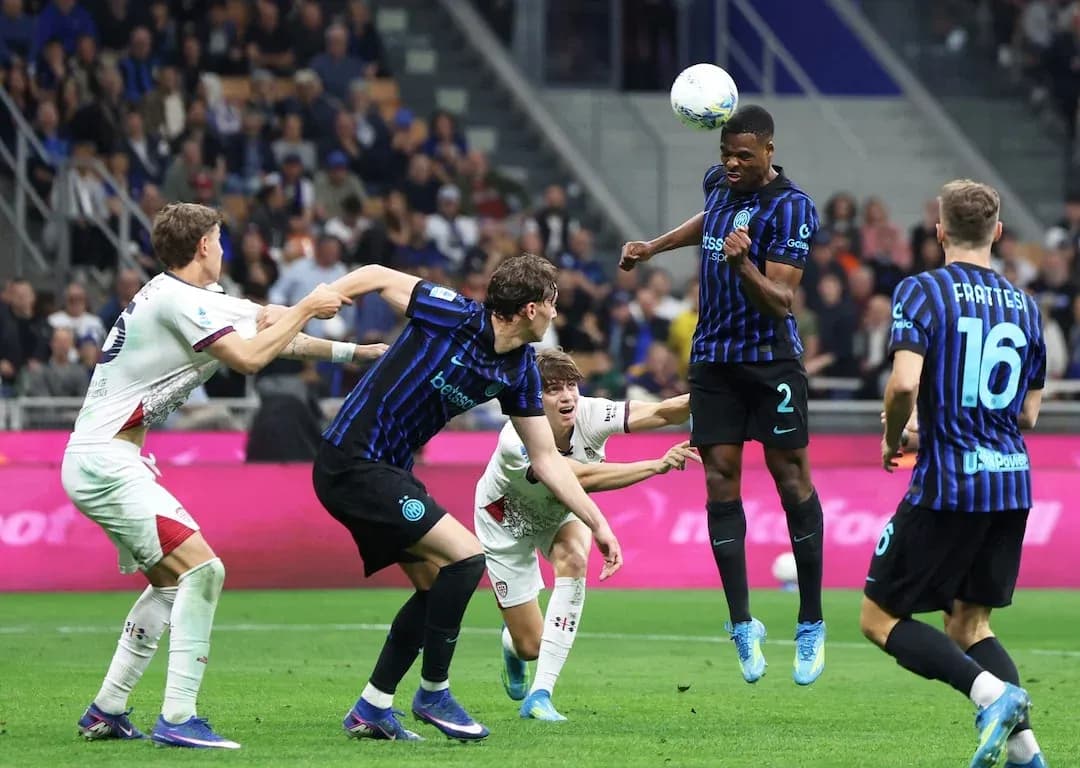
Cagliari vs Inter: Tactical Insights from Serie A Clash
Under the late-summer lights of the Unipol Domus, Cagliari’s return to home soil in Serie A met the hard edge of an Inter side that already looks built for a title run. The 1–0 scoreline in favour of Inter, sealed within the regular 90 minutes, felt almost minimalist compared to the balance of power on the pitch, yet it told a precise story: a top–end machine doing just enough, and a newly shaped Cagliari still learning the limits of its structure.
The Big Picture – Early-Season Identities Collide
Heading into this game, the table framed the contest starkly. Cagliari sat 12th with 3 points from 2 matches, their overall goal difference perfectly balanced at 0 after scoring 1 and conceding 1. The pattern was already clear: on their travels they had been efficient, winning once with a 1–0 scoreline, but at home they had lost 1–0 and failed to score. Inter, meanwhile, arrived in Sardinia as early pacesetters in 2nd place with 6 points from 2 games, their overall goal difference at +4, built on 5 goals scored and just 1 conceded. At home they had already produced a 4–1 statement win; away they had shown they could grind, winning 1–0 without conceding.
The formations on the night mirrored these identities. Fabio Pisacane doubled down on continuity, rolling out Cagliari’s now-familiar 4-2-3-1 – the same shape they had used in both league fixtures so far. Cristian Chivu answered with Inter’s 3-5-2, a structure also used in both of their matches this season, a system that turns into a back five without the ball and a wave of five lanes in possession.
E. Caprile anchored Cagliari in goal behind a back four of J. Pedro, A. Deiola, J. Rodriguez and A. Obert. In front of them, H. Winks and A. Romano formed the double pivot, with a creative trio of M. Adopo, D. Maldini and J. Fazzini supporting lone forward P. Mendy. Inter’s spine was equally clear: J. Martinez in goal; a back three of B. Pavard, M. Akanji and A. Bastoni; a five-man midfield of F. Dimarco, P. Sucic, H. Calhanoglu, N. Barella and Luis Henrique; and a strike pairing of L. Martinez and F. Esposito.
Tactical Voids – Absences and Discipline
Both sides were forced to navigate notable absences. Cagliari were without R. Idrissi, ruled out with a knee injury, and Y. Trepy, also sidelined. For a squad that already struggles for end product at home – with 0 goals scored at the Unipol Domus so far this season and an overall average of 0.0 goals at home per game – those missing attacking and rotational options narrowed Pisacane’s ability to change the game from the bench.
Inter, too, had to cope without D. Spence (inactive) and M. Spinacce (injury). Chivu, however, could absorb these losses thanks to a deep bench: J. Stones and Carlos Augusto to reinforce the back line, P. Zielinski and H. Mkhitaryan to reshape midfield, and M. Thuram or A. Bonny to alter the front line’s profile.
Discipline has been a quiet but telling subplot for both teams. Across the campaign so far, Cagliari’s yellow cards have been spread with a clear peak in the 46–60 minute window, where 50.00% of their cautions have arrived, with another 25.00% in the opening 15 minutes and 25.00% in the final quarter-hour. That pattern speaks to a team that starts nervously, then risks overreaching just after the break as they try to reset the rhythm. Inter’s yellows are evenly split across three phases: 33.33% in 0–15, 33.33% in 31–45, and 33.33% in 46–60, reflecting an aggressive but controlled press that never fully drops.
Individually, J. Fazzini embodies Cagliari’s edge: 3 fouls committed in the league so far and already 1 yellow card, despite contributing 4 successful dribbles from 4 attempts and 3 interceptions. On the other side, Inter’s spine is equally combative – H. Calhanoglu, M. Akanji and L. Martinez all carry a yellow each this season – but crucially, neither team has seen a red card, and both have a spotless record from the spot with no penalties taken or missed.
Key Matchups – Hunter vs Shield, Engine Room vs Enforcer
The central duel of this fixture was written in the middle third. Inter’s “engine room” – H. Calhanoglu, N. Barella and P. Sucic – went up against Cagliari’s double pivot of H. Winks and A. Romano, with D. Maldini and J. Fazzini floating between lines.
Calhanoglu arrived as one of Serie A’s standout early performers: 2 total goals from midfield, both shots on target, 125 completed passes with 91% accuracy, 3 key passes, plus 3 tackles and 3 interceptions. His blend of control and bite is rare; he dictates tempo while still contributing directly to goals. Against a Cagliari side that averages just 0.5 goals scored and 0.5 conceded overall, his presence tilted the territory battle decisively in Inter’s favour.
For Cagliari, Winks and Romano were tasked with screening lanes into L. Martinez and Esposito while also providing the first pass to escape Inter’s press. Yet Inter’s front two are not just finishers; Esposito has 1 goal and 1 assist this season, with 6 shots (3 on target), 4 key passes and 9 duels won from 15. His willingness to drop and link allowed L. Martinez to threaten depth, even if Lautaro’s finishing has yet to ignite, with 7 shots and only 1 on target so far.
Behind them, the “shield” of Pavard, Akanji and Bastoni once again justified Chivu’s trust. Inter’s away record now shows 1 goal scored and 0 conceded, with an away average of 1.0 goal for and 0.0 against per game. Akanji in particular has been quietly dominant: 126 passes at 95% accuracy, 4 interceptions and 7 duels won from 8, plus 1 yellow card that underlines how tight his marking can become.
For Cagliari, the “hunter” role fell to P. Mendy. But with the home side’s season so far yielding 0 goals at home and just 1 overall – coming on their travels – Mendy often found himself isolated against three centre-backs, reliant on flashes from Maldini between the lines and Fazzini’s dribbling from the left half-space.
Statistical Prognosis – Margins, xG Logic and What Comes Next
Even without explicit xG values, the pattern of numbers and structures points to a clear underlying story. Inter, with an overall scoring rate of 2.5 goals per game and only 0.5 conceded, are operating like a side whose xG consistently outstrips their opponents. Their ability to win 4–1 at home and 1–0 away suggests a team that can both overwhelm and manage game states, toggling between high-risk attacking and low-risk control.
Cagliari, by contrast, are living on a knife-edge of minimal margins. Their overall 0.5 goals scored and 0.5 conceded per match, combined with a clean sheet only on their travels and a failure to score in both home fixtures so far, suggest a low-event profile where any defensive lapse is fatal. The reliance on a single formation (4-2-3-1 in both games) hints at tactical clarity but also a lack of alternative plans when chasing a result.
Following this result, the trajectories diverge further. Inter reinforce their status as early contenders, their 3-5-2 and central triangle of Calhanoglu, Barella and Sucic already functioning as one of the league’s most balanced midfields. Cagliari, meanwhile, emerge with some positives – defensive organisation that kept the scoreline narrow, flashes from Fazzini and Maldini – but the core issue remains unsolved: how to turn structure into goals, especially at the Unipol Domus, where the stands demand more than resistance.