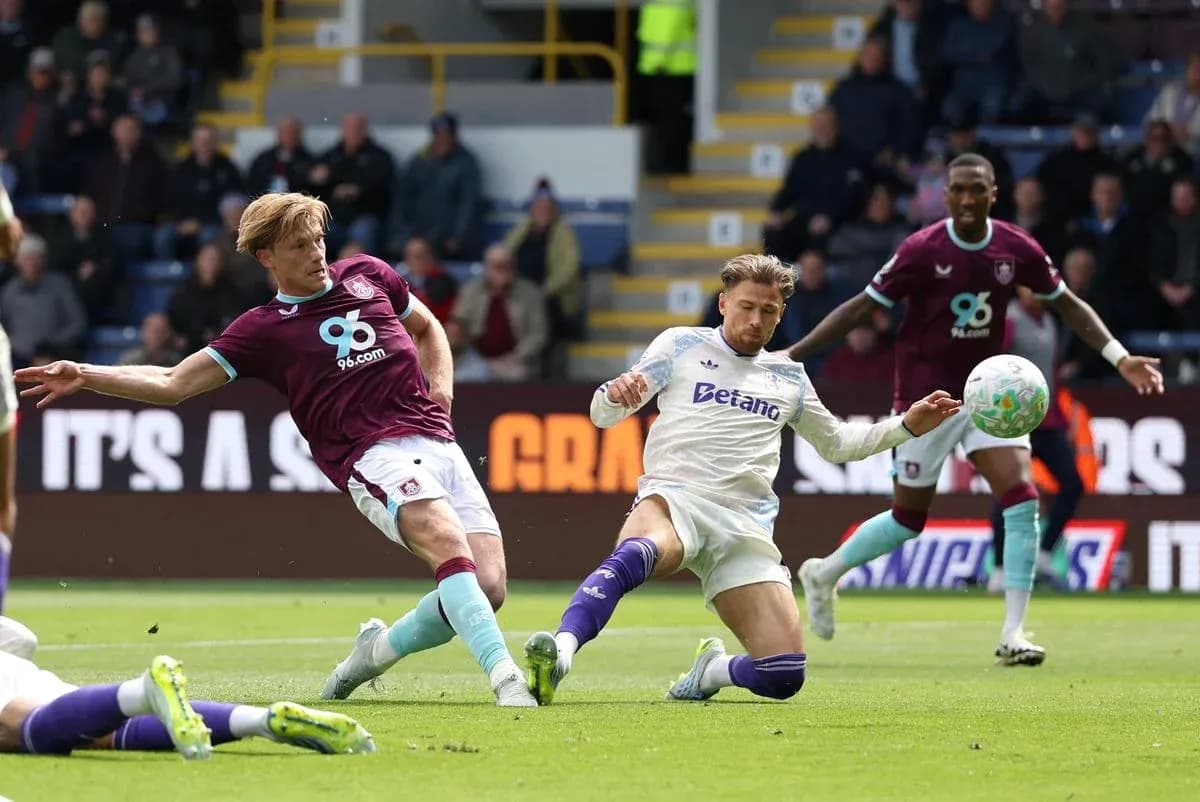
Burnley vs Aston Villa: Tactical Analysis of the 2-2 Draw
Burnley and Aston Villa shared a 2-2 draw at Turf Moor in Premier League Regular Season Round 36, a match defined by contrasting approaches: Burnley’s vertical, transitional 4-2-3-1 against Villa’s ball-dominant, control-oriented 4-2-3-1. Despite Villa’s territorial and possession superiority, the underlying chance quality and game flow point to a contest where Burnley’s structure and directness repeatedly stressed Unai Emery’s side and ultimately earned a deserved point.
I. Executive Summary
Villa owned the ball (66% possession, 510 passes) and territory, but Burnley’s compact mid-block and fast attacking transitions produced a marginal xG edge (1.77 vs Villa’s 1.42) and the more incisive central threat. Mike Jackson’s team accepted long spells without the ball, trusting their double pivot and aggressive three behind the striker to spring forward quickly. Aston Villa, meanwhile, tried to build patiently through Youri Tielemans and Ross Barkley, with Ollie Watkins as the depth runner. The final 2-2 reflected Burnley’s resilience and Villa’s inability to turn control into a decisive advantage.
II. Scoring Sequence & Disciplinary Log
The game opened with Burnley striking early. On 8', Jaidon Anthony converted a “Normal Goal” for the home side, the culmination of Burnley’s direct play from their 4-2-3-1: quick progression into the attacking three, with Anthony attacking the space wide and exploiting Villa’s early defensive spacing.
Villa thought they had found parity on 40' when a potential goal by Ollie Watkins was disallowed by VAR. That incident underlined Villa’s growing grip on the game but also Burnley’s vulnerability when their back line was stretched and recovering towards its own goal.
The equaliser did arrive on 42'. Ross Barkley scored a “Normal Goal”, assisted by John McGinn. The pattern was classic Emery: central overload, McGinn finding Barkley between the lines, and Barkley stepping into the half-space to finish, punishing Burnley’s midfield for being drawn too deep.
Discipline began to shape the second half rhythm.
Card log (chronological, with reasons):
- 49' Tyrone Mings (Aston Villa) — Foul
- 60' Zian Flemming (Burnley) — Persistent fouling
On 56', Villa’s control translated into a second “Normal Goal” for Ollie Watkins, assisted by Emiliano Martínez. The goalkeeper’s involvement points to Villa’s desire to build from deep and exploit Watkins’ runs behind; Burnley’s line was caught high, and the direct connection from Martínez to Watkins turned possession dominance into vertical penetration.
Burnley responded immediately. On 58', Zian Flemming scored a “Normal Goal”, assisted by Hannibal Mejbri, bringing the score to 2-2. Mejbri’s involvement between the lines and Flemming’s timing from the forward line showcased the home side’s key attacking mechanism: quick, central combinations once the first line of pressure was broken.
Substitutions followed as both coaches adjusted the balance of the game:
- 69' Lyle Foster (IN) came on for Hannibal Mejbri (OUT) — Burnley
- 74' Lucas Digne (IN) came on for Ian Maatsen (OUT) — Aston Villa
- 74' Emiliano Buendía (IN) came on for Victor Lindelöf (OUT) — Aston Villa
- 79' Josh Laurent (IN) came on for Lesley Ugochukwu (OUT) — Burnley
- 79' Zeki Amdouni (IN) came on for Zian Flemming (OUT) — Burnley
- 80' Douglas Luiz (IN) came on for Ross Barkley (OUT) — Aston Villa
- 80' Lamare Bogarde (IN) came on for Matty Cash (OUT) — Aston Villa
- 85' Leon Bailey (IN) came on for John McGinn (OUT) — Aston Villa
- 87' James Ward-Prowse (IN) came on for Florentino Luís (OUT) — Burnley
- 87' Jacob Bruun Larsen (IN) came on for Jaidon Anthony (OUT) — Burnley
No further cards were issued, leaving the final disciplinary totals locked at: Burnley 1 yellow, Aston Villa 1 yellow, Total 2.
III. Tactical Breakdown & Personnel
Burnley’s 4-2-3-1 under Mike Jackson was built around structural compactness and vertical threat. Max Weiss in goal made 5 saves, indicating that while Villa generated 7 shots on target, many were either from manageable locations or well-handled by the goalkeeper. The back four of Lucas Pires, Maxime Estève, Axel Tuanzebe, and Kyle Walker had to contend with a Villa side that loaded the half-spaces, particularly through Barkley and McGinn. Walker’s presence at right-back was key for recovery runs against Morgan Rogers and overlapping pressure from Matty Cash.
The double pivot of Florentino Luís and Lesley Ugochukwu was central to Burnley’s plan. Their job was twofold: screen passing lanes into Barkley and McGinn, and immediately find forward lanes into Loum Tchaouna, Hannibal Mejbri, and Jaidon Anthony once possession was regained. Burnley’s 255 passes, 186 accurate (73%), underline the intention: not to circulate for control, but to play forward quickly and accept lower completion in exchange for territory and transitions.
Ahead of them, Mejbri operated as the primary connector, evidenced by his assist for Flemming’s goal. Tchaouna and Anthony attacked the channels, while Zian Flemming, as the forward, constantly sought to pin Villa’s centre-backs and arrive late into the box. Flemming’s goal and subsequent yellow card for “Persistent fouling” encapsulate his dual role: aggressive presser and penalty-box presence.
Jackson’s substitutions were coherent with game state. Lyle Foster for Mejbri at 69' shifted Burnley towards a more direct, dual-forward threat. Josh Laurent for Ugochukwu at 79' brought fresh legs and physicality in midfield, while Zeki Amdouni replacing Flemming maintained a mobile focal point. Late, James Ward-Prowse for Florentino Luís added passing range and set-piece quality, and Jacob Bruun Larsen for Anthony refreshed the left flank for counter-attacking possibilities.
Aston Villa’s 4-2-3-1 under Unai Emery was textbook possession dominance: 510 passes, 439 accurate (86%), 66% possession. Emiliano Martínez’s 4 saves and his assist for Watkins’ goal highlight his role as both shot-stopper and first attacker. The back four of Ian Maatsen, Tyrone Mings, Ezri Konsa, and Matty Cash pushed high, especially the full-backs, to pin Burnley back and create width.
In midfield, Victor Lindelöf and Youri Tielemans formed the double pivot. Lindelöf’s use as a midfielder allowed Emery to build with an extra passer, but it also left space behind when Burnley broke. Tielemans dictated tempo, while Barkley and McGinn operated as advanced interiors, constantly looking to receive between the lines. Morgan Rogers provided width and secondary runs, and Ollie Watkins was the primary depth runner and finisher, reflected in his goal and the earlier disallowed potential goal.
Emery’s substitutions were aimed at refreshing control and adding final-third threat. Lucas Digne for Maatsen retained attacking width on the left. Emiliano Buendía for Lindelöf tilted the structure towards a more offensive 4-1-4-1, with greater creative density. Douglas Luiz for Barkley maintained central quality while adding defensive balance, Lamare Bogarde for Cash gave fresh energy on the right side, and Leon Bailey for McGinn introduced pure pace and one-versus-one threat late on.
IV. The Statistical Verdict
The statistical profile reinforces the narrative of stylistic contrast. Villa led in Total Shots (18 vs 15), Shots on Goal (7 vs 6), Corners (8 vs 2), and possession (66% vs 34%), underscoring their territorial dominance and sustained pressure. However, Burnley’s xG of 1.77 compared to Villa’s 1.42 suggests that the home side crafted slightly better quality chances relative to volume, particularly via central transitions and quick combinations.
Defensively, both goalkeepers posted identical goals-prevented figures at -0.16, implying that each conceded marginally more than the modelled expectation. Weiss’s 5 saves versus Martínez’s 4, in the context of Villa’s higher shot volume, reflects Burnley’s heavier defensive workload but also a reasonably solid last line. Burnley’s 17 fouls and single yellow for “Persistent fouling” against Villa’s 8 fouls and one yellow for “Foul” show a home side willing to disrupt rhythm, contrasted with Villa’s more controlled, less disruptive approach.
Overall, the data paints a fair 2-2: Villa imposed the structure of the game, but Burnley’s tactical discipline and direct attacking patterns generated enough high-quality moments to justify a share of the points.