Beşiktaş Dominates FC Midtjylland in Tactical Battle
Beşiktaş’s 1–0 win over FC Midtjylland at Tüpraş Stadyumu was a tactical strangling more than a dramatic cup tie, a Europa League 2nd Qualifying Round first leg in which structure, spacing and game-state control mattered far more than the narrow scoreline suggested. With 75% possession and a 28–5 shot count, Vincenzo Italiano’s side imposed their positional game from the opening minutes, turning an early red card for the visitors into a sustained siege rather than a chaotic end-to-end contest. The outcome was a single, well-constructed first-half goal, but the pattern of play underlined a clear gap in technical security and collective organisation between the two sides.
Tactical Shift
The match’s tactical hinge came as early as the 15th minute, when Friday Etim’s dismissal left FC Midtjylland to navigate 75 minutes plus stoppage time with ten men. Already set up in a 4-3-3, Mike Tullberg’s team were forced to collapse into a low, narrow block, sacrificing any meaningful front-press. From that point on, the visitors’ 25% share of the ball and total of just five shots reflected a survival brief: compress central spaces, protect the box, and trust transitions to the few remaining outlets.
Beşiktaş’s Dominance
Beşiktaş’s 4-1-4-1 was built precisely for this kind of territorial dominance. S. Ozcan, as the lone pivot, anchored circulation, allowing both full-backs, R. Yilmaz and E. Topcu, to step high and wide. Ahead of him, the line of four – V. Cerny, J. Olaitan, O. Kokcu and I. Fakili – constantly rotated between half-spaces and wide channels, while Oh Hyeon-Gyu pinned the centre-backs. The structure created repeatable patterns: full-back to interior, bounce to pivot, switch to far side, then attack the box with late runs from the second line.
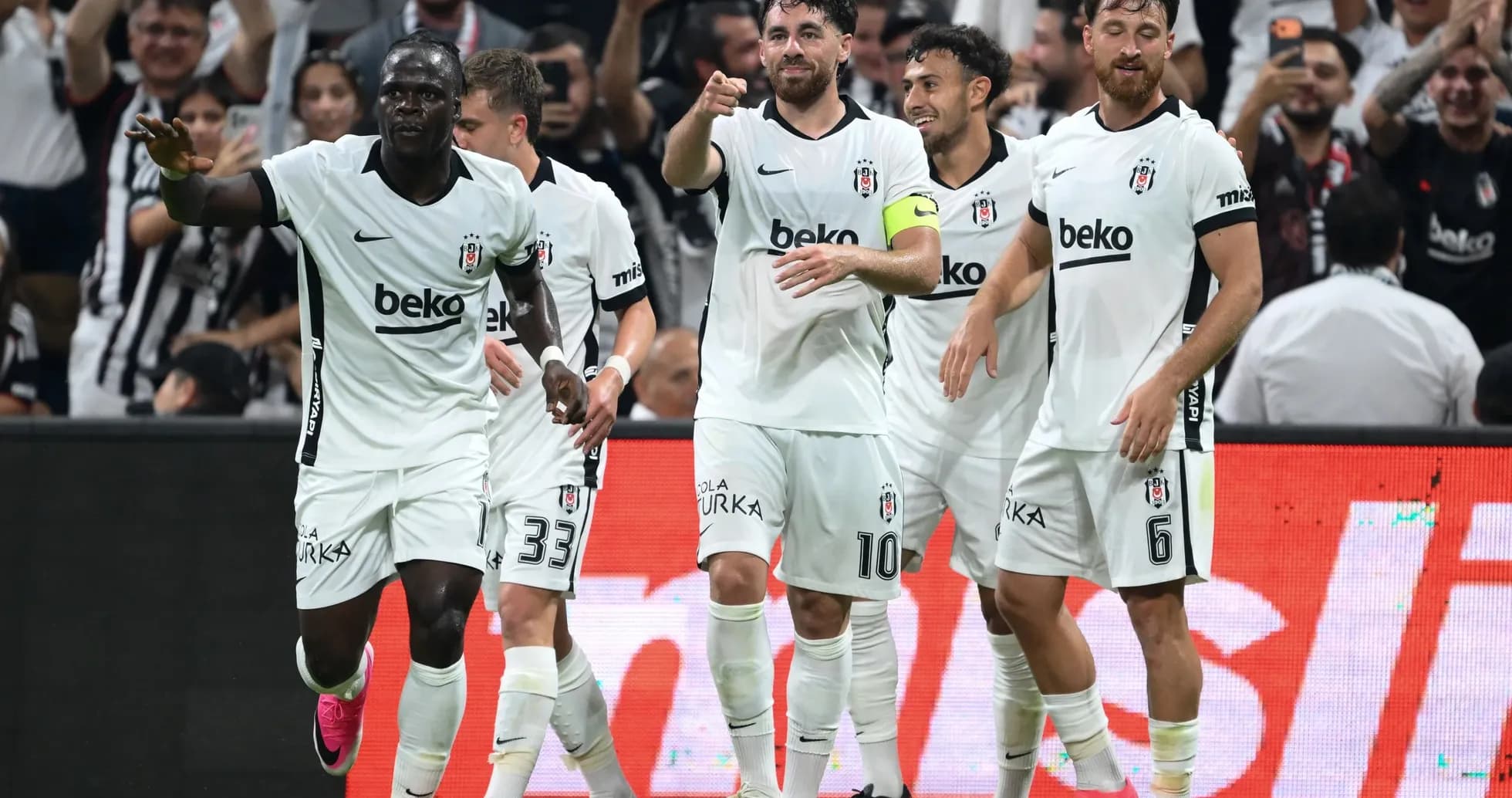
The breakthrough on 26 minutes encapsulated that design. O. Kokcu’s goal, assisted by V. Cerny, was not an isolated moment of brilliance but the payoff of sustained occupation of the right half-space and quick combinations around a retreating Midtjylland block. With the visitors already a man down, Beşiktaş were able to position multiple players between the lines; Cerny’s involvement as provider underscored how Italiano’s wide midfielders were instructed to invert and connect, not simply hug the touchline.
Statistical Dominance
Numerically, the dominance was stark. Beşiktaş attempted 685 passes with 606 accurate, compared to FC Midtjylland’s 237 total and 146 accurate. That passing volume and accuracy were not sterile: 28 total shots, 15 from inside the box and 13 from outside, illustrated how the hosts alternated between probing centrally and testing from range when the low block refused to open. Five blocked shots highlighted the density of bodies Midtjylland kept in front of goal, while 16 shots off target showed both the license to shoot and, at times, impatience in search of a second goal.
Goalkeeping Performances
In goal, A. Nubel (Beşiktaş) had a largely supervisory role, required for just 1 save across the 90 minutes. That figure, aligned with Midtjylland’s single shot on goal, underlined how effectively the home side defended transitions despite their aggressive positioning. The rest defence – usually formed by the two centre-backs, T. Djalo and E. Topcu, plus Ozcan as the screening pivot – consistently prevented clean counter-attacks, forcing the Danish side into speculative efforts rather than clear breaks.
At the other end, E. Olafsson (FC Midtjylland) was central to keeping the tie alive. He made 6 saves against 7 Beşiktaş shots on goal, a workload consistent with the shot volume and territorial pressure he faced. The visitors’ defensive plan, especially after the red card, revolved around protecting the central lane and channelling attempts into less optimal angles, trusting Olafsson to handle the rest. His interventions, combined with three blocked shots by his outfield teammates, kept the scoreline at a manageable 1–0 despite the overwhelming territorial tilt.
Substitution Patterns
The substitution patterns reinforced the tactical narratives rather than reshaping them. Tullberg’s changes – V. Byskov (OUT) for D. Castillo (IN) on 18 minutes, Franculino (OUT) for M. Erlic (IN) at 46 minutes, and D. Osorio (OUT) for Cho Gue-Sung (IN) on 62 minutes – progressively traded attacking width and mobility for extra defensive solidity and fresh legs in central areas. The late introduction of K. Watjen (IN) at 83 minutes, with no outgoing player specified, further underlined the focus on shoring up the middle rather than chasing an equaliser with structural risk.
Italiano, by contrast, used his bench to maintain intensity and control rather than to alter the shape. At 63 minutes, I. Fakili (OUT) made way for M. Rashica (IN), and Oh Hyeon-Gyu (OUT) was replaced by S. Kilicsoy (IN), injecting fresh attacking energy into the same 4-1-4-1 framework. Later, S. Ozcan (OUT) for K. Kayra Yilmaz (IN) and R. Yilmaz (OUT) for K. Ouattara (IN) at 73 minutes, followed by T. Djalo (OUT) for E. Agbadou (IN) on 78 minutes, were about preserving legs and concentration in key zones while keeping the positional structure intact. The constant like-for-like nature of these changes preserved Beşiktaş’s passing rhythm and counter-press.
Discipline and Conclusion
Discipline also played a quiet but significant role. Beşiktaş committed 12 fouls to Midtjylland’s 9, yet the hosts finished without a single yellow or red card, while the visitors’ lone dismissal defined the game-state. With no yellow cards issued to either side, the contest remained tactically, rather than emotionally, charged.
Statistically, the verdict is unambiguous: Beşiktaş’s 75% possession, 28 total shots, 15 efforts inside the box and 606 accurate passes point to a team that controlled every phase of the match except the scoreline margin. FC Midtjylland’s 5 shots, only 1 on target, and 237 passes reflected a reactive, damage-limitation approach enforced by the early red card. Yet within that imbalance, Olafsson’s 6 saves and the visitors’ compactness preserved a narrow 1–0 that keeps the tie theoretically open for the return leg. From a tactical standpoint, though, this first meeting at Tüpraş Stadyumu showcased a Beşiktaş side fully aligned with Italiano’s possession-heavy, territorially dominant blueprint – and a Midtjylland outfit whose survival instincts, rather than proactive ideas, defined their evening.