Benfica Dominates Aarhus 3-1 in UEFA Europa League Playoffs
Benfica’s 3-1 win over Aarhus at Estádio da Luz was a textbook example of territorial domination translating into scoreboard control. With 71% possession and a 13–1 advantage in shots on goal, Marco Silva’s 4-1-3-2 suffocated Aarhus’ 3-5-2, forcing the visitors into a reactive, foul-heavy game that never allowed them to build sustained attacks. The match was effectively decided by half-time, with Benfica 3-1 up and then managing the second half through structure and circulation rather than risk.
Rafa Silva’s goal after just 2 minutes set the tone: Benfica immediately pushed their full-backs high and locked Aarhus deep. The home side’s shape was very clear: S. Soares in goal behind a back four of A. Bah, C. Lenglet, Tomás Araújo and S. Dahl; Leandro Barreiro as the single pivot; a fluid line of G. Sudakov, E. Barrenechea and G. Prestianni supporting the front pairing of Vangelis Pavlidis and Rafa Silva.
The 4-1-3-2 operated almost as a 2-3-5 in settled possession. Both full-backs advanced early, with Barreiro dropping between or alongside the centre-backs to form the first line of build-up. This gave Benfica a constant free man against Aarhus’ front two, allowing clean progression into midfield. Once over the first line, the three attacking midfielders occupied all three interior lanes: Sudakov drifting into the left half-space, Barrenechea central and Prestianni between lines on the right. Pavlidis pinned the centre-backs, while Rafa Silva roamed, often receiving between Aarhus’ midfield and defence.
The shot profile reflects this structure. Thirteen shots on goal and eleven blocked shots indicate not just volume but territorial siege: Benfica were repeatedly working the ball into the final third, forcing Aarhus into emergency defending and last-ditch blocks. The 11 corner kicks, compared to Aarhus’ single corner, underline how often Benfica ended sequences deep in the attacking third.
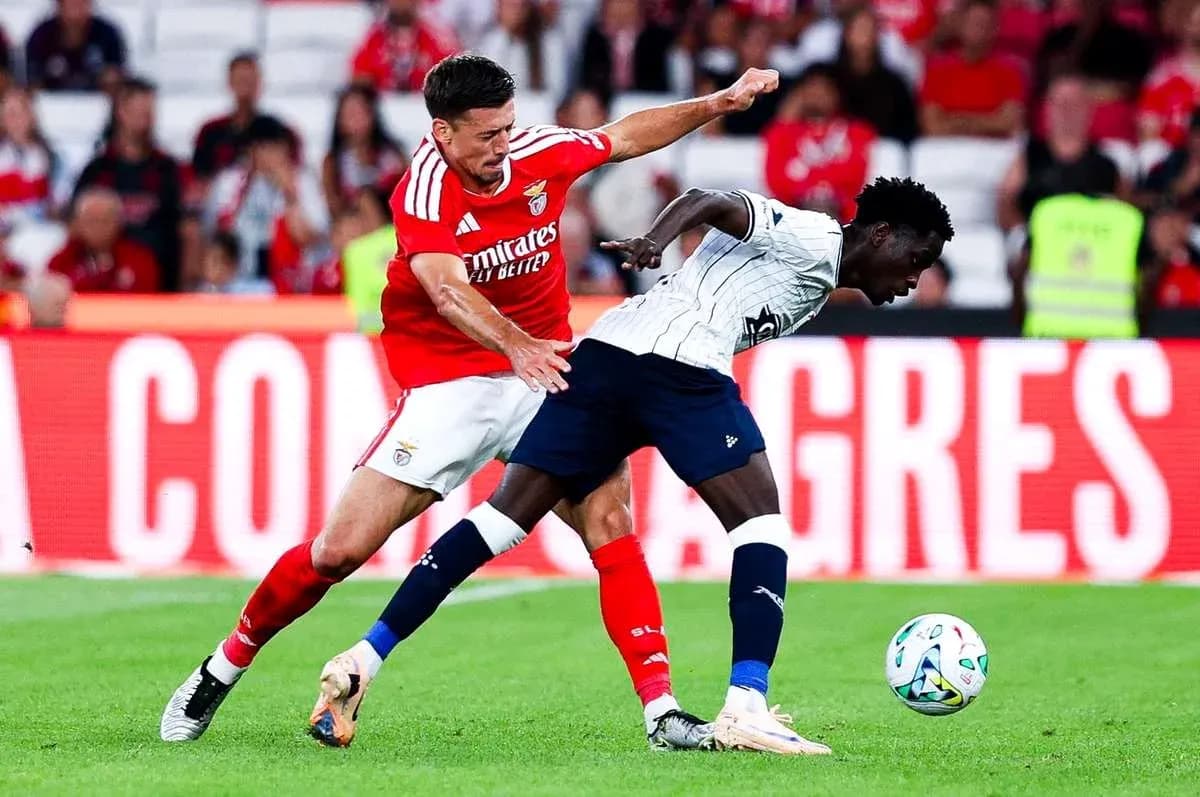
Out of possession, Benfica’s pressing was coordinated rather than wild. The two forwards initiated the press on Aarhus’ back three, curving runs to screen passes into midfield. Behind them, Sudakov, Barrenechea and Prestianni stepped onto the Aarhus midfield line, with Barreiro anchoring and protecting the space in front of Lenglet and Tomás Araújo. The early yellow cards for Barreiro (9') and Tomás Araújo (24') show Benfica’s willingness to defend aggressively when Aarhus did manage to break the first line, but the overall foul count (10 to Aarhus’ 17) shows the hosts were not reckless; they controlled transitions well enough to avoid being constantly exposed.
Aarhus’ 3-5-2 under Jakob Poulsen was built to absorb and counter, but the execution never matched the game-state demands. With M. Hedenstad in goal behind a back three of C. Rosler, M. Camara and E. Kahl, and a crowded midfield of J. Andersen, S. Jorgensen, K. Arnstad and M. Knudsen plus F. Emmery, the idea was to congest central zones and spring T. Bech and J. Bogere on the break. However, with only 29% possession and just 1 shot on goal and 1 shot off goal, Aarhus rarely escaped Benfica’s press with enough numbers to threaten consistently.
Their best spell came around the 36th minute, when S. Jorgensen scored from a move involving J. Andersen, momentarily punishing Benfica’s high positioning. But structurally, Aarhus’ wing-backs were pinned too deep by Benfica’s wide midfielders and full-backs. That left the front two isolated, and the midfield line was constantly forced backwards, leading to rushed clearances rather than controlled counters. The 17 fouls and single yellow card for Stefen Tchamche (83') capture a team mostly reacting, breaking up play and trying to slow Benfica rather than imposing their own rhythm.
The penalty sequence at the end of the first half was decisive tactically as well as on the scoreboard. A VAR intervention at 45+1' confirmed a penalty for Benfica, which V. Pavlidis converted in the 45th minute. Beyond the 3-1 scoreline, this allowed Benfica to enter the second half with a clear mandate: manage space, not chase goals. The second-half substitutions reflected that shift. R. Rios (IN) came on for L. Barreiro (OUT) at 66', J. Duran (IN) for V. Pavlidis (OUT) and A. Schjelderup (IN) for G. Prestianni (OUT) at 72', then F. Aursnes (IN) for G. Sudakov (OUT) and J. Kaminski (IN) for Rafa Silva (OUT) at 84'. Silva rotated energy and profiles in midfield and attack without altering the fundamental 4-1-3-2/4-3-3 hybrid shape.
Aarhus’ response changes at 57' and 73' showed an attempt to inject fresh legs and slightly more vertical threat: R. Carstensen (IN) for C. Rosler (OUT) and S. Tchamche (IN) for S. Jorgensen (OUT) at 57', J. Jonsson (IN) for M. Knudsen (OUT) and G. Links (IN) for F. Emmery (OUT) at 73', then M. Anderson (IN) for J. Bogere (OUT) at 81'. Yet the underlying problem remained: they could not progress the ball cleanly through Benfica’s mid-block, and with only 1 corner and 1 blocked shot, they lacked the territorial presence to sustain pressure.
Without goalkeeper save data, we cannot quantify S. Soares’ (Benfica) or M. Hedenstad’s (Aarhus) shot-stopping, but the shot-on-goal disparity (13–1) strongly suggests Benfica’s keeper had a largely supervisory role, while Hedenstad faced sustained pressure behind a stretched defensive block.
Statistically and tactically, this was a comprehensive home performance. Benfica’s dominance in possession, shots on goal, blocked efforts and corners all point to a side that controlled both territory and tempo. Aarhus’ low shot volume and high foul count show a game spent mostly in survival mode. In the context of UEFA Europa League Play-offs, Benfica produced the kind of structurally sound, high-control display that travels well across two-legged ties, while Aarhus leave Lisbon with a clear picture of the gap in pressing resistance, ball progression and attacking cohesion they must close to compete at this level.