Bayern München vs Paris Saint Germain: Tactical Insights from UEFA Champions League Semi-Final
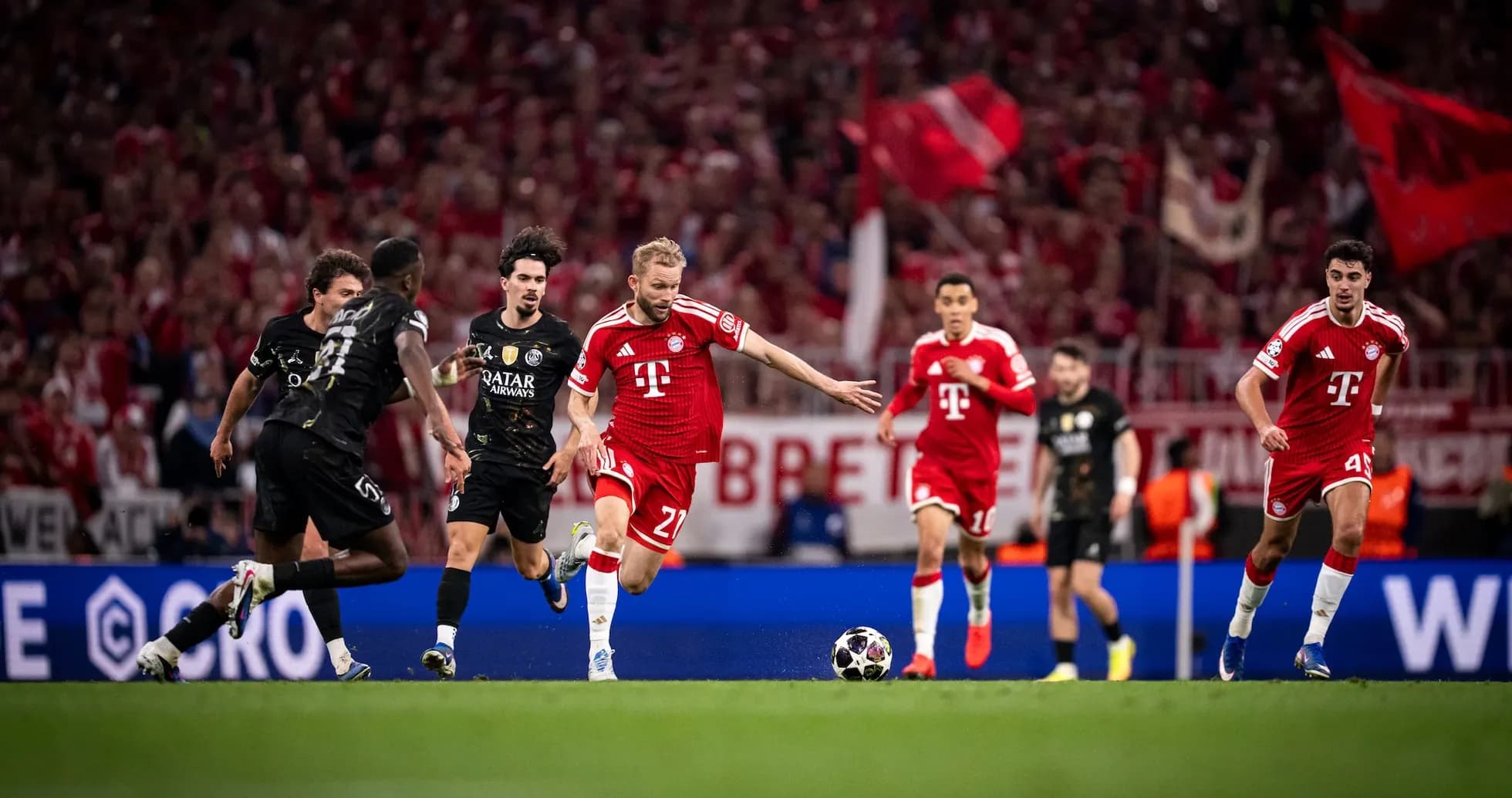
Bayern München and Paris Saint Germain played out a finely poised 1–1 draw at Allianz Arena in this UEFA Champions League semi-final, a contest defined by contrasting game plans and a late tactical payoff for Vincent Kompany. PSG struck in the 3rd minute and then largely ceded the ball, defending compactly and attacking through rapid transitions. Bayern, with 66% possession and a 4-2-3-1 structure, spent most of the evening probing a disciplined 4-3-3 block, eventually equalising through Harry Kane on 90' to keep the tie balanced heading into the second leg.
Executive Summary of Scoring and Discipline
The scoring opened almost immediately. At 3', O. Dembele (Paris Saint Germain) finished a transition move, assisted by K. Kvaratskhelia, punishing Bayern’s high line before they had settled into their defensive spacing. Bayern’s response was territorial rather than chaotic; they controlled the ball but trailed 0–1 at half-time despite their dominance in possession.
The disciplinary tone was set early and remained consistent, with both teams picking up three yellow cards each, six in total:
- [8'] Nuno Mendes (Paris Saint Germain) — Foul
- [33'] Jonathan Tah (Bayern München) — Argument
- [45+3'] Khvicha Kvaratskhelia (Paris Saint Germain) — Time wasting
- [78'] Luis Díaz (Bayern München) — Argument
- [86'] Marquinhos (Paris Saint Germain) — Foul
- [90+7'] Joshua Kimmich (Bayern München) — Argument
No VAR interventions are listed around either goal, so both strikes stand as clean, on-field decisions without review. The second half saw Bayern’s pressure intensify and Kompany’s substitutions progressively tilt the pitch. The breakthrough arrived on 90', when H. Kane converted from close range after a delivery from A. Davies, making it 1–1. That scoreline held through seven minutes of added time.
Scoring Sequence & Disciplinary Log in Context
PSG’s opener at 3' reflected Enrique Luis’s plan: J. Neves and Vitinha helped spring an early vertical attack, with K. Kvaratskhelia drifting inside from the left to slip in O. Dembele. Dembele’s finish gave PSG a 0–1 platform to drop into a more conservative 4-5-1 out of possession, with the wingers tracking Bayern’s full-backs.
The first card at 8' to Nuno Mendes for “Foul” underlined PSG’s readiness to break Bayern’s rhythm on the flanks, particularly against M. Olise and Luis Díaz. At 33', Jonathan Tah’s yellow for “Argument” suggested growing Bayern frustration at PSG’s game management and perhaps the refereeing of contact in advanced areas.
Kvaratskhelia’s yellow at 45+3' for “Time wasting” captured PSG’s willingness to slow the game with a 0–1 lead just before the interval. Half-time arrived with Bayern trailing 0–1 despite already building shot volume and territorial control.
Second-half substitutions sharpened the tactical battle. At 65', B. Barcola (IN) came on for O. Dembele (OUT), giving PSG fresh legs to attack space behind A. Davies when he later entered. Bayern’s response was immediate: at 67', A. Davies (IN) came on for J. Stanisic (OUT), and at 68', Kim Min-Jae (IN) came on for J. Tah (OUT), adding more progressive passing from the back and more aggressive overlapping on the left.
At 76', Enrique Luis doubled down on defensive solidity and fresh energy: L. Hernandez (IN) came on for D. Doue (OUT), and L. Beraldo (IN) came on for F. Ruiz (OUT), reinforcing the back line and central protection. Bayern then introduced N. Jackson (IN) for J. Musiala (OUT) at 79' to add direct running ahead of Kane, and later L. Karl (IN) for D. Upamecano (OUT) at 85' to maintain tempo from deep.
In between, Luis Díaz’s yellow at 78' for “Argument” and Marquinhos’ at 86' for “Foul” showed tensions peaking as Bayern camped in PSG’s half. On 85', PSG also brought on S. Mayulu (IN) for N. Mendes (OUT), slightly rebalancing the left side late on. Kimmich’s yellow at 90+7' for “Argument” closed a heated finale.
The decisive Bayern moment came on 90': A. Davies, now high and wide on the left, attacked PSG’s right channel and delivered for H. Kane, who finally converted one of Bayern’s many box touches to level the match.
Tactical Breakdown & Personnel
Bayern’s 4-2-3-1 was possession-heavy by design. With 570 total passes at 87% accuracy, they built systematically through J. Kimmich and A. Pavlovic as a double pivot, using Olise and Luis Díaz to pin PSG’s full-backs. J. Musiala operated between the lines, trying to drag Vitinha and J. Neves out of their compact midfield triangle. The 66% possession figure reflects Bayern’s territorial siege rather than sterile circulation: 18 total shots, 13 inside the box, and an xG of 1.4 indicate sustained, high-quality pressure.
The substitution of A. Davies for J. Stanisic was the key structural shift. Davies’ overlapping runs transformed Bayern’s left flank into their primary attacking lane, culminating in his assist for Kane. Kim Min-Jae’s introduction for Tah also allowed Bayern to defend higher and recycle attacks quickly against PSG’s sporadic counters.
PSG’s 4-3-3 without the ball resembled a 4-5-1, with K. Kvaratskhelia and D. Doue (later Barcola and Hernandez) dropping to form a narrow midfield five. They accepted a deep block, finishing with just 301 passes at 71% accuracy and 34% possession, but remained threatening on the break: 15 total shots, split almost evenly between inside (8) and outside (7) the box, and an xG of 1.03. That output, from limited ball, validates their transition focus.
In goal, M. Neuer made 6 saves versus M. Safonov’s 5. The identical goals prevented metric (0.23 for each) suggests both keepers performed slightly above the quality of chances they faced, reinforcing the idea that the 1–1 scoreline was not purely down to poor finishing. Neuer’s workload came mostly from sharp PSG counters and early-phase shots; Safonov’s from sustained Bayern pressure and repeated box entries.
Enrique Luis’s late defensive substitutions (Hernandez and Beraldo) aimed to preserve the 0–1, but they also pushed PSG deeper, inviting the wave that led to Bayern’s equaliser. Kompany, conversely, used his bench to increase verticality and width, and was rewarded.
The Statistical Verdict
The numbers support the tactical story. Bayern’s 66% possession, 570 passes, and 18 shots to PSG’s 34%, 301 passes, and 15 shots show a clear pattern: Bayern as the territorial aggressor, PSG as the compact, counter-attacking side. Bayern’s xG of 1.4 versus PSG’s 1.03 suggests a slight edge in chance quality, aligning with the late equaliser rather than a dominant multi-goal win.
Defensively, Bayern committed 11 fouls to PSG’s 12, reflecting a relatively balanced physical contest despite Bayern’s greater time on the ball. Corners (1 for Bayern, 8 for PSG) highlight how PSG’s attacks, when they came, often ended with shots deflected or forced wide, while Bayern more frequently constructed through central combinations.
Discipline was symmetrical: three yellow cards each, six total, precisely matching the event log. With both goalkeepers preventing more than a fifth of an expected goal and no red cards, the 1–1 result feels like a fair equilibrium between Bayern’s structural dominance and PSG’s efficiency in transition and game management.