The Art of Interception in Football: Dayot Upamecano's Mastery
The most important action in football often lasts less than a heartbeat.
A midfielder shapes to pass, the crowd inhales, and somewhere behind the forward line a defender reads the picture, steps in, and steals the ball. One stride, one touch, and the move is gone. That tiny intervention demands a staggering calculation: speed, distance, angle, body shape, balance. All of it solved in real time, under pressure, at full tilt.
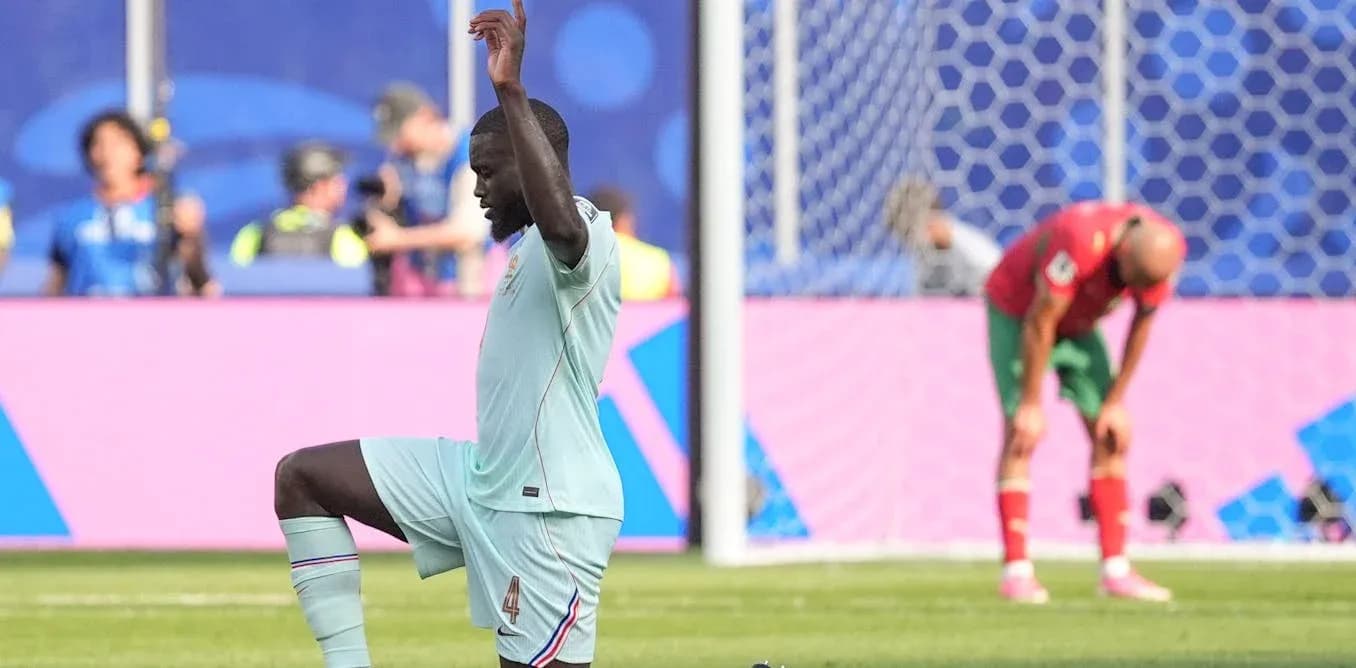
At this World Cup, no one has embodied that art quite like Dayot Upamecano. As semi-final week began, the France centre-back sat atop the interception charts with 12. Each one is a frozen frame of elite decision-making — the product of a brain and body working in ruthless sync across a month of unforgiving football.
But interceptions are not just numbers on a page. They are where cognition, courage and fatigue collide.
The split-second gamble
To cut out a pass, a defender has to live in the future for a moment.
Before the ball is even struck, the brain starts its work. Research on anticipation in sport shows that top players blend what they know about the game situation with what they see in front of them. The passer’s run-up, their posture, the angle of the hips, the way their foot approaches the ball — all of it feeds into a prediction.
Then the pass is played and the clock starts.
Speed becomes everything. In experimental work with well-trained amateur footballers, players backed away from interceptions as passes grew faster. When they did commit, their success rate dropped. The ball simply travelled too quickly for their bodies to match the calculation in their heads.
Distance weighs in as well. A study of senior male futsal players showed that the defender’s starting distance from the ball heavily influenced whether an interception was even on. Yet once they went, they never moved at a fixed pace. They kept adjusting their speed and line, constantly re-solving the equation until the action ended.
An interception, then, is not a single choice. It’s a rolling negotiation between intention and reality.
Experience sharpens that negotiation. A football-specific study comparing expert and less-expert athletes found that players initially overestimated what they could intercept. With practice and feedback, their estimates tightened. They learned, quite literally, what their bodies could and could not do.
That learning is priceless. But it is not bulletproof.
When the brain starts to fade
The World Cup does not just test lungs and legs. It tests concentration.
Mental fatigue — the dulled alertness that follows long spells of intense focus — has a direct impact on decision-making. In one study involving 20 professional male footballers, players completed a demanding 30‑minute mental task before a training match. Their passing decisions deteriorated. They chose worse options, more often.
Another study with well-trained male players found that mental fatigue slowed down their football-specific decisions and made them less accurate.
Those experiments did not look at interceptions specifically, but the overlap is obvious. To step in front of a pass, a defender must pick the right visual cues, judge speed and distance, predict the next phase and commit to an action — all in fractions of a second. When the mind is tired, the whole chain wobbles. React a fraction late and the ball is gone. React on time but misjudge the angle and the back line is split open.
Now add the weight of physical fatigue.
When the legs won’t cash the brain’s cheques
Early in a match, a defender might back themselves to explode five metres across a passing lane. After an hour of sprints, duels and recovery runs, that same ball may no longer be reachable at the same speed.
Research with 24 trained male players showed that acute physical fatigue cut down how far and how intensely they moved. It also altered aspects of their positioning and team play. Tired bodies did not just run less; they behaved differently.
A related study drew a sharper line. Players with stronger decision-making skills managed to hold their positioning and defensive impact under acute fatigue by subtly altering how they moved — often by operating at a slightly slower pace. Those with weaker decision-making profiles did the opposite: they kept pushing physically but lost their positional edge and defensive effectiveness.
The message is stark. The best defenders do not just run harder; they think better about when and how to run as their capacities change. A tired centre-back has to estimate where the ball is going while staying honest about what their legs can still deliver, all without abandoning a crucial zone.
That is the hidden work behind every interception that never happens — the decision not to go.
Cape Verde and the value of saying “no”
Few teams at this World Cup have lived inside that tension more than Cape Verde.
On their tournament debut, they turned Group H on its head by holding Euro 2024 winners Spain to a 0-0 draw. The numbers told a story of defiance: 15 interceptions in that opener alone, and an average of around 13 per match across four games. They battled through their group and then took defending champions Argentina to extra time in the round of 32, losing 3-2 in a match that confirmed they belonged at this level.
Those interception figures do not prove causation. A high count can just as easily mean a team spent long spells without the ball, forced to react rather than dictate. But cutting out passes clearly helped Cape Verde disrupt more dominant opponents and launch counters before those sides could reset.
Each successful step-in was a tiny revolt against the expected script. Each one required that same brutal honesty: Can I get there? If I go, what do I leave behind?
On this stage, the wrong answer is punished.
The art of deception
Of course, attackers are not passive victims in this duel. They fight back with disguise.
Research on deception in competitive sport has mapped how athletes hide their true intentions. A passer may wind up as if to feed the striker’s feet, selling the defender on that picture, then slide the ball inside to a late runner. By the time the real direction reveals itself, the defender has already shifted weight towards the wrong lane.
Wait longer and you see more. Move earlier and you gain ground. That is the trade-off. Delay, and the ball has more time to travel into danger. Jump the gun, and you become a target for feints and no-look passes.
The best defenders live in that grey area, never fully committing to the first story the attacker tells, but never so cautious that they arrive second.
Training the invisible skill
All of this has sharp implications for how teams train and manage players across a tournament.
Work on realistic practice design argues that training should preserve the key information and actions found in actual competition. For interceptions, that means no more sterile drills with static mannequins and predictable passes. It means live opponents, changing angles, varied pass speeds, realistic starting distances and, crucially, deception.
Coaches also have to think about the state players are in when they make these calls. Fatigue does not just slow the legs; it can warp the decision itself. A defender who reads the game perfectly in the first 20 minutes may misjudge the same picture in the 85th.
That reality exposes the limits of relying solely on GPS numbers and running data. How far and how fast a player moves tells only part of the story. The other part lives in those split-second choices: to step in, to hold, to shuffle across and wait.
The goal is not simply to rack up interception totals. The smartest defenders learn which balls are truly on, and they keep updating that judgment as the pass travels. As the tournament wears on and fatigue bites, they adjust again, aligning ambition with what their bodies can still deliver.
By the time Dayot Upamecano stretches out a leg to nick away a through ball in the semi-finals, the visible touch is just the final frame. Behind it sits a dense, invisible calculation — one that might decide not just a move, but who plays for the World Cup on the final night.